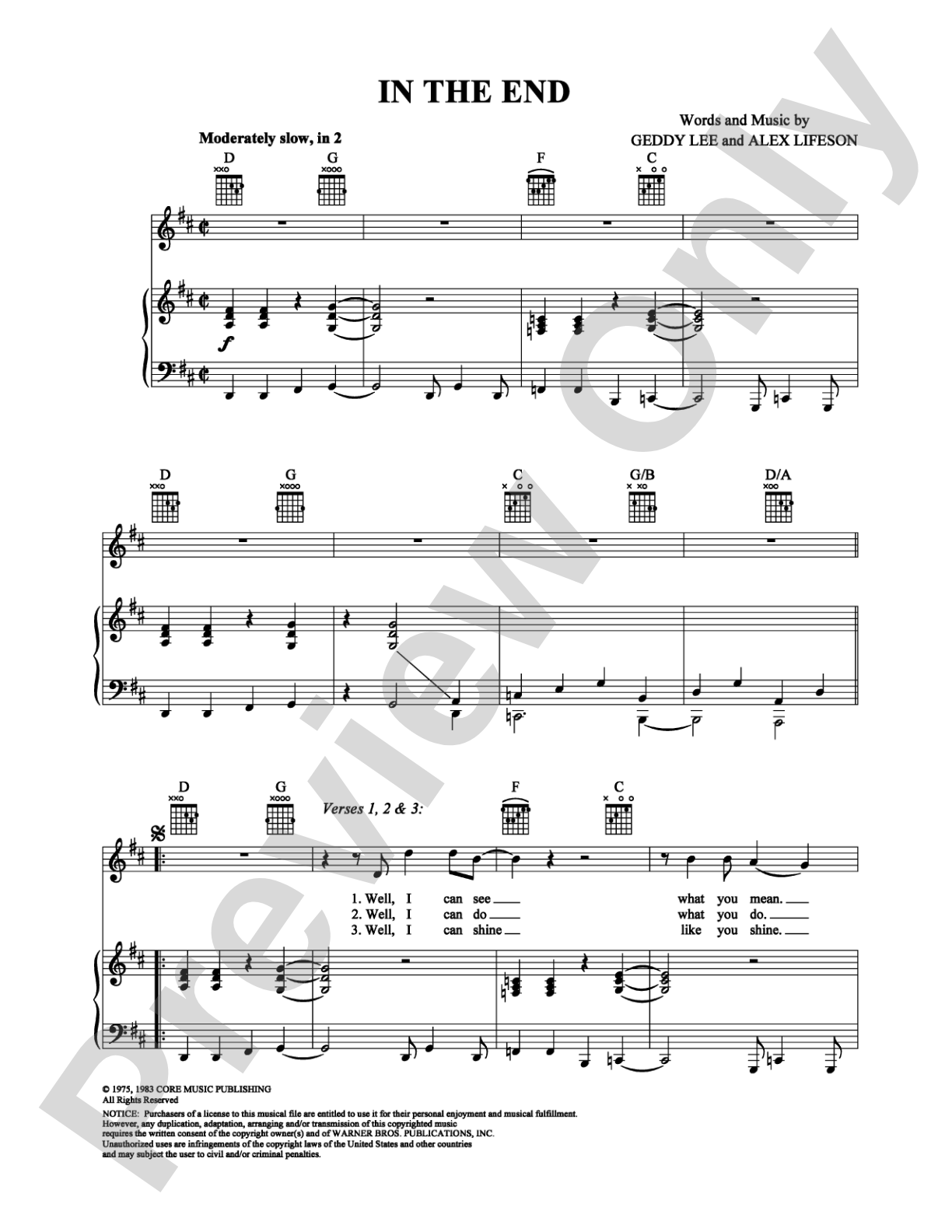
In The End: Piano/Vocal/Chords Digital Sheet Music

In The End: Piano/Vocal/Chords Digital Sheet Music

Rush, Geddy Lee, Alex Lifeson

Item: 00-PS-0005228

Digital Download
$2.95
Description

In The End: Piano/Vocal/Chords Digital Sheet Music isn't in MakeMusic Cloud just yet...but it could be. Let us know you'd like to see it, and you'll help shape what comes next. In the meantime, start a free trial and dive into thousands of interactive titles your students can play along with today.

Sample Audio
No sample audio found.
Sample Video
Additional Details
SKU: 00-PS-0005228

More about this title

About the Artist: Rush

Rush stands as one of rock music's most technically ambitious and philosophically engaged bands. Formed in Toronto in 1968, the trio of Geddy Lee, Alex Lifeson, and Neil Peart earned respect across generations for their instrumental virtuosity, complex time signatures, and lyrics rooted in science fiction, philosophy, and personal reflection. Their influence extends far beyond rock radio into progressive music pedagogy, where their work serves as a benchmark for harmonic sophistication and rhythmic complexity.

For music educators and serious students, Rush's catalog offers a masterclass in how commercial rock music can demand genuine musicianship. The band's evolution from heavy rock to synth-driven progressive styles demonstrates how artists grow and reinvent without abandoning technical rigor. Their appeal to young musicians lies partly in the accessibility of their catalog through digital sheet music, making sophisticated arrangements available for classroom and studio work.

Why we love this

"In The End" captures the reflective power that defines Rush's later work, pairing Geddy Lee's distinctive vocal range with chord progressions that reward thoughtful interpretation. Piano/vocal arrangements of Rush material tend to expose the harmonic architecture that gets obscured in the full band texture, making this a compelling choice for students ready to engage with rock music at a serious compositional level.

What to expect

There's an introspective quality to the piece that invites careful listening. The piano/vocal setting creates an intimacy absent from the full band version, allowing the weight of the lyrics to sit front and center while harmonic tensions emerge through fingering choices and voicing decisions.

Who it's for

Piano students and singers preparing rock repertoire with harmonic and lyrical substance will find real value here. This arrangement works equally well in private studio settings, ensemble rehearsals, or as supplementary material for students exploring how rock composition functions at an advanced level.

How to get the most out of it

  • Map out the chord changes before touching the piano; Rush's harmonic movement often surprises players expecting straight rock progressions, and understanding the underlying structure will anchor your performance.
  • Balance vocal melody against the piano voicings rather than competing with them. The piece works best when the keyboard supports the narrative arc of Lee's lyrics instead of overshadowing them.
  • Pay attention to rhythmic precision in the vocal line. Rush's appeal partly stems from rhythmic sophistication, and even slight timing adjustments will feel intentional rather than accidental.
  • Use dynamics to shape the progression from verse to chorus. The piano/vocal format strips away production layers, so your control of volume and intensity becomes the primary tool for building emotional momentum.

How to use it

This works beautifully as a solo or duo feature in contemporary music showcases or rock-focused recitals where serious compositional chops matter. Pairing it with other progressive rock arrangements creates a compelling set that demonstrates how the genre rewards musicianship and attention to detail.

Skills your students will build

  • Navigating non-diatonic chord progressions and voice leading between unexpected harmonic changes
  • Coordinating syncopated vocal rhythms with independent piano accompaniment patterns
  • Interpreting rock music notation with the same interpretive care applied to classical or art song literature
  • Building stamina and emotional control across extended melodic lines
  • Understanding how harmony and lyrics reinforce each other in narrative-driven rock songwriting

You May Also Like