
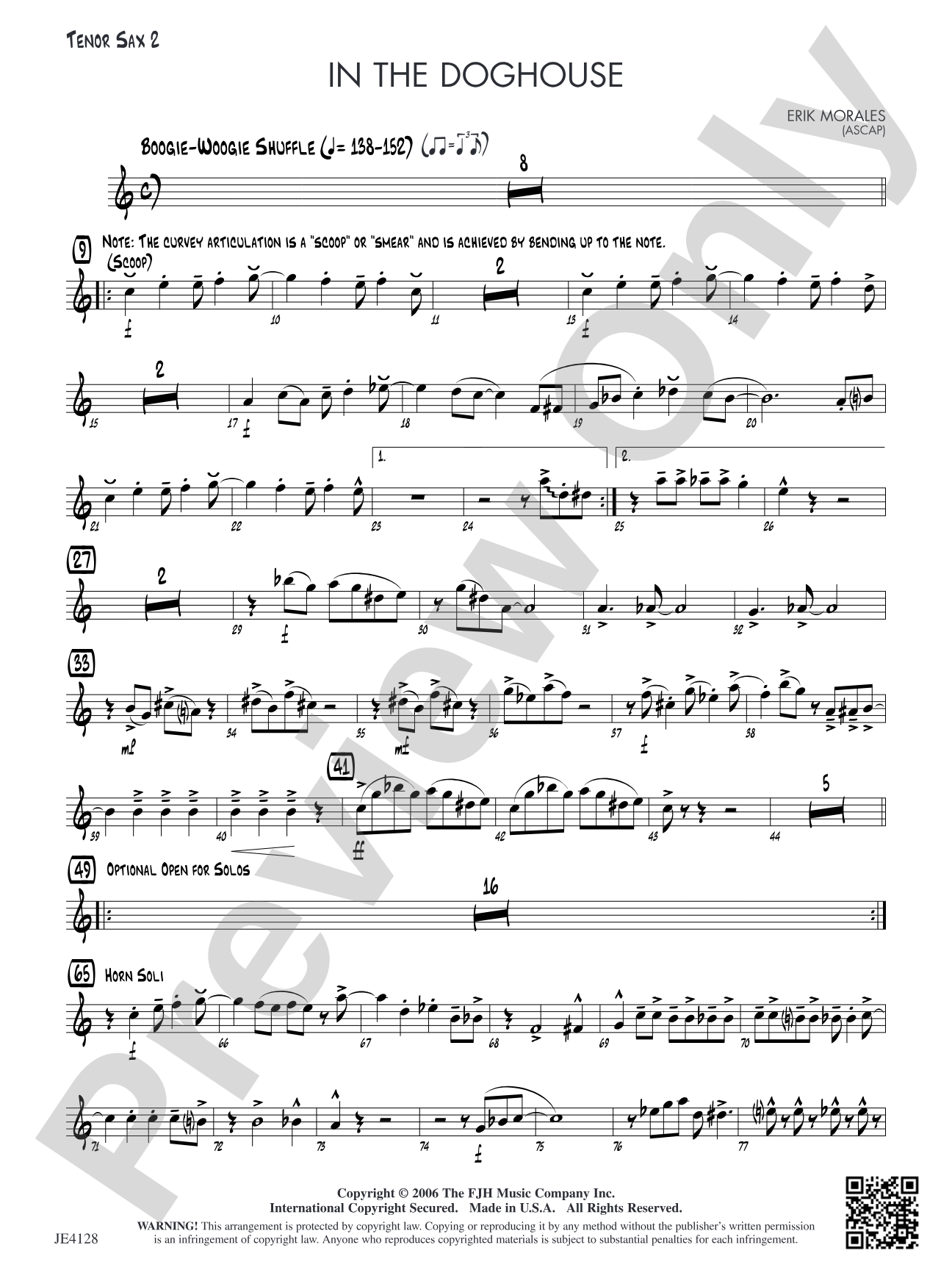

In the Doghouse: Tenor Sax 2
By Erik Morales
Grade: 2.5
Item: 98-PC-DJE4128_TX2
$7.00
Pickup currently not available
Description
Who says being in the doghouse is no fun? This phenomenal work fuses boogie-woogie and shuffle into a chart with a unique style and attitude. The opening piano groove grabs the listener and sets the pace for the entire work. A hot tenor solo (written or improvised) is backed by the ensemble and leads to an a cappella statement that really grooves. The ending shout chorus makes sure your audience knows that this is one doghouse with an open invitation to all!


Discover MakeMusic Cloud: thousands of interactive titles your students can play along with today.
Sample Audio
1
Audio File
--:--
0:00
0:00
Sample Video
No sample videos found.
Additional Details
Series:
FJH Developing Jazz Ensemble
Publisher:
The FJH Music Company, Inc.
SKU:
98-PC-DJE4128_TX2
More about this title
About the Composer: Erik Morales

Erik Morales brings a compositional voice shaped by decades of experience across jazz, wind, and chamber genres. Born in New York City in 1966, he began arranging music for marching band while still in high school in south Florida (1985) and never stopped. His formal training at Florida International University and the University of Louisiana, Lafayette grounded him in composition, but his real education came through commissions and publications. Since 2002, his work has circulated globally, and he now has over 150 published compositions to his name.
Morales has built particular strength in trumpet writing; his trumpet ensemble works have placed at the National Trumpet Competitions, and his Concerto for Trumpet in C and Piano premiered at the 2009 International Trumpet Guild conference. A 2012 consortium commission resulted in a Concerto for Two Trumpets, premiered at the 2013 ITG conference in Grand Rapids. Throughout his career, he has sought balance between artistic merit and pedagogical value, making his work accessible to students while respecting the intelligence of the musicians who perform it. In 2016, the Louisiana Association for Jazz Education inducted him into its Hall of Fame.
Why we love this
Morales understands what makes a jazz ensemble chart stick with performers and audiences alike. The opening piano groove immediately signals attitude and style, while the written tenor solo (with room for improvisation) lets your section shine without demanding virtuosity beyond Grade 2.5 reach. The a cappella moment and shout chorus payoff give students the dramatic arc they need to feel invested in the performance, making this more than a study piece: it's a genuine musical statement.
What to expect
Upbeat and funky, with the swagger of a blues joint and the tightness of a well-oiled ensemble. The boogie-woogie energy never lets up, but the a cappella section gives you a moment to breathe and connect with the lyrical side of jazz before the final shout brings everything back home.
Who it's for
This chart belongs in any Grade 2.5 jazz ensemble program where students are ready to play with style and groove but still need clear structural guidance. It works equally well for high school ensembles building their jazz library or community bands seeking accessible but soulful repertoire that swings with genuine personality.
How to get the most out of it
- Establish the boogie-woogie foundation in the rhythm section before adding horns. The piano groove sets everything else; lock it in first.
- If your tenor player chooses to improvise, outline the harmonic structure in rehearsal and keep early versions close to the written solo until confidence builds.
- Bring out the contrast between the ensemble backings and the a cappella statement by shifting dynamics and texture. This moment is the emotional center of the chart.
- The shout chorus demands ensemble unity and rhythmic precision. Mark the hits clearly and rehearse entrances deliberately so the ending lands with impact.
How to use it
Open a jazz concert with this piece to set an energetic, approachable tone and show your audience that a developing ensemble can still command a room. It also pairs well on a program with other blues-based or funk-influenced charts, creating a coherent set around a single groove vocabulary.
Skills your students will build
- Boogie-woogie and shuffle rhythmic feels and articulation
- Ensemble balance and phrasing in a groove-based context
- Trading and responding in call-and-response textures
- Dynamic contrast between ensemble sections and featured soloists
- Basic jazz improvisation (for tenor solo) or reading written jazz notation with swing feel