
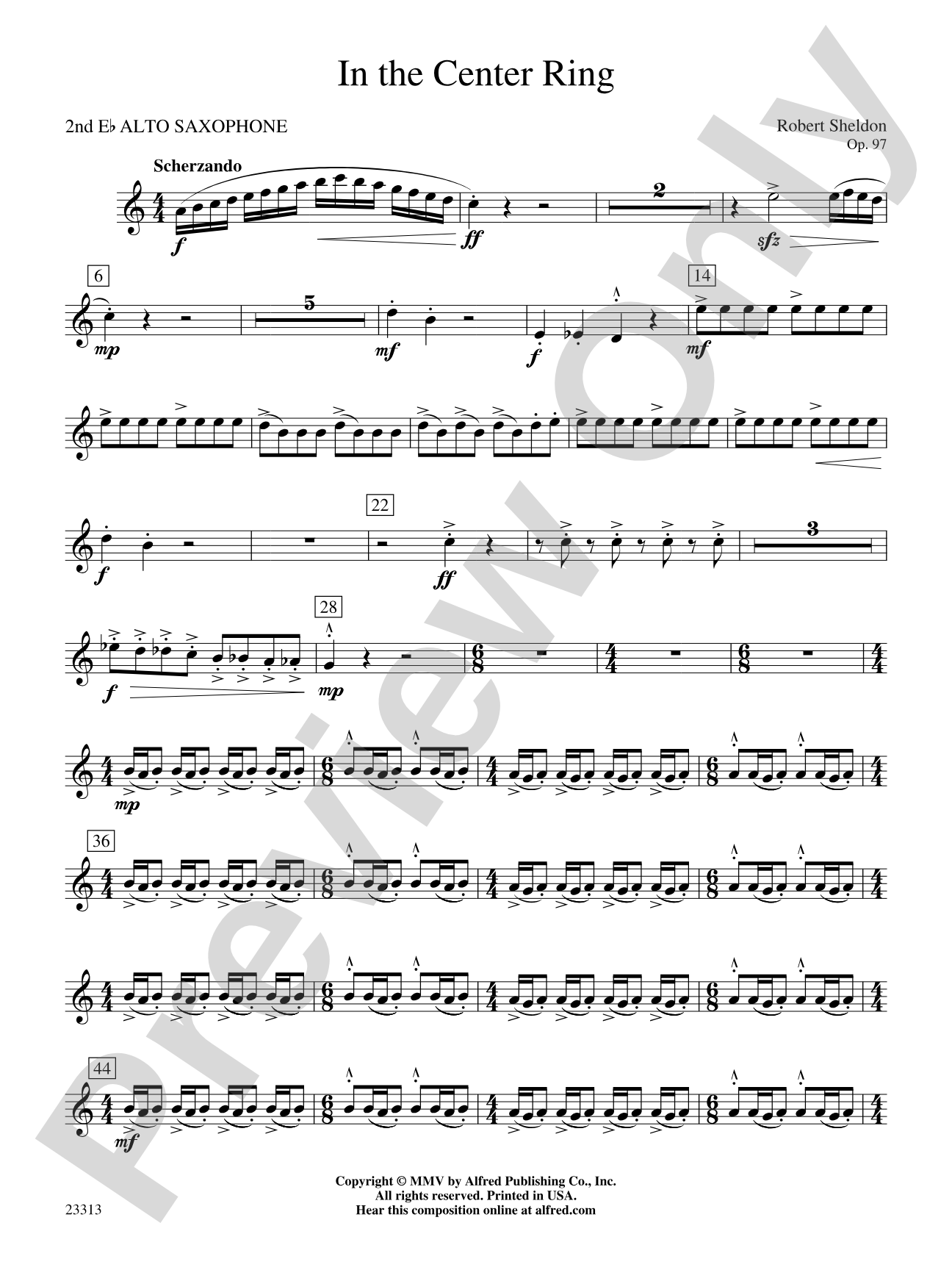

In the Center Ring: 2nd E-flat Alto Saxophone
By Robert Sheldon
Grade: 4 (Medium Difficult)
Item: 00-PC-0000663_AX2
$3.00
Pickup currently not available
Description
"In The Center Ring" was written in the autumn of 2003 for the Upper Antioch Grade School Band from Antioch, Illinois, Earl Bush, director. The piece is a musical snapshot of a circus performance, from the madcap antics of the jugglers and clowns to the elegance of the high-wire and trapeze performers. This wild musical romp is certainly a technical challenge, but is also great fun for the performer and listener alike. Above all, remember this is a theatrical piece - so emphasize the dynamics, bring out the inherent comedy and have FUN! This title is available in MakeMusic Cloud.


Don't just read it, hear it, play along with it, and watch your students grow with it. In MakeMusic Cloud, In the Center Ring: 2nd E-flat Alto Saxophone comes alive with professional accompaniment, adjustable tempo, and built-in practice tools that turn solo practice into real progress.
Open in the Player
Jump straight in and assign it today.
Start Your Free Trial
Open this title and explore the full library in minutes.
Sample Audio
1
Audio File
--:--
0:00
0:00
Sample Video
Additional Details
Series:
Alfred Concert Band
Publisher:
Alfred Music
Page Count:
292
SKU:
00-PC-0000663_AX2
More about this title
About the Composer: Robert Sheldon

Robert Sheldon stands among the most widely performed composers in wind band repertoire today. His works appear on contest lists and concert programs across the globe, and he has received major recognition from the American School Band Director's Association, Phi Beta Mu, and ASCAP. Beyond composing, Sheldon co-authored Sound Innovations for Concert Band and regularly accepts commissions for new works.
As a clinician and guest conductor, Sheldon has worked with All-State and Regional Honor Bands throughout the United States and internationally in Japan, Canada, Italy, Germany, Australia, and China. He has conducted his own compositions at Carnegie Hall, Orchestra Hall, the Sydney Opera House, and the Kennedy Center. VanderCook College of Music awarded him an honorary doctorate in 2020.
Why we love this
Sheldon writes for the reality of the rehearsal room: this piece challenges your ensemble's technical chops while keeping them engaged because the music itself is genuinely entertaining. The theatrical demands mean your students won't just play notes; they'll think like performers, making intentional choices about character and comedy. It's a showstopper that earns its Grade 4 difficulty.
What to expect
Imagine walking into a circus tent: the opening hooks you immediately, then your pulse quickens as jugglers cartwheel across the ring while clowns tumble through chaotic humor. Without warning, the band slows and the big top hushs as a solitary performer holds the wire. The contrast is electric, and you're reminded that this music breathes.
Who it's for
Concert bands at the Grade 4 level ready to tackle both technical demands and stylistic nuance. This works equally well for ensembles prepping for contests and those planning a concert program that needs energy and personality.
How to get the most out of it
- Shape the comedic moments through precision rather than slovenliness. Clean articulation and exact rhythms in the fast passages are what make the clown antics land.
- Let the dynamics tell the story. The contrast between the manic juggler sections and the graceful high-wire music is written into the score; play what's on the page and the narrative becomes unmissable.
- Treat the ensemble like an ensemble of actors with different roles. Soloists and section leaders should own their moments while the rest of the band provides the dramatic backdrop.
- Commit fully to the theatrical intent in your conducting. Your confidence in the piece's comedic premise will liberate your students to play with style and conviction rather than apologetically.
How to use it
Program this as your closing number or the anchor of a spring concert when your ensemble has the rehearsal time to work both the technical passages and the theatrical character. It also sits confidently on a contest program where judges and audiences appreciate writing that doesn't take itself too seriously.
Skills your students will build
- Fast scalar and arpeggio technique at tempo
- Stylistic contrast between comedic and lyrical passages
- Dynamic control across the full range of the ensemble
- Ensemble precision in rapid unison passages
- Musical storytelling and character interpretation