
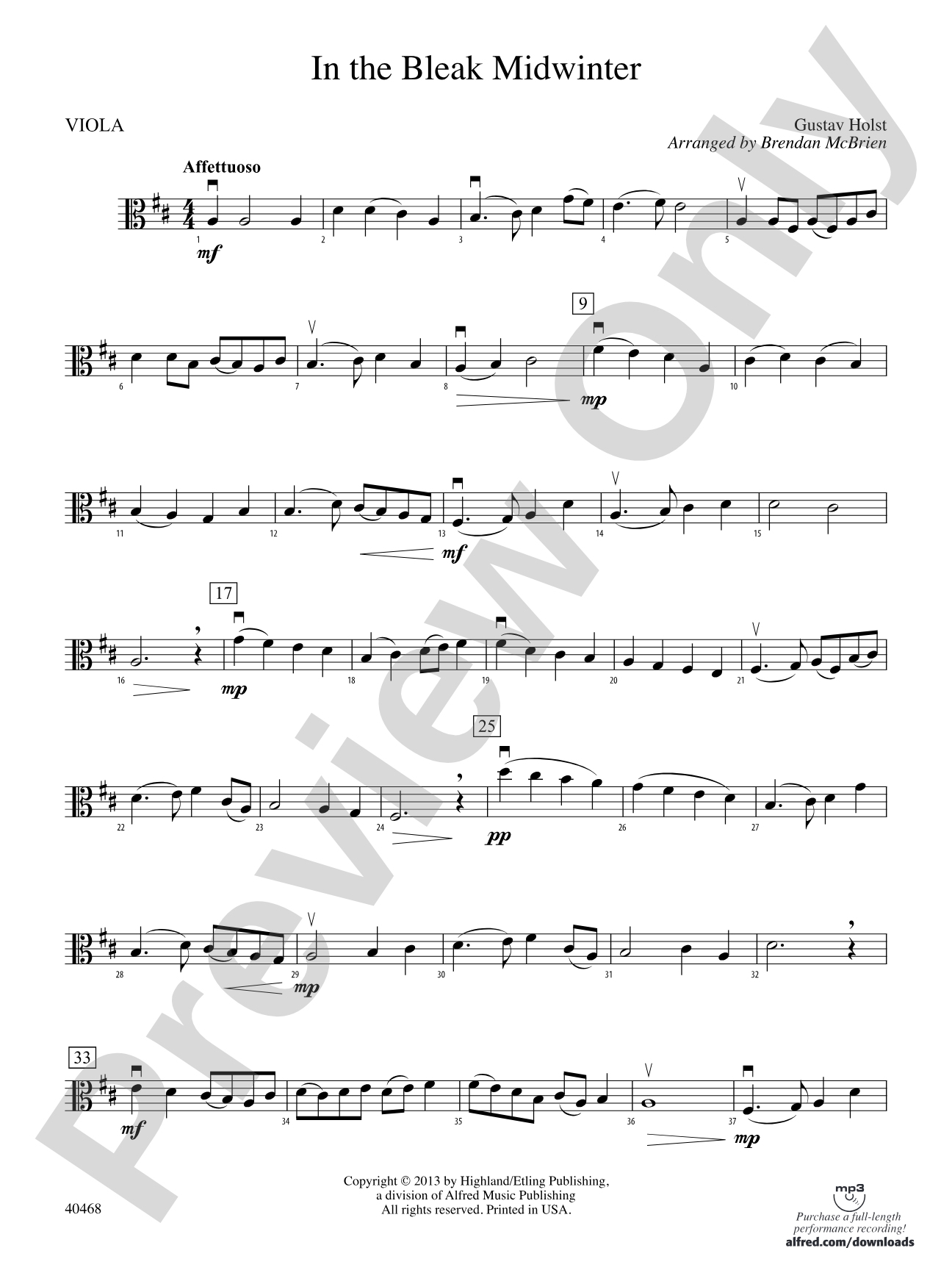

In the Bleak Midwinter: Viola
By Gustav Holst / arr. Brendan McBrien
Grade: 2.5
Item: 00-PC-0016000_VA1
$7.99
Pickup currently not available
Description
From the composer of The Planets comes this beloved Christmas carol. Voted the best carol in a 2008 BBC Music Magazine poll of some of the world's leading music directors, this lesser-known carol is a touching and beautiful work by one of England's greatest composers. This lush setting for string orchestra features all sections of the orchestra in the presentation of this gorgeous tune, and will be a memorable addition to any holiday program. This title is available in MakeMusic Cloud.


Don't just read it, hear it, play along with it, and watch your students grow with it. In MakeMusic Cloud, In the Bleak Midwinter: Viola comes alive with professional accompaniment, adjustable tempo, and built-in practice tools that turn solo practice into real progress.
Open in the Player
Jump straight in and assign it today.
Start Your Free Trial
Open this title and explore the full library in minutes.
Sample Audio
1
Audio File
--:--
0:00
0:00
Sample Video
No sample videos found.
Additional Details
Series:
Highland/Etling String Orchestra
Publisher:
Alfred Music
Page Count:
130
SKU:
00-PC-0016000_VA1
More about this title
About the Composer: Gustav Holst
Gustav Holst (1874-1934) stands among England's most significant twentieth-century composers, best known for his orchestral suite The Planets. His musical language blended English folk traditions with modernist harmonic thinking, creating works that were both intellectually rigorous and deeply accessible. Beyond his symphonic output, Holst wrote extensively for educational settings and amateur musicians, believing passionately that music should serve communities rather than exist solely in concert halls.
Holst's approach to sacred and seasonal music reflects his conviction that familiar melodies deserve sophisticated, thoughtful treatment. In the Bleak Midwinter demonstrates this philosophy perfectly: he took a poem by Christina Rossetti set to a traditional tune and created arrangements that honored both the text's spiritual depth and the carol's essential simplicity. His string writing for educational ensembles shows remarkable skill in distributing musical material across players of varying abilities.
Why we love this
This arrangement captures something rare: a carol that feels both intimate and orchestrally rich without overwhelming younger players. Brendan McBrien's setting for Grade 2.5 strings preserves Holst's harmonic language while keeping individual parts manageable, making it genuinely rewarding for students to perform rather than merely competent. Audiences recognize the tune immediately, which means your ensemble gets to share a beloved work that lands emotionally every time.
What to expect
The opening unfolds with quiet, snow-fall stillness, gradually gathering warmth as the orchestra enters. Holst's harmonic language creates a sense of wistful contemplation, neither sentimental nor austere, with moments of genuine tenderness when the full ensemble plays together. The piece never rushes; it invites listeners into a moment of quiet reflection.
Who it's for
String orchestras at the intermediate level will find this arrangement sits comfortably within their capabilities while offering genuine musical substance. Conductors programming holiday concerts need repertoire that audiences love and students find satisfying to execute, and this piece delivers both. It works equally well for school orchestras and community ensembles.
How to get the most out of it
- Allow the melody to sing through whatever section carries it; resist the urge to balance all parts equally. The tune should always reach the listener clearly.
- Shape phrases with gentle rubato in the slower passages; this carol benefits from breathing room rather than metronomic precision.
- Listen carefully to how divisi sections blend together. Time the entrances of dividing voices so they feel like a natural unfolding of the harmony rather than a sudden split.
- Bring out inner voices when they carry harmonic movement or gentle counterpoint; these moments deepen the texture and show your violists and cellists that their parts matter.
How to use it
Place this as a centerpiece in a winter or holiday concert rather than filler. Its emotional weight and the audience's immediate connection to the tune make it memorable enough to bookend a program or serve as the moment of repose between more energetic works. It also programs beautifully alongside other Holst arrangements or Christmas music by English composers.
Skills your students will build
- Sustaining long, expressive melodic lines without losing tone quality
- Balancing independent parts in divisi passages
- Following conductor-led phrasing and rubato in lyrical music
- Reading full orchestral context (understanding how their part fits within the complete harmonic texture)
- Executing smooth dynamic transitions across string sections