In the Bleak Midwinter Sheet Music Preview

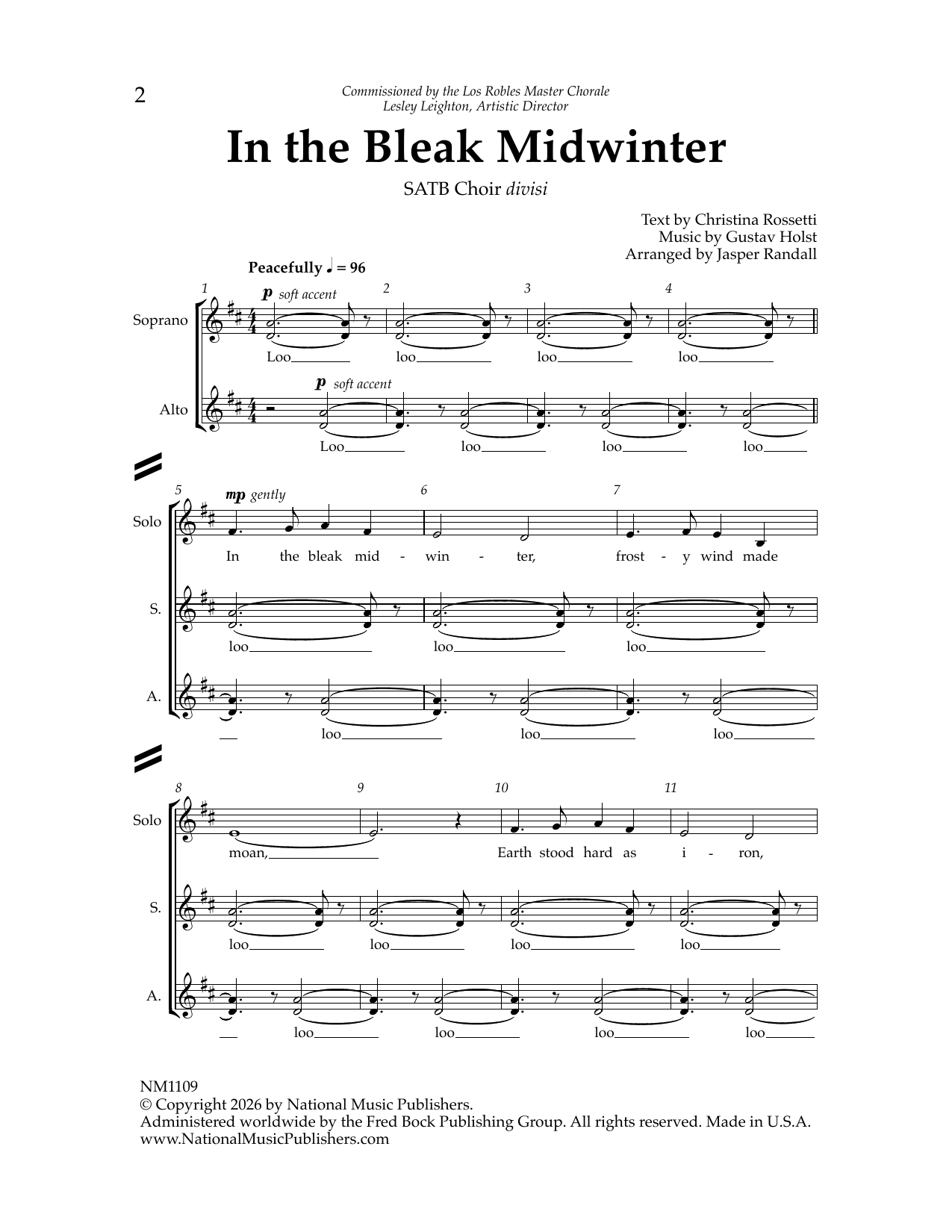
In the Bleak Midwinter: SATB Choral Octavo

By Gustav Holst / By Christina Rossetti / Arranged by Jasper Randall

Item: 35-DS01880538

Digital Download
$3.35
Description

In the Bleak Midwinter: SATB Choral Octavo isn't in MakeMusic Cloud just yet...but it could be. Let us know you'd like to see it, and you'll help shape what comes next. In the meantime, start a free trial and dive into thousands of interactive titles your students can play along with today.

Sample Audio
No sample audio found.
Sample Video
Additional Details
Publisher: Hal Leonard
Page Count: 11
SKU: 35-DS01880538

More about this title

About the Composer: Gustav Holst

Gustav Holst (1874–1934) was a visionary British composer who shaped music education as profoundly as he shaped the concert hall. Beyond his iconic orchestral works, Holst devoted significant energy to choral writing and music pedagogy, believing that accessible yet artistically substantial music could serve both amateur and professional singers. His arrangements and original choral works reflect his conviction that singers of all levels deserved repertoire that was both musically rewarding and technically manageable.

Holst's approach to composition was rooted in melody and clarity of voice leading. He drew inspiration from diverse sources: English folk traditions, Hindu philosophy, and the poetry of his era. His choral arrangements, including this setting of Christina Rossetti's beloved text, demonstrate his gift for honoring the integrity of a poem while creating vocal lines that sit naturally in the voice.

Why we love this

Holst's setting captures the austere beauty of Rossetti's text without sentimentality, giving choirs a winter carol with genuine emotional weight. The SATB voicing sits comfortably across all sections while maintaining harmonic sophistication, making it equally viable for good community choirs and advanced groups. This arrangement has become a staple precisely because it feels inevitable once you've sung it—the music and poetry are so naturally paired that singers understand why every note matters.

What to expect

Holst's arrangement inhabits a hushed, crystalline world that mirrors Rossetti's stark winter landscape. The harmony is modal and sometimes unexpected, creating an almost timeless quality that feels both deeply familiar and subtly otherworldly. This is carol writing stripped of excess: spare, truthful, and profoundly moving.

Who it's for

This setting works for intermediate to advanced SATB choirs of any ensemble size. Singers need secure part reading and the ability to blend in close-voiced passages, but the piece rewards even student singers with its lyrical accessibility. It's equally suitable for church choirs, concert ensembles, and educational settings.

How to get the most out of it

  • Shape the opening phrases with restraint; the strength of this arrangement lies in its directness rather than dynamic extremes. Let the text and melody do the expressive work.
  • Balance the soprano melody against the supporting lines in all four parts. The altos and tenors carry harmonic material that shouldn't disappear into the background.
  • Pay attention to the text underlay and natural speech rhythm of Rossetti's lines. Rushing through syllables will flatten the poetic effect that Holst's music is designed to enhance.
  • Consider the organ or piano accompaniment as a full harmonic partner rather than mere support. It should be clearly audible without overwhelming the voices.

How to use it

Program this alongside other art-song arrangements or unaccompanied carols to create a recital segment that showcases choral artistry beyond traditional holiday fare. It pairs beautifully with contemporary choral works or older a cappella repertoire, or it can anchor a winter concert as a reflective moment between more energetic pieces. Its eleven pages make it substantial enough to warrant careful rehearsal and programming prominence, not filler.

Skills your students will build

  • Reading closely voiced four-part harmony with chromatic voice leading
  • Sustaining legit tone across sustained harmonic movement without vibrato interference
  • Balancing independent melodic lines while maintaining unified choral tone
  • Interpreting modal harmony and understanding its effect on emotional color
  • Coordinating text clarity with sustained legit singing in English verse

You May Also Like