
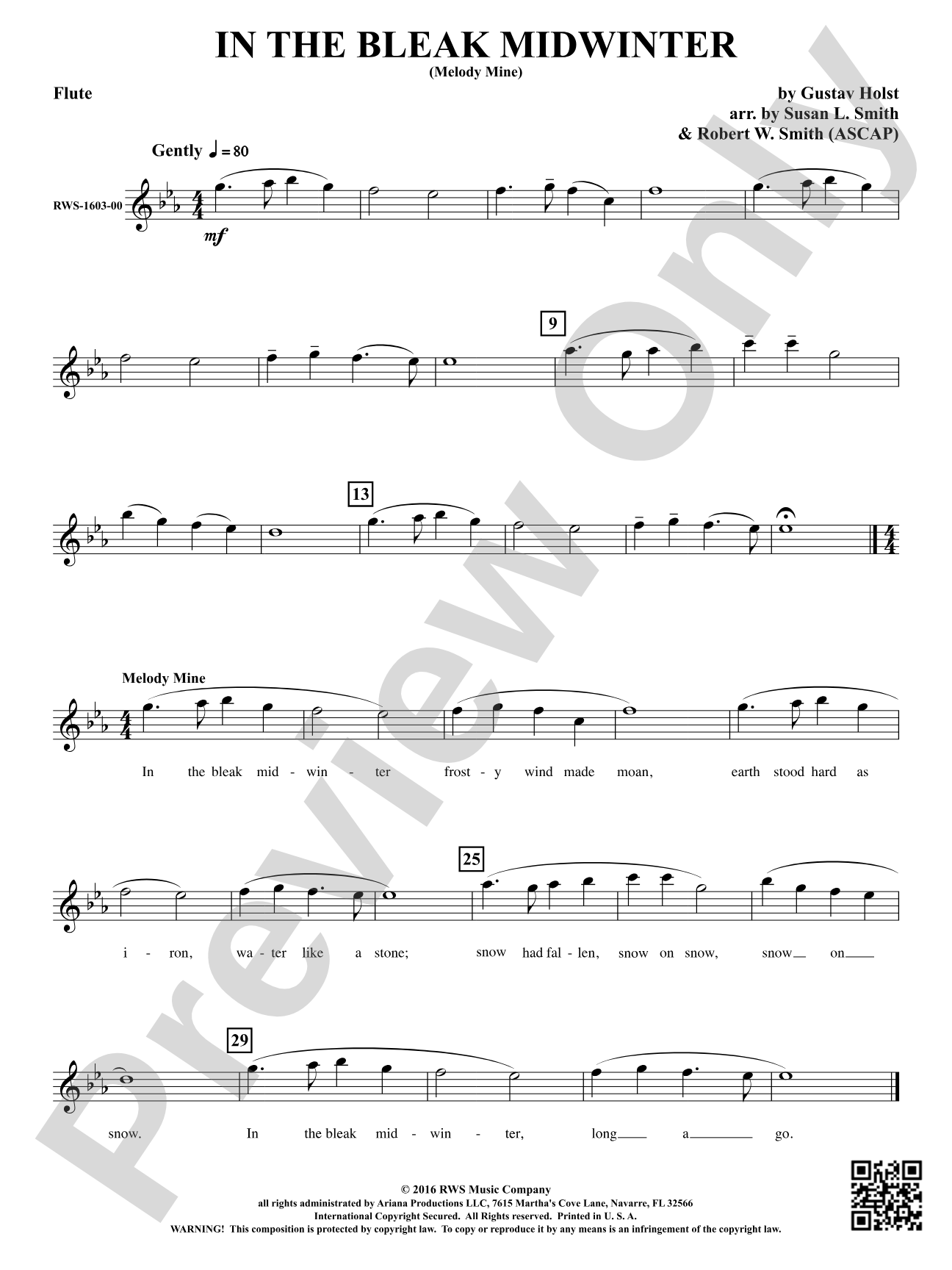

In the Bleak Midwinter: 1st Flute
By Gustav Holst / arr. Robert W. Smith, Susan L. Smith
Grade: 1
Item: 98-PC-RWS1603_F1
$3.99
Pickup currently not available
Description
This timeless melody by Gustav Holst is a perfect musical setting for exceptional teaching. The "Melody Mine" gives each member of the band the opportunity to play the melodic line while the teacher focuses on phrasing, shaping and other core musical concepts. The full band arrangement provides a lush chorale setting of the Holst hymn. The director also has the option to craft their own arrangement to feature soloist(s), instrumental choirs and full band. Master teacher Susan L. Smith has crafted a powerful teaching resource for use in any beginning band program.
Original Item#: RWS-1603-00


Original Item#: RWS-1603-00
Discover MakeMusic Cloud: thousands of interactive titles your students can play along with today.
Sample Audio
1
Audio File
--:--
0:00
0:00
Sample Video
No sample videos found.
Additional Details
Series:
RWS - Beginning Band
Publisher:
RWS Music Company
SKU:
98-PC-RWS1603_F1
More about this title
About the Composer: Gustav Holst
Gustav Holst (1874-1934) was an English composer whose gift for melody and harmonic sophistication made him a cornerstone of the twentieth-century concert band and wind music repertoire. His works span orchestral, vocal, and instrumental genres, but his band compositions remain among the most performed pieces in American schools and ensembles.
Holst's approach to composition emphasizes accessibility without sacrificing musical depth. His melodies are memorable and singable, his harmonies are rich yet transparent, and his orchestration invites musicians of all levels to participate in genuine musical experiences. These qualities made him a trusted voice in music education long before his death, and they remain the reason his works continue to open doors for young musicians.
Why we love this
The Melody Mine format is ingenious for beginning bands because it isolates the musical work from the machinery of full ensemble playing. Every student gets a turn carrying the tune while the rest of the band provides context and support, which builds confidence, ear training, and genuine musical ownership. Holst's hymn tune is so well-crafted that it rewards this kind of focused attention, and the inclusion of both solo and full band settings gives you maximum flexibility in how you develop the piece across multiple rehearsals.
What to expect
Serene and introspective. The melody unfolds with the simplicity and inevitability of a hymn, while the harmonic setting wraps it in warmth and dignity. Even at Grade 1 difficulty, the piece carries genuine musical weight; students feel that they are playing something that matters.
Who it's for
Beginning band directors who want to teach phrasing, musical shape, and ensemble balance using a work that every player finds rewarding. Holst's melody is strong enough to maintain focus even when surrounded by harmonic texture, making it ideal for Grade 1 ensembles building foundational skills.
How to get the most out of it
- Use the Melody Mine rotations to highlight different instrumental timbres. When the flutes carry the tune, the harmony takes on brightness; with clarinets or saxophones, the melody deepens. Point this out to your students so they understand how orchestration shapes musical character.
- Shape the opening phrase to breathe at the natural text point ('In the bleak midwinter'), even if your players are not singing. This teaches phrasing as a function of language and meaning, not just air management.
- Balance the harmonic voices in the full band arrangement carefully. Beginning band musicians often play their parts at uniform dynamic levels, so mark the score to clarify which voices are foundational and which are decorative.
- Rehearse the full arrangement in sections first. Divide the band into harmonic choirs (soprano, alto, tenor, bass) and have each group learn its part and its relationship to the melody before combining everyone.
How to use it
Program the full band arrangement as a seasonal concert selection or festival offering. Use the Melody Mine format across several rehearsals as a rotating solo feature, giving each section a spotlight moment that keeps attention high and builds individual accountability. The piece works equally well as a winter or holiday concert anchor or as a year-round reminder of Holst's gift for melody.
Skills your students will build
- Phrasing and musical shaping at the phrase and sentence level
- Harmonic listening and balance in four-part writing
- Solo confidence and individual melodic responsibility
- Understanding the relationship between text-based phrasing and instrumental expression