
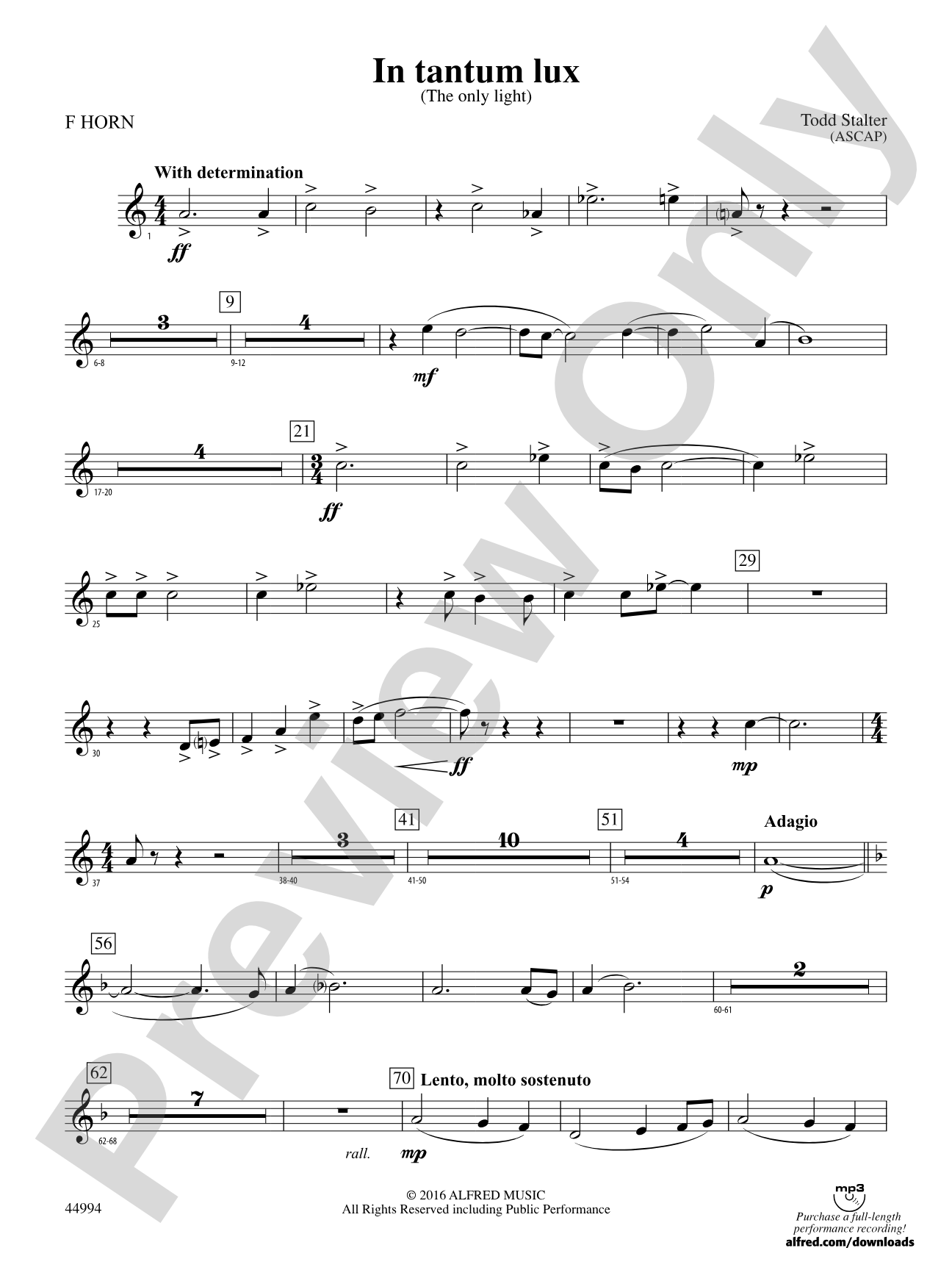

In tantum lux: 1st F Horn
The Only Light
By Todd Stalter
Grade: 3 (Medium)
Item: 00-PC-0017459_H1
$3.00
Pickup currently not available
Description
"In tantum lux" (The only light) was written as a memorial and celebration honoring the life of a music educator and her faith, who taught in a small school her entire career and persevered through the challenges and unique demands that teaching small school bands present. The piece also serves as a celebration of every band student and teacher in small schools everywhere who may not have the resources to have a full ensemble, yet strive every day to experience the joy of making music to the fullest just the same. (4:00)


Don't just read it, hear it, play along with it, and watch your students grow with it. In MakeMusic Cloud, In tantum lux: 1st F Horn comes alive with professional accompaniment, adjustable tempo, and built-in practice tools that turn solo practice into real progress.
Open in the Player
Jump straight in and assign it today.
Start Your Free Trial
Open this title and explore the full library in minutes.
Sample Audio
1
Audio File
--:--
0:00
0:00
Sample Video
Additional Details
Series:
Young Symphonic
Publisher:
Alfred Music
Page Count:
260
SKU:
00-PC-0017459_H1
More about this title
About the Composer: Todd Stalter

Todd Stalter spent 34 years as Director of Bands at Eureka High School in Illinois, building one of the state's most respected band programs. His marching band claimed 16 Class 1A state championships, his concert band earned consistent Superior ratings at IHSA contests, and his ensembles performed at Orchestra Hall in Chicago and Walt Disney World, along with earning festival championships at the Cotton and Liberty Bowls. He was inducted into the Illinois State Marching Band Championships Hall of Fame.
Beyond his teaching career, Stalter has conducted All-State Bands in Georgia and Delaware, led numerous honor and district bands, and maintained an active schedule as an adjudicator and clinician. His compositions for band and string orchestra have earned national recognition; many appear on state contest and festival lists and are featured in the GIA series "Teaching Music Through Performance in Band." He holds degrees from Illinois State University in Music Education and Trumpet Performance, where he studied conducting with Dr. Stephen K. Steele.
Why we love this
Stalter writes with genuine understanding of what small school programs need: music that sounds substantial and rewarding without requiring resources that only large ensembles possess. The piece honors the real work of band directors and students in under-resourced schools while offering a meaningful concert moment that celebrates their effort and joy. At Grade 3, it lands exactly where ambitious small programs can program with confidence.
What to expect
The piece carries a quiet dignity. Rather than celebrating with fanfare, it honors perseverance through modest, heartfelt writing that lets individual voices shine. There is brightness here, but it emerges from sincerity rather than spectacle, leaving performers and listeners alike with a sense of quiet pride.
Who it's for
This score belongs in the hands of directors at small schools and rural programs who want their students to play music with real substance and purpose. It also works for any Grade 3 concert band looking for a thoughtful, accessible piece that performs well at festivals and contests without overreaching the ensemble's resources.
How to get the most out of it
- Balance the piece around its lyrical centerline. The opening and closing material frame a heartfelt core; resist the urge to rush through quieter passages in service of the fuller sections.
- Let the harmonic movement breathe. Stalter's voice leading rewards attention to blend and sonority balance across parts, especially where middle voices carry the melodic weight.
- Use the full four minutes to establish the commemorative character. This is not a showpiece; allow space for the emotional arc to settle with your audience.
How to use it
Program this as a centerpiece of a concert devoted to ensemble values and community; its contemplative character and modest instrumentation will anchor a program alongside other Grade 2-4 works. It also serves well at festivals and contests where the piece's earnest writing and clean orchestration can make a strong impression without overshooting the ensemble's technical level.
Skills your students will build
- Balancing dynamics across a four-minute arc without crescendo/diminuendo markings
- Sustaining tone quality in slower-moving harmonic progressions
- Listening for inner voices and supporting melodic lines rather than playing the uppermost part
- Understanding how modest instrumentation can achieve rich sonority through careful voice leading