
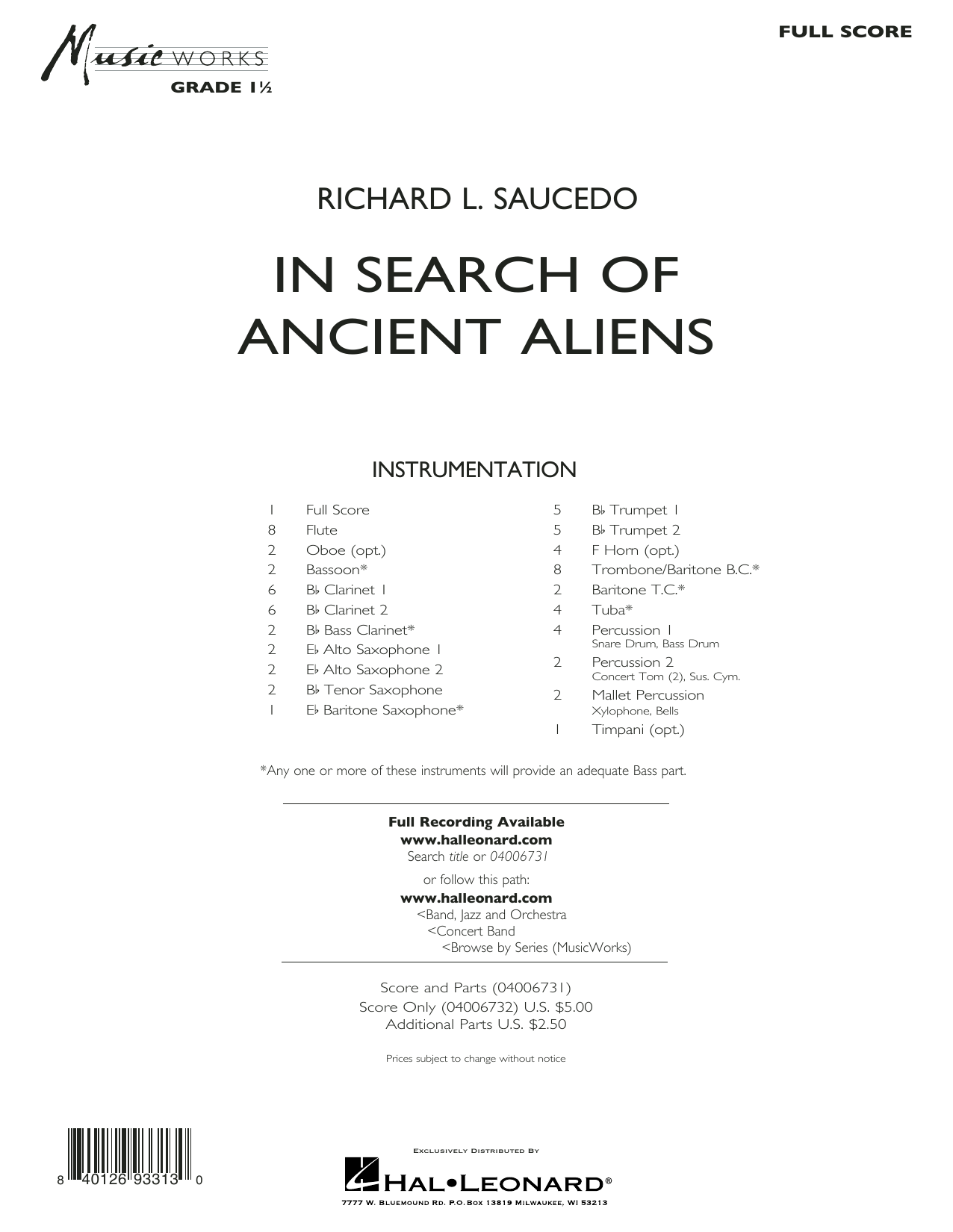

In Search of Ancient Aliens: Concert Band Conductor Score & Parts
By Richard L. Saucedo
Grade: 1.5
Item: 35-PK00469399
$45.00
Pickup currently not available
Buy Extra Parts (Digital PDF Download)
Parts Added to Cart!
Description
Hinting at the possibility of visitors from another world coming to earth in ancient times, Richard's musical adventure for second year players evokes feelings of excitement and also mystery. Using dark harmonies, driving rhythms, and a brief lyric section in the middle this is a great teaching tool as well as just plain fun.


In Search of Ancient Aliens: Concert Band Conductor Score & Parts isn't in MakeMusic Cloud just yet...but it could be. Let us know you'd like to see it, and you'll help shape what comes next. In the meantime, start a free trial and dive into thousands of interactive titles your students can play along with today.
Request This Title
Tell us you want it.
Start Your Free Trial
Explore everything that's ready to play right now.
Sample Audio
No sample audio found.
Sample Video
No sample videos found.
Additional Details
Publisher:
Hal Leonard
SKU:
35-PK00469399
More about this title
About the Composer: Richard L. Saucedo

Richard L. Saucedo spent 31 years leading the Carmel High School bands program in Indiana, where he built one of the nation's most successful concert and marching ensembles. His Wind Symphony I performed at the Music for All National Concert Band Festival three times and earned Indiana State Champion status, while the Carmel Marching Greyhounds secured back-to-back BOA National Championships in 2005 and 2012.
Beyond the podium, Saucedo has shaped music education as a Senior Educational Consultant for Music for All and Bands of America, Chief Judge Team Leader for BOA competitions, and arranger for two DCI world championship corps. He was named Indiana Bandmaster of the Year in 1998-99, inducted into the Music for All Hall of Fame in 2015, and elected to the American Bandmasters Association. His prolific output as a freelance composer spans marching bands, concert bands, orchestras, and choral works.
Why we love this
Saucedo understands exactly what second-year players can execute without oversimplifying the arranging. The piece delivers genuine dramatic tension through dark harmonies and propulsive rhythms, not just novelty theming, while the brief lyric section in the middle provides a pedagogically smart contrast that keeps rehearsals engaging. It's the kind of concert opener that makes your ensemble sound sharper and your students feel the stakes of what they're playing.
What to expect
The opening establishes an atmosphere of intrigue and unease through shadowy harmonies and insistent rhythmic patterns. A brief moment of lyrical reflection provides breathing room before the ensemble builds back to a climax that feels earned rather than overdone.
Who it's for
Young concert bands ready to explore more sophisticated arranging while staying within grade 1.5 technical demands. Students get their first taste of thematic coherence and dramatic tension; directors get a piece that impresses audiences without requiring advanced virtuosity.
How to get the most out of it
- Balance the driving rhythms across the ensemble by rehearsing the accompaniment patterns separately from melodic content; lock your foundation instruments (tubas, basses, low woodwinds) before adding texture above.
- Shape the dark harmonic language with dynamic clarity. These aren't meant to sit at the same volume; let the dissonance breathe by emphasizing entrances and releases rather than trying to blend everything into a smear.
- Treat the lyric section as a moment of genuine repose. Ease the tempo slightly and encourage singing tone quality, even in the brass, to create emotional contrast before returning to the mysterious energy.
How to use it
Program this as a concert or festival opener to establish mood and energy immediately. The 1.5 difficulty makes it accessible for early-season programming or festival seasons when you want artistic substance without stretching students' technical limits.
Skills your students will build
- Reading and executing syncopated rhythmic patterns
- Voice leading and harmonic awareness in contemporary concert band writing
- Dynamic contrast and phrasing across sustained passages
- Responding to non-traditional harmonic language with accurate intonation
- Balancing rhythmic precision with musicality in ensemble settings