In Quiet Times: Bassoon Sheet Music Preview

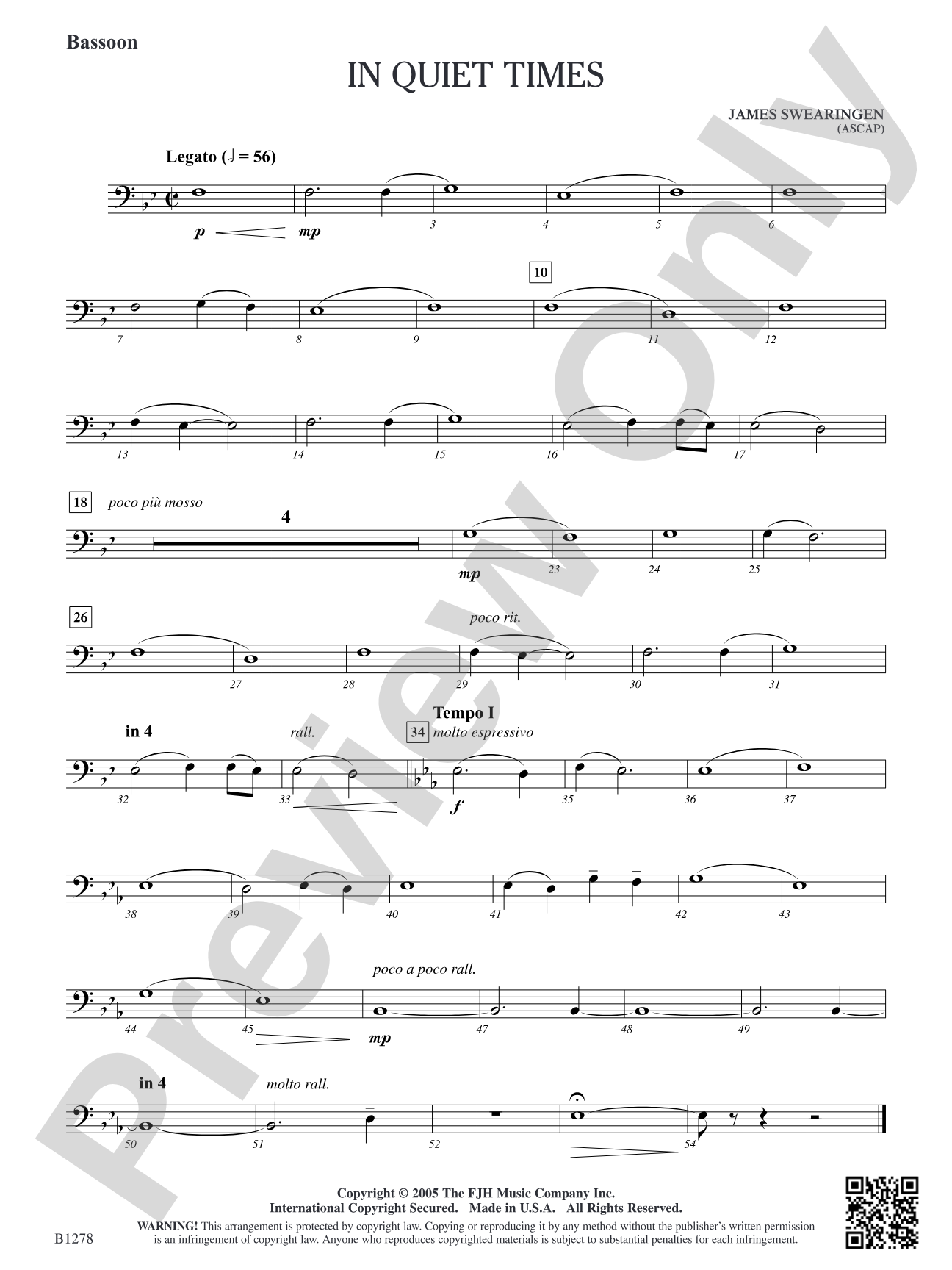
In Quiet Times: Bassoon

By James Swearingen

Grade: 1.5

Item: 98-PC-DB1278_B1

Digital Download
$7.00
Description
This beautiful ballad offers plenty of opportunities for focusing on musicality with little concern for technical demands. The humble melody in the clarinets and horn is answered first by flutes then trumpets, before the glorious key change. As beautifully as it began, the piece fades back to a final "quiet time." Sure to work with virtually any instrumentation, and a truly musical experience!

In Quiet Times: Bassoon isn't in MakeMusic Cloud just yet...but it could be. Let us know you'd like to see it, and you'll help shape what comes next. In the meantime, start a free trial and dive into thousands of interactive titles your students can play along with today.

Sample Audio
0:00
0:00
Sample Video
Additional Details
Series: FJH Developing Band
Publisher: The FJH Music Company, Inc.
SKU: 98-PC-DB1278_B1

More about this title

About the Composer: James Swearingen

James Swearingen is a prolific composer whose works span concert band, wind ensemble, orchestra, and choral settings. His writing for developing ensembles demonstrates a gift for crafting pieces that sound mature and musical while remaining accessible to younger players, making him a trusted voice in band education.

Why we love this

Swearingen understands that young musicians respond to genuine musical substance, not technical busywork. This piece gives every section a moment to sing, and the architecture of statement, response, and key change teaches formal thinking without overwhelming players. It's the kind of piece that builds confidence and reminds students why they play.

What to expect

Serene and introspective, yet never slight. The piece unfolds like a moment of reflection, beginning in quiet contentment, gathering warmth and light through the responses of different voices, and then gently returning to stillness. It has the emotional clarity of a genuine ballad.

Who it's for

Developing concert bands working at grades 1 to 2 who are ready to explore expressive playing and simple formal structures. Directors seeking repertoire that sounds polished and purposeful without requiring technical virtuosity will find reliable material here.

How to get the most out of it

  • Shape the opening clarinet and horn melody with long, connected phrasing; resist the urge to over-punctuate. Let it breathe naturally as the foundation for what's to come.
  • Balance the antiphonal exchanges between clarinet, flute, and trumpet so each statement feels like a genuine musical conversation, not a call and response drill.
  • Honor the key change as a structural arrival by allowing slight breathing space and a subtle lift in energy before the new harmonic area takes hold.
  • In the final fade, maintain control and focus through the diminuendo; an under-prepared ensemble often rushes or loses pitch awareness as the dynamic drops.

How to use it

Open a concert with this piece to establish a reflective mood, or place it as a quieter moment within a mixed program to provide contrast with more energetic repertoire. It works equally well as a standalone feature or as part of a thematic program exploring lyrical writing.

Skills your students will build

  • sustained legato phrasing across full phrases
  • balance between melodic and harmonic sections
  • listening for intonation in sustained chords
  • responding to the architecture of statement and response
  • control and focus through dynamic reduction

You May Also Like