In Pace Sheet Music Preview

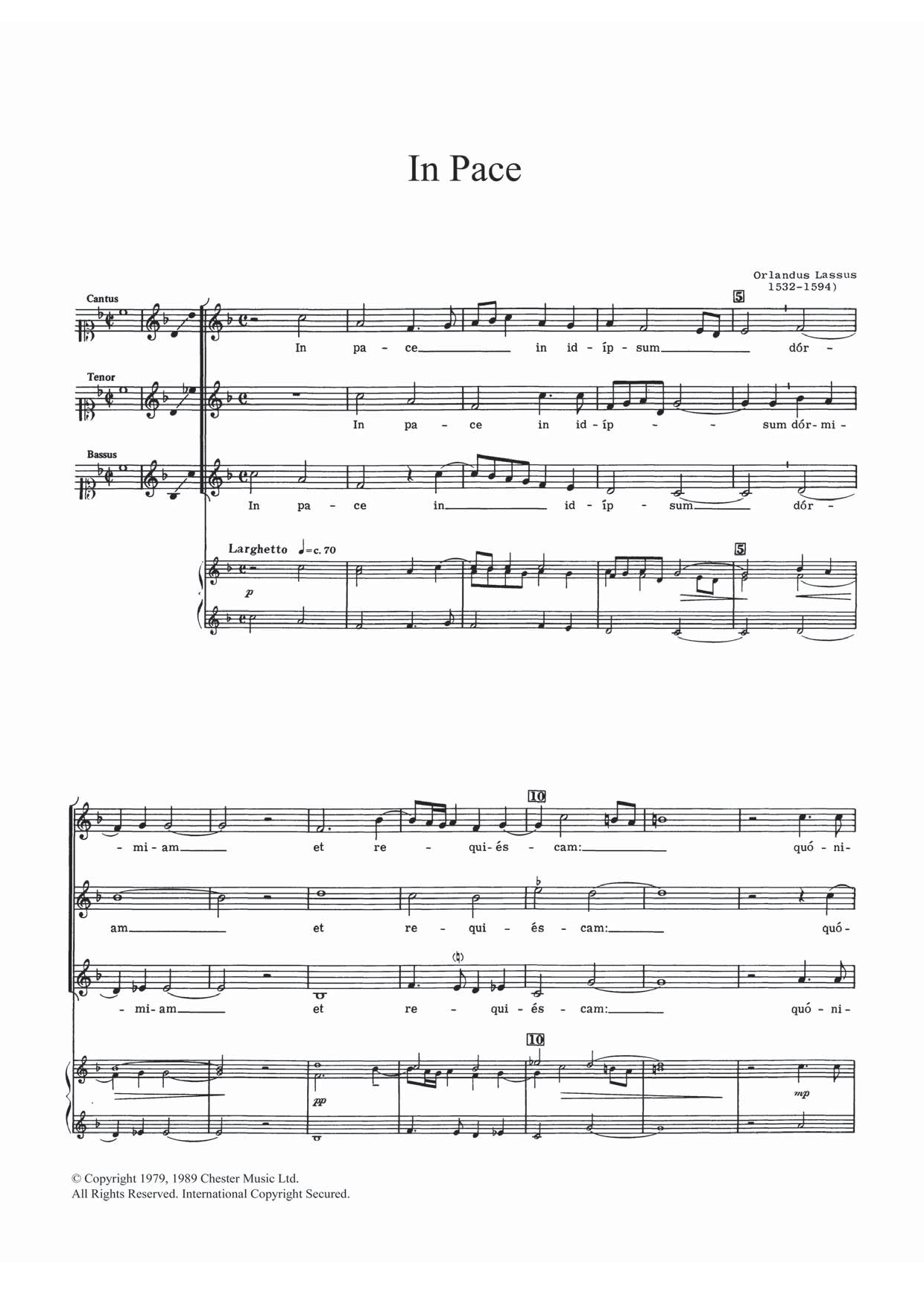
In Pace: SATB Choral Octavo

As performed by Orlandus Lassus

Item: 35-DS00366805

Digital Download
$2.99
Description

In Pace: SATB Choral Octavo isn't in MakeMusic Cloud just yet...but it could be. Let us know you'd like to see it, and you'll help shape what comes next. In the meantime, start a free trial and dive into thousands of interactive titles your students can play along with today.

Sample Audio
No sample audio found.
Sample Video
Additional Details
Publisher: Hal Leonard
Page Count: 2
SKU: 35-DS00366805

More about this title

About the Artist: Orlandus Lassus

Orlandus Lassus (1532-1594) was one of the most prolific composers of the Renaissance, with over 2,000 works attributed to him across every vocal genre of his time. Working primarily in Munich as court composer, he became a master of the motet and secular choral forms, crafting music that balanced technical sophistication with emotional directness. His gift for setting text to music influenced generations of composers and remains a cornerstone of choral repertoire.

For choirs, Lassus offers an invaluable resource: pieces that are genuinely singable yet never simplistic, with counterpoint that teaches voice independence while remaining musically rewarding. His output spans from devotional works to lighter secular pieces, making him essential to understanding Renaissance choral writing.

Why we love this

In Pace is the kind of piece that works equally well as a learning tool and a performance vehicle. Its economical two-page format means your singers can master it thoroughly without it consuming your rehearsal calendar, and the text setting is so transparent that it naturally teaches good diction and phrase shaping. Lassus's gift for making contrapuntal writing feel inevitable rather than imposed shines here.

What to expect

In Pace carries the serene inevitability of Renaissance counterpoint without heaviness. The four voices move with quiet purposefulness, each supporting the others, creating a sense of calm resolution. There's clarity in every moment and a gentle sophistication that rewards careful listening.

Who it's for

This piece suits intermediate to advanced high school choirs, college ensembles, and community choirs ready for genuine Renaissance polyphony without the density of a six or eight voice motet. It works beautifully for singers who've tackled some Palestrina or Victoria and are ready to experience Lassus's lighter, more direct compositional voice.

How to get the most out of it

  • Balance the text intelligently across the four voices. Lassus often hides important words in inner parts, so insist that altos and tenors carry their lines with the same care as sopranos and basses.
  • Shape each phrase to its natural conclusion rather than marking every bar line. The harmonic rhythm and text flow guide you; let them breathe without artificial segmentation.
  • Keep the tempo moderate enough that your singers can manage the text clarity and part independence. Rushing Renaissance polyphony sacrifices the very clarity it demands.
  • Tune the fifth and octave intervals strictly in homophonic moments. Renaissance sonorities reward just intonation more noticeably than later styles.

How to use it

Pair this with other Renaissance sacred motets to create a program exploring different regional and generational voices within the period. Its modest length makes it an ideal anchor for a choral concert centered on shorter works, or a thoughtful opener that establishes sophistication and control. It also serves well as a performance vehicle in competitions where Renaissance repertoire is valued.

Skills your students will build

  • Renaissance text underlay and diction across polyphonic texture
  • Independent part singing with clear phrase shaping
  • Just intonation in traditional harmonic intervals
  • Recognition of imitative and homophonic techniques in a compact form

You May Also Like