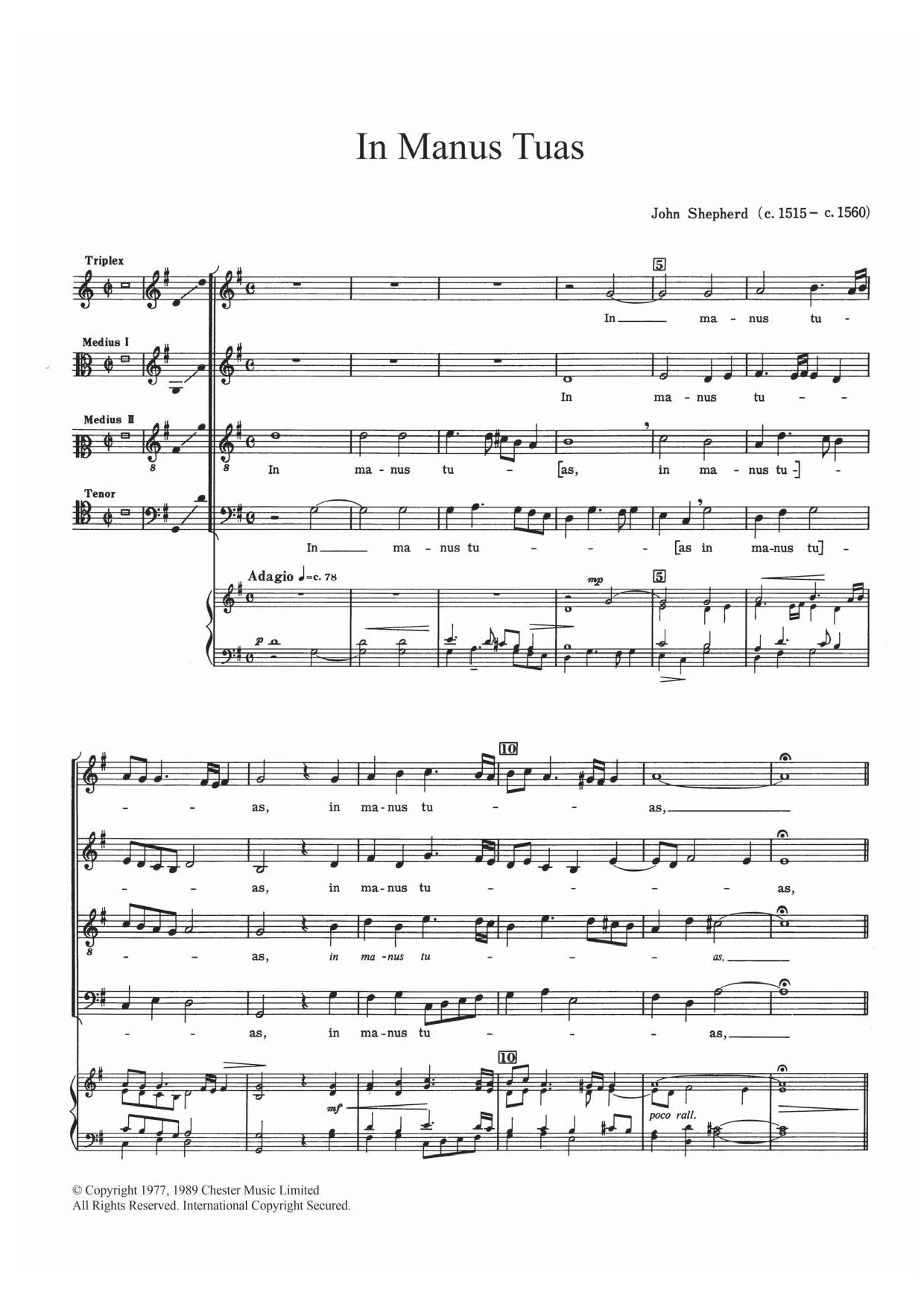
In Manus Tuas Sheet Music Preview

In Manus Tuas: SATB Choral Octavo

As performed by John Shepherd

Item: 35-DS00366753

Digital Download
$2.99
Description

In Manus Tuas: SATB Choral Octavo isn't in MakeMusic Cloud just yet...but it could be. Let us know you'd like to see it, and you'll help shape what comes next. In the meantime, start a free trial and dive into thousands of interactive titles your students can play along with today.

Sample Audio
No sample audio found.
Sample Video
Additional Details
Publisher: Hal Leonard
Page Count: 3
SKU: 35-DS00366753

More about this title

About the Artist: John Shepherd

John Shepherd stands among the most significant choral composers of the Renaissance, active during the mid to late 16th century in England. His sacred and secular vocal works demonstrate remarkable contrapuntal craftsmanship and emotional restraint, qualities that secured his reputation across both Catholic and Protestant musical traditions during a period of religious upheaval.

Shepherd's compositions remain essential to any serious choral program, particularly for singers developing facility with Renaissance counterpoint and text expression. His influence on English choral writing extended well beyond his lifetime, establishing conventions that later composers would refine and expand.

Why we love this

This setting sits perfectly at the intersection of technical substance and emotional accessibility. The text pairs with Shepherd's measured harmonic language to create a piece that feels both intimate and dignified, giving your singers something genuinely meaningful to express rather than merely execute.

What to expect

A prayer rendered in careful, almost architectural harmony. The piece unfolds with quiet conviction, its lines interlocking like voices in conversation, each phrase bringing a new angle of light to the text. The overall mood is contemplative and clear, neither dramatic nor ornamental.

Who it's for

This octavo works for high school, college, and community choirs comfortable with Renaissance repertoire and seeking sacred works that don't require large forces or complex staging. It's especially valuable for programs building Renaissance literacy or exploring the English choral tradition.

How to get the most out of it

  • Bring the soprano line into clear relief during opening phrases; it carries the primary melodic statement and should register with clarity even in a fuller texture.
  • Shape phrases by understanding the text's natural breathing points rather than phrase marks alone. This approach honors Shepherd's word-painting choices.
  • Balance the inner voices (alto and tenor) so they function as independent lines, not filler. This requires rehearsal sectionals where these parts lead.
  • Consider tempo stability over flashy expressive gestures. Shepherd's music responds beautifully to steady, warm tempos that let the counterpoint unfold.

How to use it

Pair this with other Renaissance motets to create a focused concert section, or program it as a centering moment between larger, more dramatic works. It also works beautifully in liturgical contexts and as part of an ensemble's core repertoire for contests and evaluations.

Skills your students will build

  • Renaissance counterpoint and voice leading
  • Sustaining independent melodic lines within harmonic texture
  • Word-painting and text expression in sacred contexts
  • Precise intonation in modal harmonic language
  • Reading three to four independent parts simultaneously

You May Also Like