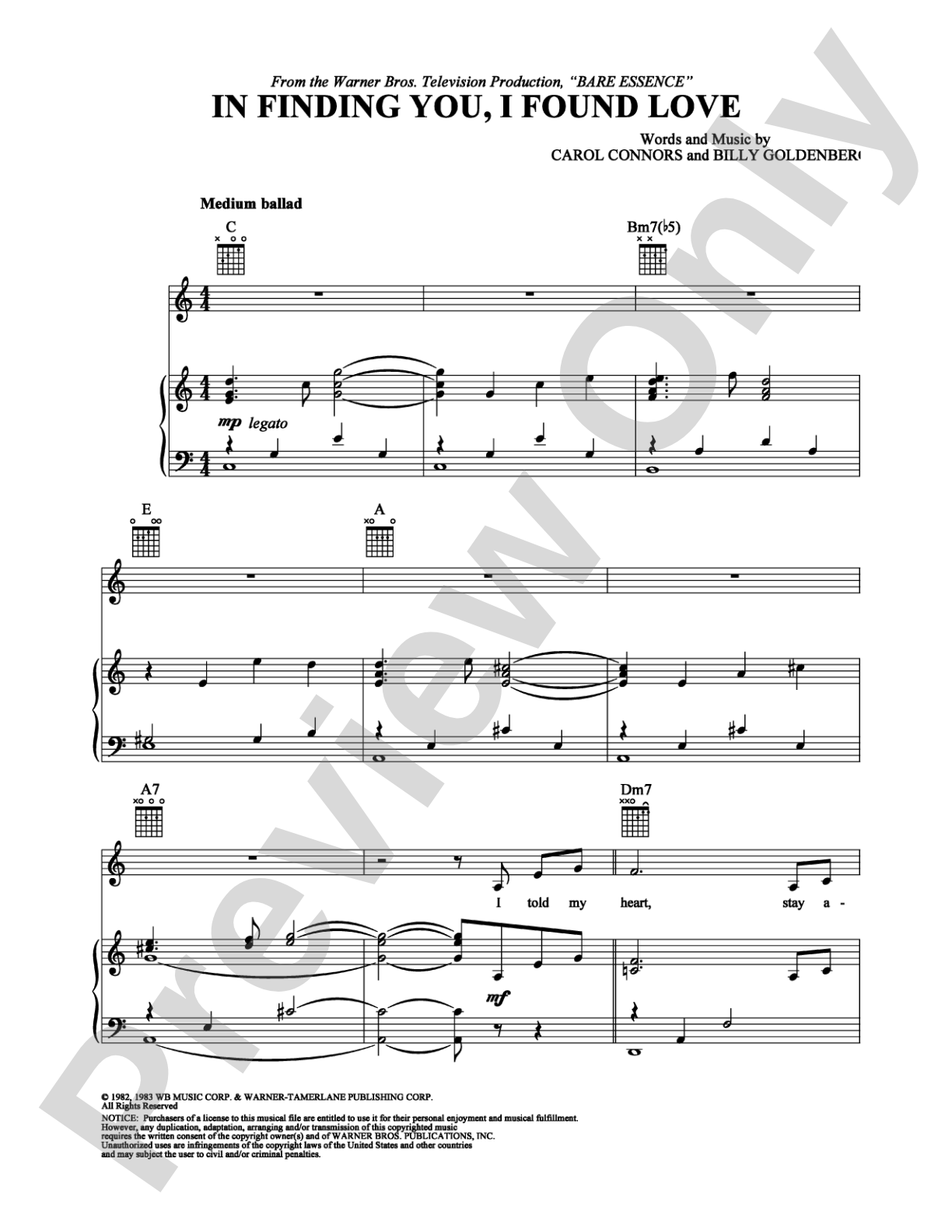
In Finding You, I Found Love: Piano/Vocal/Chords Digital Sheet Music

In Finding You, I Found Love: Piano/Vocal/Chords Digital Sheet Music

Carol Connors, Billy Goldenberg, Sarah Vaughan

Item: 00-PS-0009033

Digital Download
$3.99
Description

In Finding You, I Found Love: Piano/Vocal/Chords Digital Sheet Music isn't in MakeMusic Cloud just yet...but it could be. Let us know you'd like to see it, and you'll help shape what comes next. In the meantime, start a free trial and dive into thousands of interactive titles your students can play along with today.

Sample Audio
No sample audio found.
Sample Video
Additional Details
SKU: 00-PS-0009033

More about this title

About the Artist: Sarah Vaughan

Sarah Vaughan (1924, 1990) was one of the most technically accomplished vocalists in jazz history, renowned for her three-octave range, perfect pitch, and ability to navigate complex harmonic territory with effortless grace. Her influence on jazz pedagogy remains profound: she demonstrated how a vocalist could function as a fully developed instrumentalist, improvising with the harmonic sophistication of a pianist or saxophonist and influencing generations of singers to deepen their understanding of chord changes and melodic reharmonization.

Why we love this

Vaughan's interpretation of this standard showcases the kind of harmonic awareness and rhythmic flexibility that separates jazz vocalists from pop singers. The piano/vocal/chords format captures her style perfectly for educators teaching jazz phrasing, improvisation, and how to shape a melody across chord changes rather than simply following a written line.

What to expect

The piece carries the warm, introspective quality of a late-night confession. Vaughan's sensibility brings emotional maturity to the lyric, with space for contemplation in the slower passages and a gentle lyricism that never tips into sentimentality.

Who it's for

Jazz singers preparing standard repertoire for recital, as well as vocal jazz students learning how to read chord charts and understand harmonic structures. Pianists working with vocalists will find this format essential for accompanying singers who expect responsiveness to phrasing and rubato rather than metronomic accompaniment.

How to get the most out of it

  • Study Vaughan's original recording to understand her approach to phrasing and dynamics; notice how she layers the melody slightly behind the beat and uses silence as effectively as sound.
  • Treat the piano part as a conversation partner, not accompaniment. Lock in with the chord changes rather than fighting against them, and allow space for the piano to breathe between phrases.
  • Build your interpretation around the harmonic movement. This standard contains sophisticated chord progressions that reward close listening; let them guide your melodic choices and emotional arc.
  • Don't nail every note to the exact pitch. Jazz singing requires flexibility with intonation around chord tones, especially on longer held notes where slight variations in pitch can express musicianship.

How to use it

Place this in a jazz standards set where it can stand alongside other vocal torch songs, or feature it as a solo feature in a vocal jazz ensemble concert. It works particularly well as an opening number or as a thoughtful ballad that creates intimacy in a concert space.

Skills your students will build

  • reading chord changes and understanding harmonic function
  • phrasing and rhythmic flexibility in jazz contexts
  • listening to and responding to the piano accompaniment in real time
  • interpreting standard repertoire with emotional nuance and musical maturity

You May Also Like