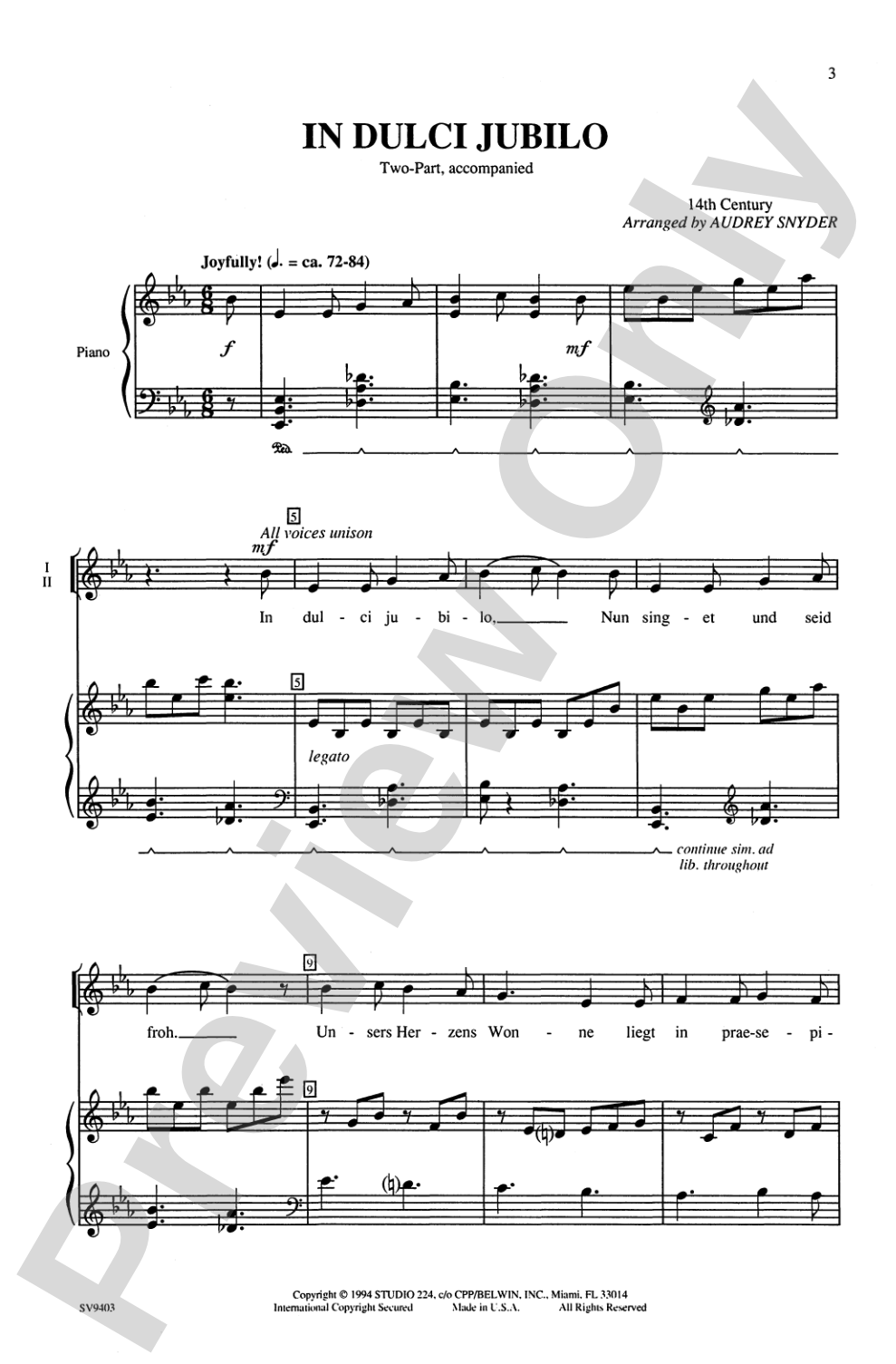
In Dulci Jubilo Sheet Music Preview

In Dulci Jubilo: 2-Part Choral Octavo

Arr. Audrey Snyder

Level: Moderate

Item: 00-PO-0005228

Digital Download
$2.25

Minimum order quantity: 20 copies

Description
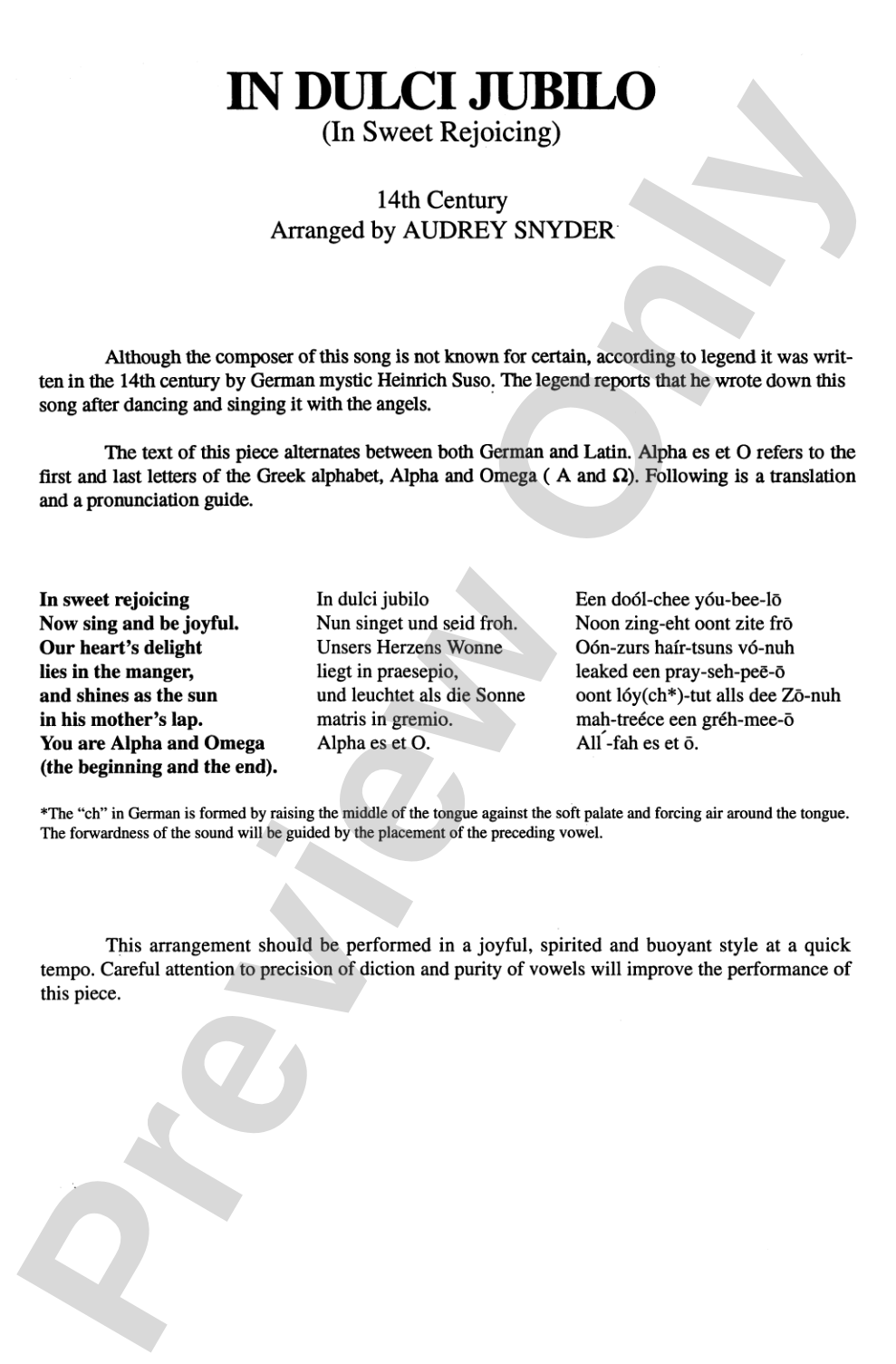
This brilliantly arranged work is performable any time of year. The combination of German and Latin text is in keeping with the 14th century setting. The accompaniment is supportive but strongly conceived to add harmonic coloration to the work. A translation and pronunciation guide are included.

In Dulci Jubilo: 2-Part Choral Octavo isn't in MakeMusic Cloud just yet...but it could be. Let us know you'd like to see it, and you'll help shape what comes next. In the meantime, start a free trial and dive into thousands of interactive titles your students can play along with today.

Sample Audio
No sample audio found.
Sample Video
Additional Details
Series: Alfred Archive Edition: Studio PR Catalog
Publisher: Alfred Music
Page Count: 8
SKU: 00-PO-0005228

More about this title

About the Arranger: Audrey Snyder

Audrey Snyder is a widely performed choral arranger whose work appears regularly on festival and competition programs across North America. Her arrangements span sacred and secular repertoire, consistently balancing accessibility with musical substance for choirs at intermediate levels.

Why we love this

Snyder's arrangement preserves the medieval carol's character while making it genuinely singable for developing choirs. The piano part moves beyond simple doubling, creating harmonic richness that elevates the piece without overwhelming young singers or demanding advanced musicianship.

What to expect

The piece carries the warmth of a medieval carol while the arrangement adds subtle harmonic depth. The combination of German and Latin text creates an intimate, reverent quality that feels both timeless and fresh, inviting singers and listeners into quiet jubilation.

Who it's for

This arrangement serves choirs with mixed voices at the intermediate stage (typically grades 3 and above) who are ready for modest part independence and text work in multiple languages. It suits ensembles preparing for festival competition or looking to build a sacred repertoire that sounds more sophisticated than their current vocal range and technique might suggest.

How to get the most out of it

  • Prepare the text carefully in both languages. The pronunciation guide provided is essential; allocate rehearsal time to nail the Latin vowels and German consonants so the text lands clearly with your audience.
  • Shape each phrase through the accompaniment's harmonic movement rather than forcing volume. Let the piano's coloration guide your dynamic arc.
  • Balance the two part lines so neither dominates. With moderate difficulty, both sections can carry melody; use rehearsal to clarify moments of unison versus divided writing.
  • Consider the piece's flexibility: it works equally well in a winter concert, a liturgical setting, or a spring festival program without feeling out of season.

How to use it

Program this as an anchor for a sacred music set, or pair it with other carols and choral settings from different centuries to show how one melody travels through musical history. Its moderate difficulty and year-round appeal make it valuable for spring festivals and as a bridge piece when you want to elevate your program's musical substance without overextending your singers.

Skills your students will build

  • Reading and performing text in German and Latin with accurate pronunciation
  • Sustaining independent melodic lines while balancing with another part
  • Responding to piano accompaniment as a harmonic and structural guide rather than relying on doubling
  • Interpreting expressive nuance in sacred music with restraint and textual awareness

You May Also Like