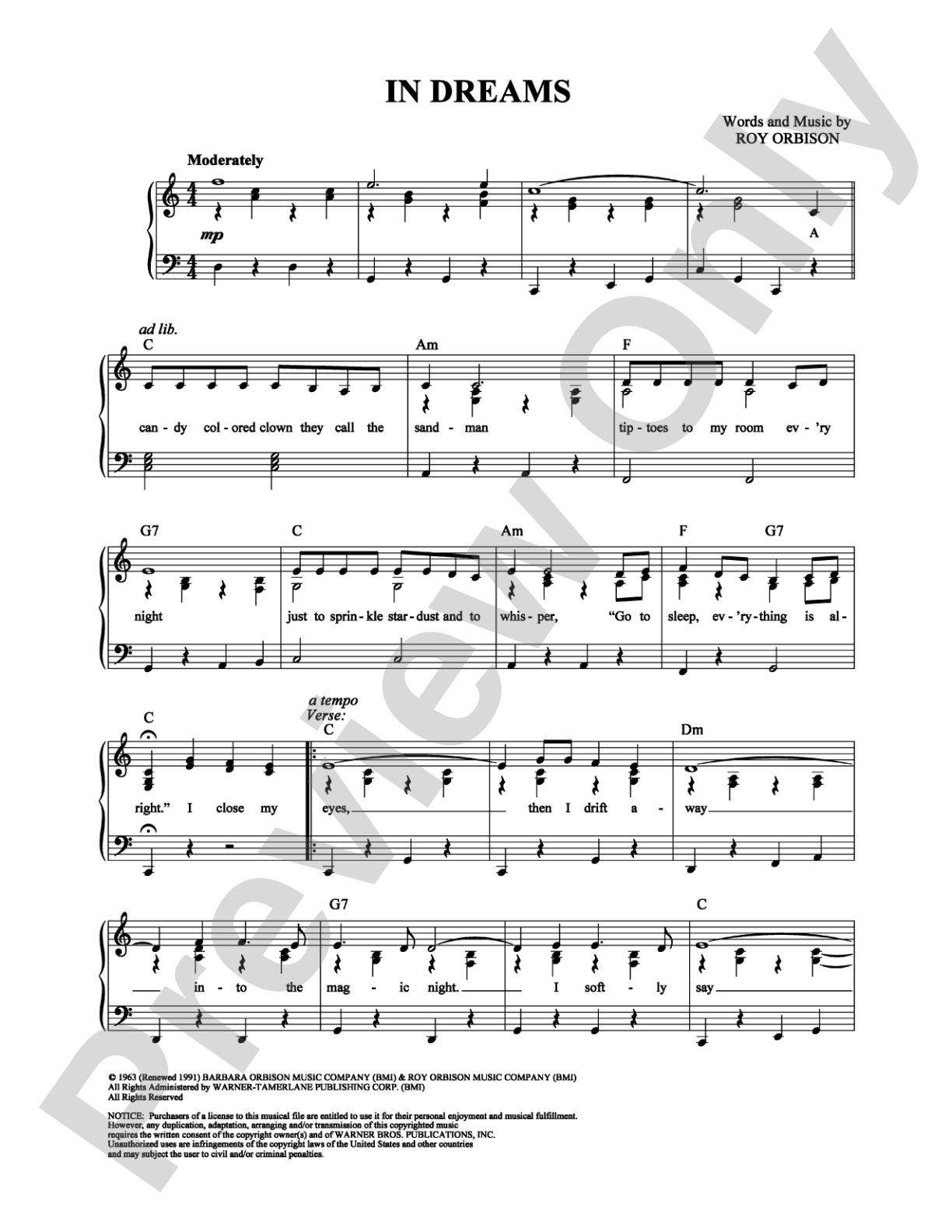
In Dreams: Piano/Vocal/Chords Digital Sheet Music

In Dreams: Piano/Vocal/Chords Digital Sheet Music

Roy Orbison

Item: 00-PS-0009450

Digital Download
$3.99
Description

In Dreams: Piano/Vocal/Chords Digital Sheet Music isn't in MakeMusic Cloud just yet...but it could be. Let us know you'd like to see it, and you'll help shape what comes next. In the meantime, start a free trial and dive into thousands of interactive titles your students can play along with today.

Sample Audio
No sample audio found.
Sample Video
Additional Details
SKU: 00-PS-0009450

More about this title

About the Artist: Roy Orbison

Roy Orbison (1936-1988) was an American singer-songwriter whose distinctive vocal style and innovative approach to rock and roll made him one of the most influential artists of the late 20th century. His mastery of melody, dynamic vocal control, and emotional depth transformed popular song into something more operatic and symphonic than his contemporaries. Orbison's work remains essential repertoire for vocalists studying how to build intensity through restraint, shape a phrase across a wide range, and command an arrangement with minimal but precise gestures.

Why we love this

In Dreams exemplifies Orbison's gift for creating lush, cinematic arrangements that give singers room to express genuine emotion without overselling it. The chord progression and melody sit comfortably for vocalists learning to sustain legit tone while navigating pop sensibilities, and the piano part provides both harmonic foundation and textural color that players at the intermediate level can expand into their own interpretations.

What to expect

In Dreams inhabits a space between reverie and longing, with a melody that floats over rich, warm harmonies. The song's emotional center rests in its restraint; it suggests intimacy and vulnerability rather than demanding them, inviting both singer and listener into a private moment.

Who it's for

This arrangement serves singers and pianists working in pop/rock repertoire who want to study how a song can be both commercially accessible and musically substantial. It is equally valuable for voice students exploring interpretation across genres and pianists seeking to build flexible accompanying skills in a non-classical context.

How to get the most out of it

  • Study the original recording to understand how Orbison shapes the vocal line with subtle dynamics and breath placement; resist the urge to oversing early phrases, reserving intensity for the emotional climax.
  • Balance the piano accompaniment so it supports rather than doubles the vocal melody; let the singer own the tune while the keys create harmonic depth.
  • Experiment with tempo flexibility in the bridge; Orbison's phrasing often stretches time in service of the lyric, and slight rubato can heighten the dreamlike quality of the text.
  • Voice the chord extensions and substitutions suggested in the lead sheet; these choices are part of what gives the song its sophisticated, orchestral character.

How to use it

This works as a bridge piece in a recital that spans genres, particularly effective following a classical art song or preceding a contemporary pop arrangement. It also pairs well in a cabaret-style program celebrating American songwriting, where its sophistication and romantic sensibility set a distinguished tone.

Skills your students will build

  • Sustaining legit tone while singing in a popular style
  • Reading and voicing chord symbols and extensions
  • Shaping a lyric-driven vocal line across dynamic changes
  • Accompanying a vocalist with harmonic sensitivity and textural awareness

You May Also Like