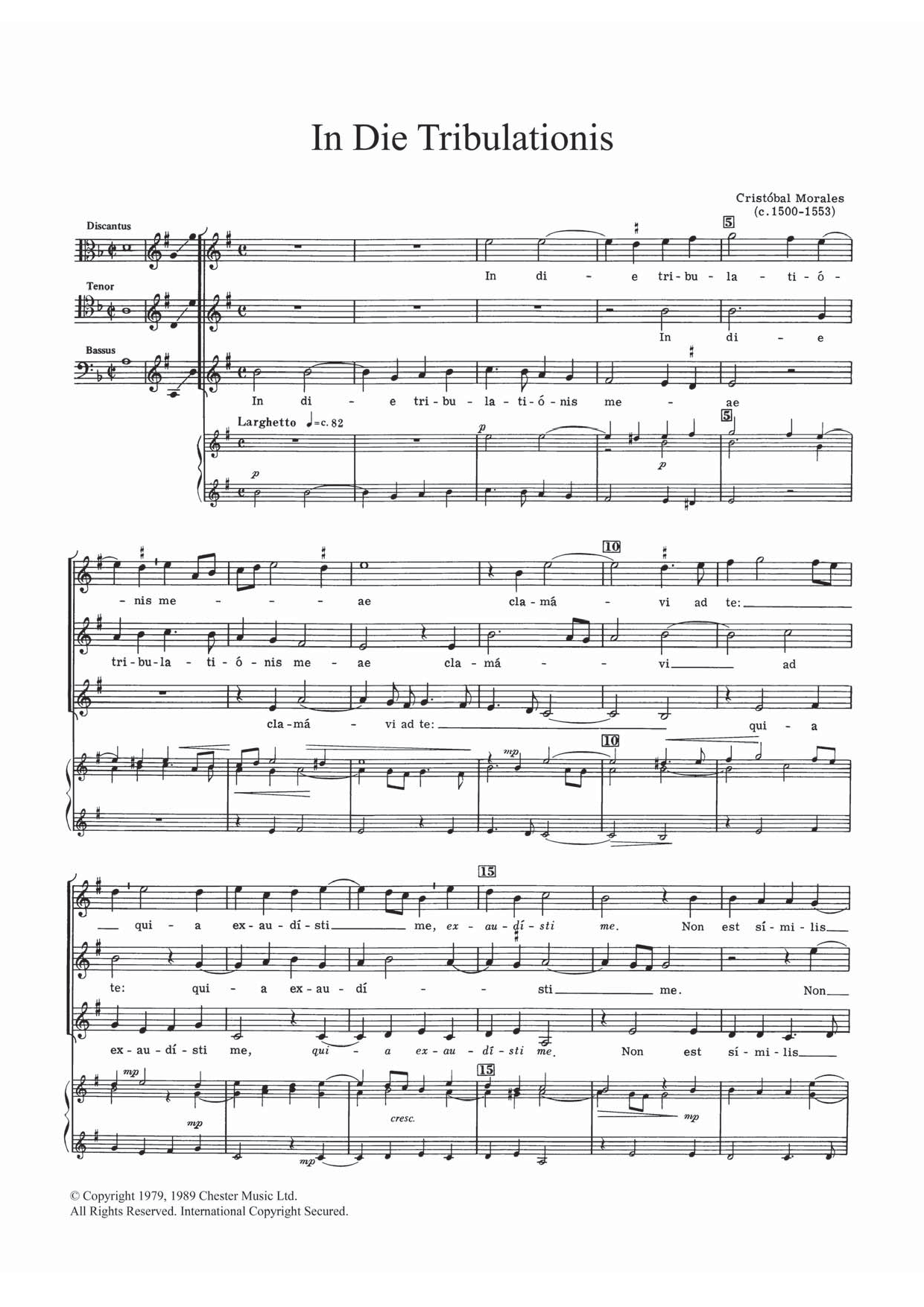
In Die Tribulationis Sheet Music Preview

In Die Tribulationis: SATB Choral Octavo

As performed by Cristobal Morales

Item: 35-DS00366695

Digital Download
$2.99
Description

In Die Tribulationis: SATB Choral Octavo isn't in MakeMusic Cloud just yet...but it could be. Let us know you'd like to see it, and you'll help shape what comes next. In the meantime, start a free trial and dive into thousands of interactive titles your students can play along with today.

Sample Audio
No sample audio found.
Sample Video
Additional Details
Publisher: Hal Leonard
Page Count: 5
SKU: 35-DS00366695

More about this title

About the Artist: Cristobal Morales

Cristóbal Morales (c. 1500-1553) was a Spanish Renaissance composer whose sacred music defined the golden age of polyphonic writing. Active in Rome and Spain, he composed over 20 masses and numerous motets that exemplify the elegant counterpoint and spiritual depth of 16th-century sacred music. His works remain cornerstones of the choral repertoire, valued for their technical sophistication and emotional directness.

Moreover, Morales influenced generations of composers through his mastery of imitative counterpoint and his ability to set text with both clarity and beauty. His motets, in particular, showcase the expressive possibilities of the human voice when combined with theological substance, making them enduring teaching tools for understanding Renaissance choral technique.

Why we love this

Morales' compositional voice carries genuine weight without unnecessary complexity. The text painting and harmonic language create moments of real spiritual resonance that singers recognize immediately, making this a piece where preparation pays off in emotional authenticity rather than technical pyrotechnics alone.

What to expect

The piece unfolds with quiet intensity, as if the text is being examined phrase by phrase rather than proclaimed. Harmonic language that shifts between minor and major inflections creates an introspective quality, while occasional homophonic moments offer listeners a landing place before diving back into the woven lines.

Who it's for

This octavo works beautifully for choirs with solid fundamentals in sight-reading and Renaissance repertoire experience. Singers at the high school advanced level or college intermediate level will find genuine challenge in the counterpoint without the extreme range demands of later Morales motets.

How to get the most out of it

  • Balance the four voices as equal partners; this is not a soprano-driven texture. Each line carries thematic material that listeners should hear clearly, so coach your singers to project their individual parts while remaining ensemble-conscious.
  • Approach the text as a conversation among the voices rather than a homophonic statement. Slight staggering of phrase endings (breathing strategically rather than uniformly) prevents the piece from feeling static across five pages.
  • Pay attention to the harmonic rhythm in the final cadential passages. Morales often slows the harmonic motion before resolving, creating natural dramatic weight if you allow those moments to breathe.
  • Intonation challenges arise when voices sustain longer notes against moving lines in other parts. Rehearse vertically in sections to lock those sonorities, then reintegrate with the full ensemble.

How to use it

Include this in a concert exploring Renaissance sacred music or pairing it with other Morales motets for a thematic program. Five pages allows it to anchor a mixed choral set without dominating the program arc, and its spiritual character pairs well alongside both lighter Renaissance secular works and more austere music from the period.

Skills your students will build

  • Sight-reading imitative counterpoint across four independent lines
  • Renaissance text underlay and proper vowel handling in Latin
  • Sustaining intonation during harmonic motion in other voices
  • Balancing individual voice independence with ensemble blend
  • Phrasing across longer melodic lines without modern harmonic guideposts

You May Also Like