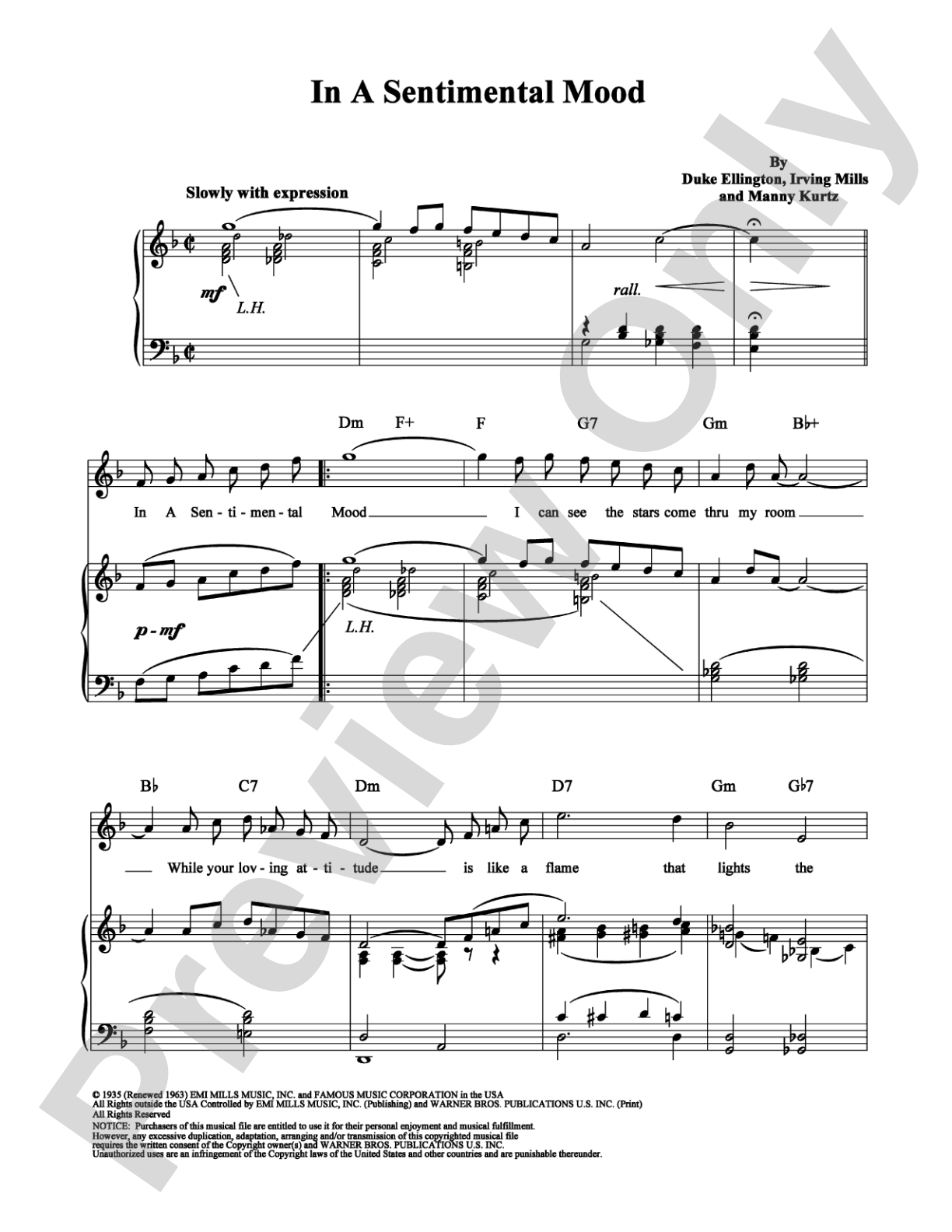
In a Sentimental Mood: Piano/Vocal/Chords Digital Sheet Music

In a Sentimental Mood: Piano/Vocal/Chords Digital Sheet Music

Duke Ellington, Irving Mills, Manny Kurtz

Item: 00-PS-0007538

Digital Download
$3.99
Description

In a Sentimental Mood: Piano/Vocal/Chords Digital Sheet Music isn't in MakeMusic Cloud just yet...but it could be. Let us know you'd like to see it, and you'll help shape what comes next. In the meantime, start a free trial and dive into thousands of interactive titles your students can play along with today.

Sample Audio
No sample audio found.
Sample Video
Additional Details
SKU: 00-PS-0007538

More about this title

About the Creator: Duke Ellington

Duke Ellington's "In a Sentimental Mood" emerged from one of jazz's most prolific compositional careers. Written in 1935, the piece became a standard that defined the sound of the swing era and beyond, recorded by countless artists across genres. Ellington's gift for melody and harmonic sophistication shaped American popular music for decades, and this composition remains a cornerstone of the jazz repertoire for good reason.

Why we love this

This standard strikes the balance between accessibility and sophistication that makes it endlessly rewarding to teach and perform. The chord changes are jazz-informed without being overly complex, and the melody sits naturally for singers while giving pianists room to voice and interpret.

What to expect

Wistful and introspective, with the kind of melodic contour that invites you to linger over each phrase. The harmony supports a contemplative mood while retaining the underlying sophistication and elegant restraint that defines the Great American Songbook.

Who it's for

Vocalists building a jazz standards repertoire and pianists looking to strengthen their jazz voicing skills and accompaniment technique. It works equally well for private studio instruction, informal performance settings, and as a bridge into the American songbook for classical musicians exploring jazz.

How to get the most out of it

  • Let the piano set the harmonic landscape first. The voicings matter as much as the melody, so spend time with the chord progression before focusing on the vocal line.
  • Resist the urge to rush. The title itself instructs the mood; lean into rubato and give the phrasing space to breathe, especially at phrase endings.
  • Experiment with the pianist's comping rhythm. The feel can shift significantly between sparse, conversational playing and fuller harmonic support depending on the singer's needs and the venue.

How to use it

Pair this with other ballads from the same era for a jazz standards recital, or use it as a solo showcase piece within a larger concert. It also serves as an excellent teaching tool for demonstrating how jazz piano accompaniment can enhance and color a vocal performance.

Skills your students will build

  • Jazz chord voicings and harmonic analysis
  • Improvised comping and rhythmic flexibility in accompaniment
  • Phrasing and rubato in the context of a written melody
  • Reading and interpreting lead sheet notation

You May Also Like