
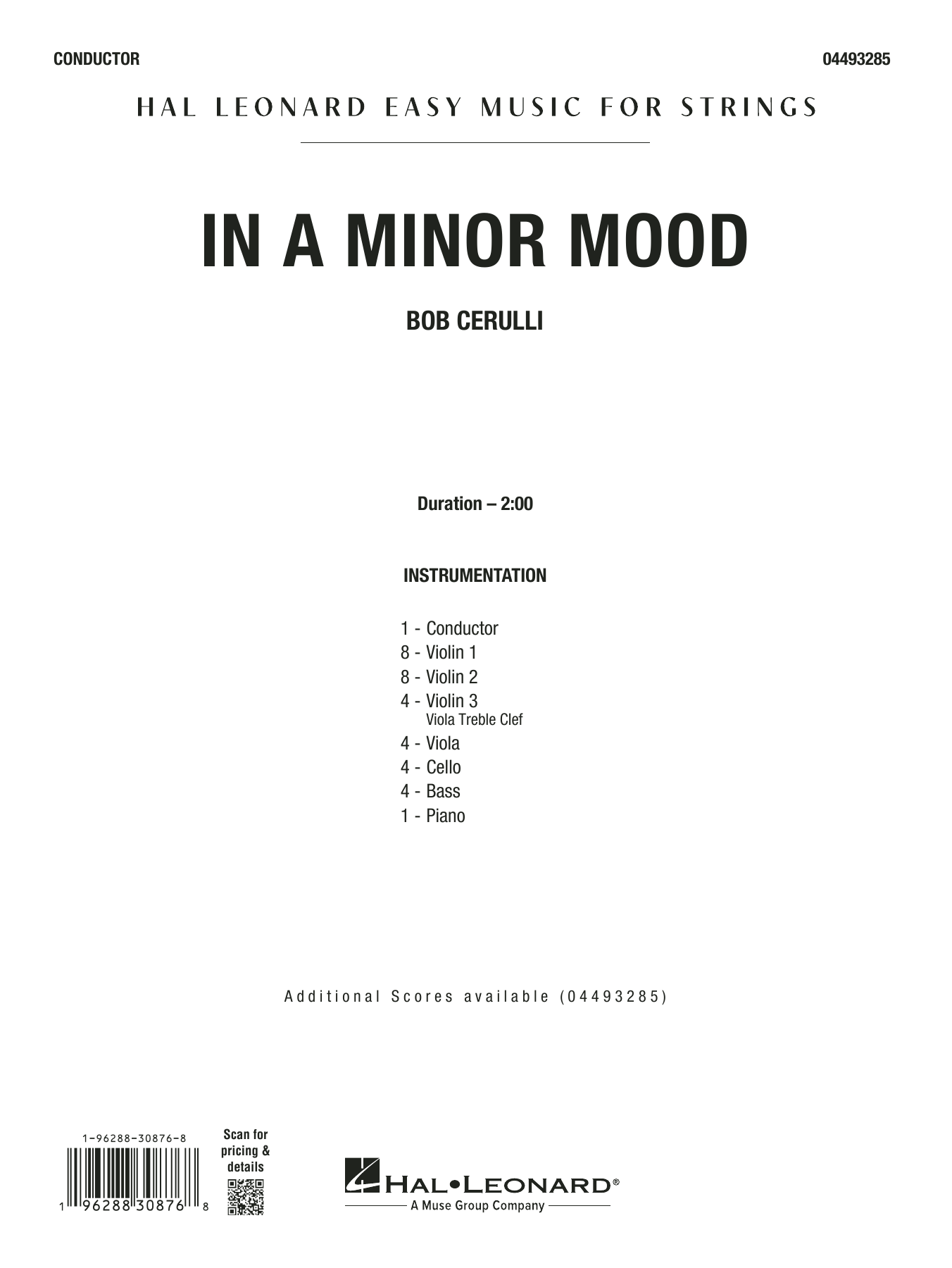

In A Minor Mood: String Orchestra Conductor Score & Parts
By Bob Cerulli
Grade: 2
Item: 35-PK01597987
$60.00
Pickup currently not available
Buy Extra Parts (Digital PDF Download)
| Product | Price | Quantity |
|---|---|---|
| In A Minor Mood - Conductor Score (Full Score) | $7.50 | |
| In A Minor Mood - Violin 1 | $7.00 | |
| In A Minor Mood - Violin 2 | $7.00 | |
| In A Minor Mood - Violin 3 (Viola Treble Clef) | $7.00 | |
| In A Minor Mood - Viola | $7.00 | |
| In A Minor Mood - Cello | $7.00 | |
| In A Minor Mood - Bass | $7.00 | |
| In A Minor Mood - Piano | $7.00 |
Parts Added to Cart!
Description
A fun, upbeat original work in G minor that uses easy scoring, a simple and catchy melody and a good mix of unison and harmony to create an accessible work that will be enjoyed by both players and audiences. Perfect for teaching L2 fingerings and pizzicato.


In A Minor Mood: String Orchestra Conductor Score & Parts isn't in MakeMusic Cloud just yet...but it could be. Let us know you'd like to see it, and you'll help shape what comes next. In the meantime, start a free trial and dive into thousands of interactive titles your students can play along with today.
Request This Title
Tell us you want it.
Start Your Free Trial
Explore everything that's ready to play right now.
Sample Audio
No sample audio found.
Sample Video
No sample videos found.
Additional Details
Publisher:
Hal Leonard
SKU:
35-PK01597987
More about this title
About the Composer: Bob Cerulli

Bob Cerulli's career spans performance, composition, and education across three decades. A Curtis Institute graduate who studied bass with Roger Scott, he went on to earn degrees in music education and conducting, performing as principal bassist with regional orchestras including the Greater Trenton Symphony and Delaware Valley Philharmonic. His performance credits include collaborations with Henry Mancini, Luciano Pavarotti, and Andrea Bocelli, along with Broadway engagements and television appearances.
Cerulli's compositional voice emerged from his deep understanding of orchestration and pedagogy. The Philadelphia Orchestra performed his work Celebration, while Romance in D Major for cello and piano was commissioned for Philadelphia Orchestra Principal Cellist William Stokking. Today he serves as Senior Adjunct Professor at Rowan College at Burlington County and continues to conduct at regional festivals, drawing on nearly three decades of public school music teaching.
Why we love this
Cerulli understands what intermediate ensembles actually need: a piece that sounds polished without requiring advanced technique or excessive rehearsal time. The scoring balances accessibility with musicianship, giving every section moments to shine while the unison passages build confidence and blend. Most importantly, it works as a concert piece that audiences genuinely enjoy, not just as a stepping stone to something else.
What to expect
Upbeat and fresh, with a melody that stays with you long after rehearsal ends. The piece moves with natural energy and warmth, balancing moments of unison strength with prettier harmonic textures that give players a chance to listen and adjust to one another.
Who it's for
Grade 2 string orchestras looking for repertoire that develops foundational technique without sacrificing musical satisfaction. Directors will appreciate material that teaches pizzicato and second position fingerings in a context where students stay engaged and hear themselves making real music together.
How to get the most out of it
- Isolate the pizzicato sections in early rehearsals to establish clean articulation and consistent rhythmic placement before layering in the bowed parts.
- Emphasize the second violin and viola harmonies during the mixed passages; these middle voices carry the harmonic color and need to balance carefully with the melody.
- Build the unison melody gradually, listening for matching bow weights and consistent vibrato speed once players are secure on pitch.
- In G minor, watch the sixth scale degree (E natural); intonation tends to pull sharp here, especially in the viola and cello lines.
How to use it
Pair this with a contrasting slower piece to create a concert flow that showcases your ensemble's range, or use it as an opener that builds confidence and audience connection early in the program. It also works well as a mid-year piece to consolidate pizzicato and intermediate position work before moving into more technical repertoire.
Skills your students will build
- Left-hand position shifting in the second position
- Clean pizzicato articulation and rhythmic precision
- Unison intonation and blend across the ensemble
- Harmonic balance when reading middle voices in mixed textures
- Melodic clarity and consistent vibrato control