
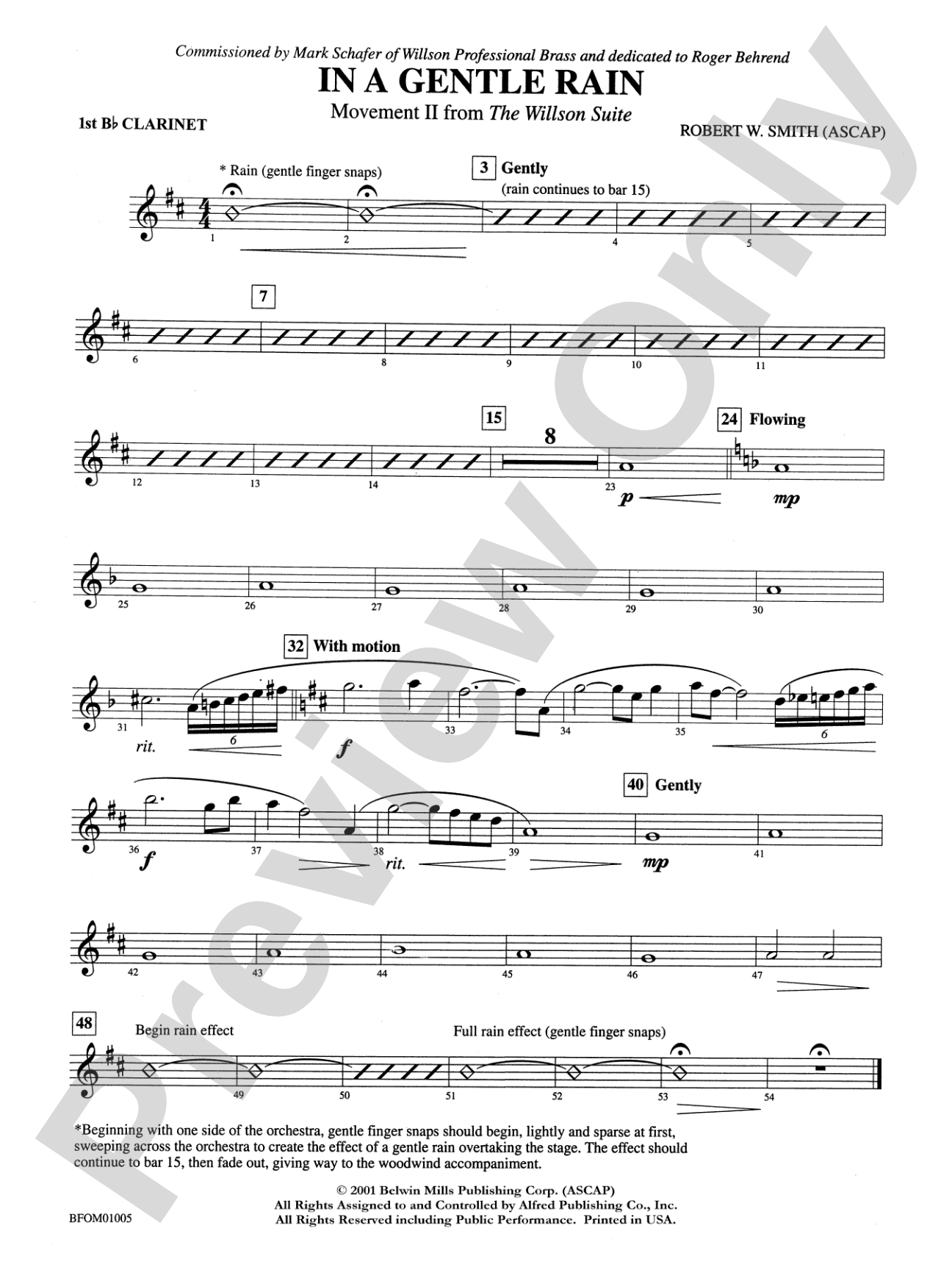

In a Gentle Rain (Movement II from the Willson Suite): 1st B-flat Clarinet
By Robert W. Smith
Grade: 2.5
Item: 00-PC-0002226_C1
$3.00
Pickup currently not available
Description
This second movement of The Willson Suite has been restructured to accommodate virtually any player as the soloist. Serene by nature, the charismatic melody is accompanied by unique effects, reminiscent of a gentle rain. The solo may be divided to feature multiple soloists. This creative approach is the perfect opportunity to feature outstanding soloists at your spring concert. An incredibly musical work. Your audience will be in awe.


Don't just read it, hear it, play along with it, and watch your students grow with it. In MakeMusic Cloud, In a Gentle Rain (Movement II from the Willson Suite): 1st B-flat Clarinet comes alive with professional accompaniment, adjustable tempo, and built-in practice tools that turn solo practice into real progress.
Open in the Player
Jump straight in and assign it today.
Start Your Free Trial
Open this title and explore the full library in minutes.
Sample Audio
1
Audio File
--:--
0:00
0:00
Sample Video
No sample videos found.
Additional Details
Series:
Belwin Intermediate Full Orchestra
Publisher:
Alfred Music
Page Count:
142
SKU:
00-PC-0002226_C1
More about this title
About the Composer: Robert W. Smith

Robert W. Smith stands among the most recorded composers of orchestral and concert band music working today, with over 400 works published primarily through Alfred Music. He holds degrees from Troy State University and the University of Miami, and his original compositions have been performed across North America, Europe, Australia, and Asia. His symphonic works, including The Divine Comedy and The Odyssey, have become touchstones for orchestras at all levels.
Beyond the concert hall, Smith's music has graced major television broadcasts, Olympic ceremonies, and events ranging from the Macy's Thanksgiving Day Parade to Opening Day at Dodger Stadium. As a guest conductor and clinician, he has worked extensively throughout the United States, Canada, Japan, Australia, and Western Europe. His gift lies in creating music that speaks to both developing ensembles and sophisticated audiences alike.
Why we love this
Smith's restructuring of this movement transforms it into a genuine vehicle for showcasing your finest players. The flexibility to feature one soloist or divide the melody among several soloists means you can build the arrangement around the strengths of your roster rather than forcing players into predetermined roles. For a spring concert seeking beauty without technical fireworks, this sits in the sweet spot: musically substantive enough to hold an audience's attention, but accessible enough that your ensemble won't spend weeks wrestling with technique instead of refining interpretation.
What to expect
Quiet contemplation unfolds as a gentle melody emerges from shimmering accompaniment, evoking the cleansing calm of spring rain. The orchestration creates an almost impressionistic soundscape where the soloist's voice becomes part of the landscape rather than simply floating above it.
Who it's for
This movement serves conductors building a spring concert around thematic programming, particularly those wanting to feature strong soloists without programming a traditional concerto. It works equally well for intermediate orchestras in contest settings where a graceful, character-driven piece can stand out against heavier repertoire.
How to get the most out of it
- Balance the solo voice carefully against the rain effects in the accompaniment; the texture should feel like the soloist is singing through the rain, not over it.
- If dividing the melody among multiple soloists, rehearse the transitions between players so the line flows as one continuous thought rather than a relay.
- Pay attention to the unique orchestral effects that create the rainfall atmosphere; these shimmer and wash should support the emotional arc, not distract from it.
How to use it
Place this as a centerpiece on a spring concert, perhaps bracketed by more energetic openers and closers that will energize your audience after this serene moment. Its moderate length and accessible difficulty make it ideal for a mid-program solo feature when you want to shift the emotional temperature without demanding a major shift in ensemble focus.
Skills your students will build
- Sustained tone quality over longer phrases in accompaniment parts
- Balance and blend within homophonic textures
- Interpretation of programmatic imagery through orchestration
- Solo line continuity across multiple players (if dividing the melody)
- Rhythmic precision in repeated accompanimental figures