
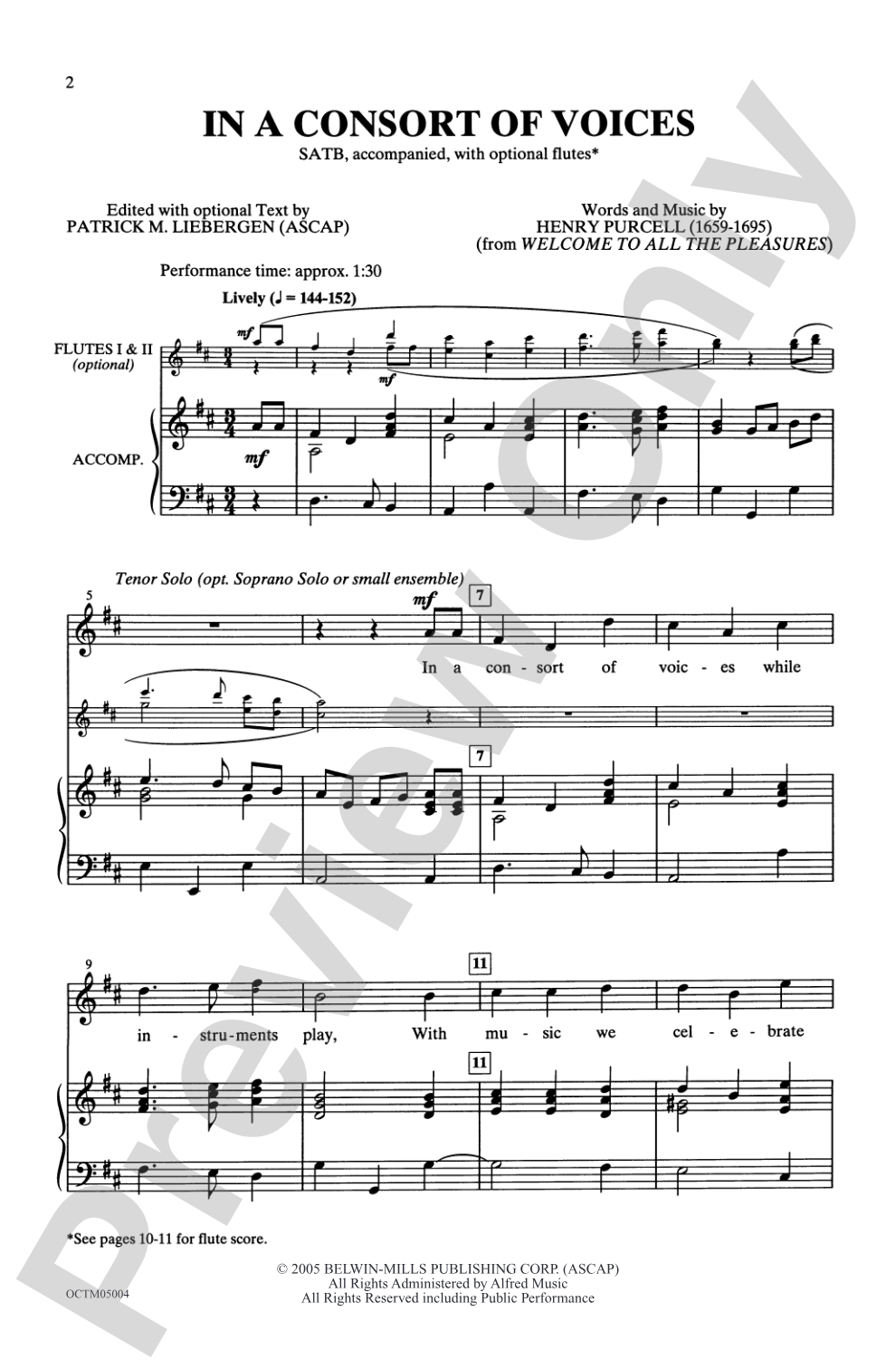
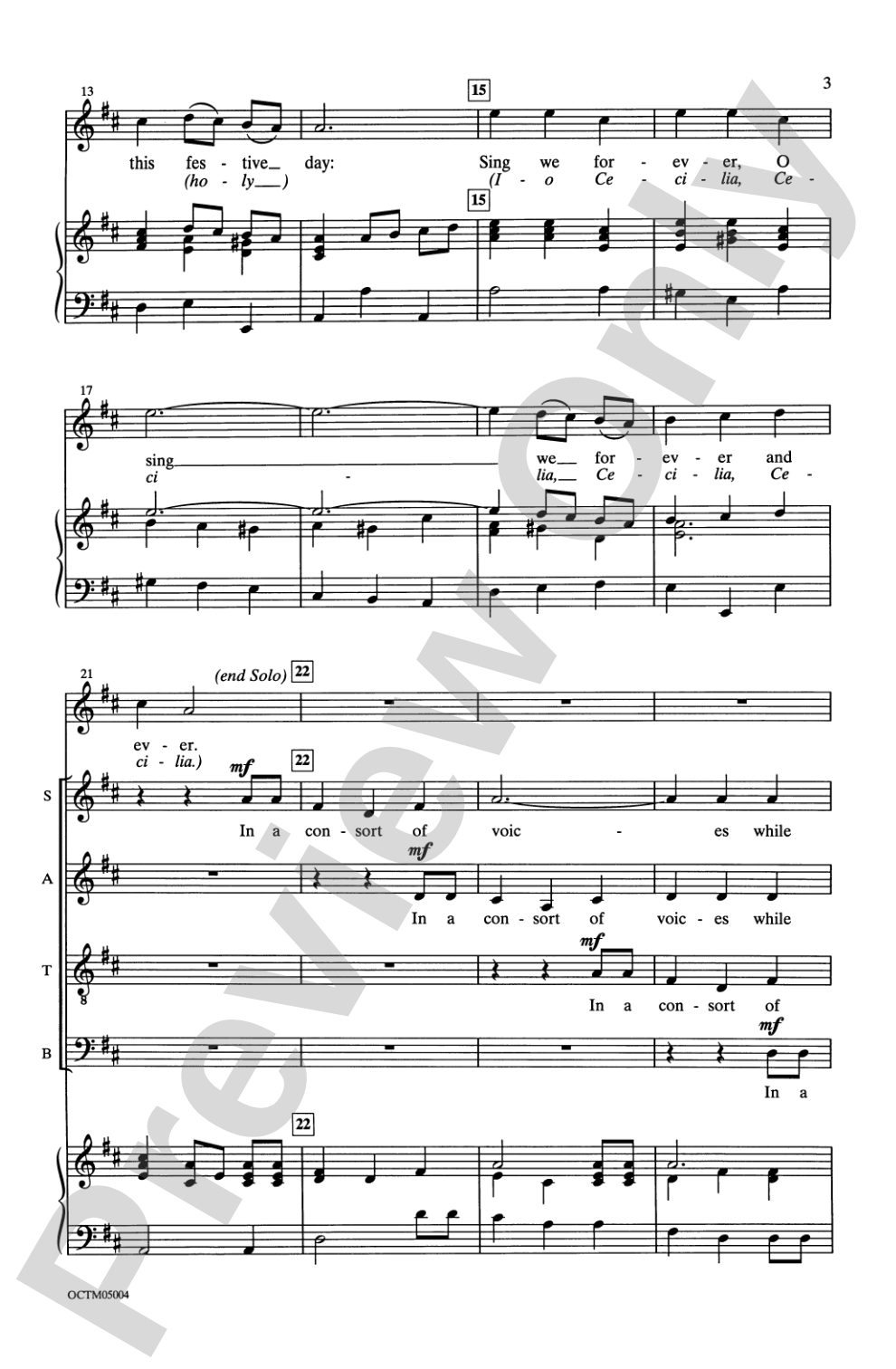

In a Consort of Voices: SATB Choral Octavo
From Welcome to All the Pleasures
Words and music by Henry Purcell / ed. with opt. text by Patrick M. Liebergen
Level: Moderate
Item: 00-PO-0006797
$1.60
Minimum order quantity: 20 copies
Pickup currently not available
Related Items
In a Consort of Voices: SATB Choral Octavo |
$1.60
|
View |
Description
Patrick Liebergen has adapted this delightful short concert work from Henry Purcell's Welcome to all the Pleasures (Ode for St. Cecilia Day) written in 1683. The opening section may be performed as a tenor solo or as a small ensemble. Add the two flutes and you get a wonderful addition to your next concert.


In a Consort of Voices: SATB Choral Octavo isn't in MakeMusic Cloud just yet...but it could be. Let us know you'd like to see it, and you'll help shape what comes next. In the meantime, start a free trial and dive into thousands of interactive titles your students can play along with today.
Request This Title
Tell us you want it.
Start Your Free Trial
Explore everything that's ready to play right now.
Sample Audio
1
Audio File
--:--
0:00
0:00
Sample Video
No sample videos found.
Additional Details
Series:
Belwin Festival Series
Publisher:
Alfred Music
Page Count:
12
SKU:
00-PO-0006797
Instrumentation:
Opt. Flute
More about this title
About the Composer: Henry Purcell
Henry Purcell (1659-1695) stands as England's greatest Baroque composer and a towering figure in the history of English music. He served as organist at Westminster Abbey and composed prolifically across genres: sacred music, dramatic works, secular songs, and instrumental pieces. His output, though curtailed by his early death at thirty-six, established a distinctly English musical voice that synthesized continental Baroque techniques with native musical traditions.
Purcell's Welcome to all the Pleasures, written for the inaugural meeting of the Musical Society in 1683, exemplifies his gift for blending ceremonial grandeur with genuine melodic warmth. The piece celebrates St. Cecilia (patron saint of music) and showcases the brilliant vocal writing and structural clarity that define his best work.
Why we love this
Patrick Liebergen's arrangement makes a cornerstone of English Baroque repertoire genuinely accessible to intermediate choirs without diminishing Purcell's musical sophistication. The optional opening solo or small ensemble section gives you flexibility in how you showcase the work, and the flute parts add textural richness that lifts a concert program.
What to expect
Sunlight pouring through stained glass: formal and luminous, yet warm. Purcell's melodies have an almost hymn-like directness paired with harmonic sophistication that keeps the ear engaged. There's genuine joy in the writing, a celebration of music itself expressed through elegant vocal lines and transparent counterpoint.
Who it's for
Intermediate choirs (high school, community, collegiate) ready to tackle Baroque masterworks with confidence. The moderate difficulty and twelve-page length make it manageable for groups building their early music literacy without requiring advanced expertise.
How to get the most out of it
- Shape the opening melodic line with clear phrase breathing, whether sung by a soloist or small ensemble; Purcell's style rewards singing through the text rather than fragmenting it.
- Balance the SATB sections so that inner voices (alto and tenor) carry their independent lines with clarity, not as harmonic filler.
- If you add the flutes, give them equal weight in rehearsal; they're not mere decoration but integral to the textural design.
- Approach the Baroque style with articulation that's precise but not stiff; this work sits between ceremonial and intimate, so let that duality breathe in your interpretation.
How to use it
This works beautifully as the centerpiece of a Baroque or early music concert, or as an elegant transition piece between heavier contemporary works and lighter secular fare. Consider pairing it with other Baroque choral works to build a thematic set, or use it as a concert opener that establishes musical authority and refinement.
Skills your students will build
- Singing Baroque style with period-appropriate phrasing and articulation
- Balancing independent lines in four-part writing
- Interpreting text underlay and word painting in seventeenth-century English
- Coordinating with optional instrumental parts (flutes) in a mixed ensemble