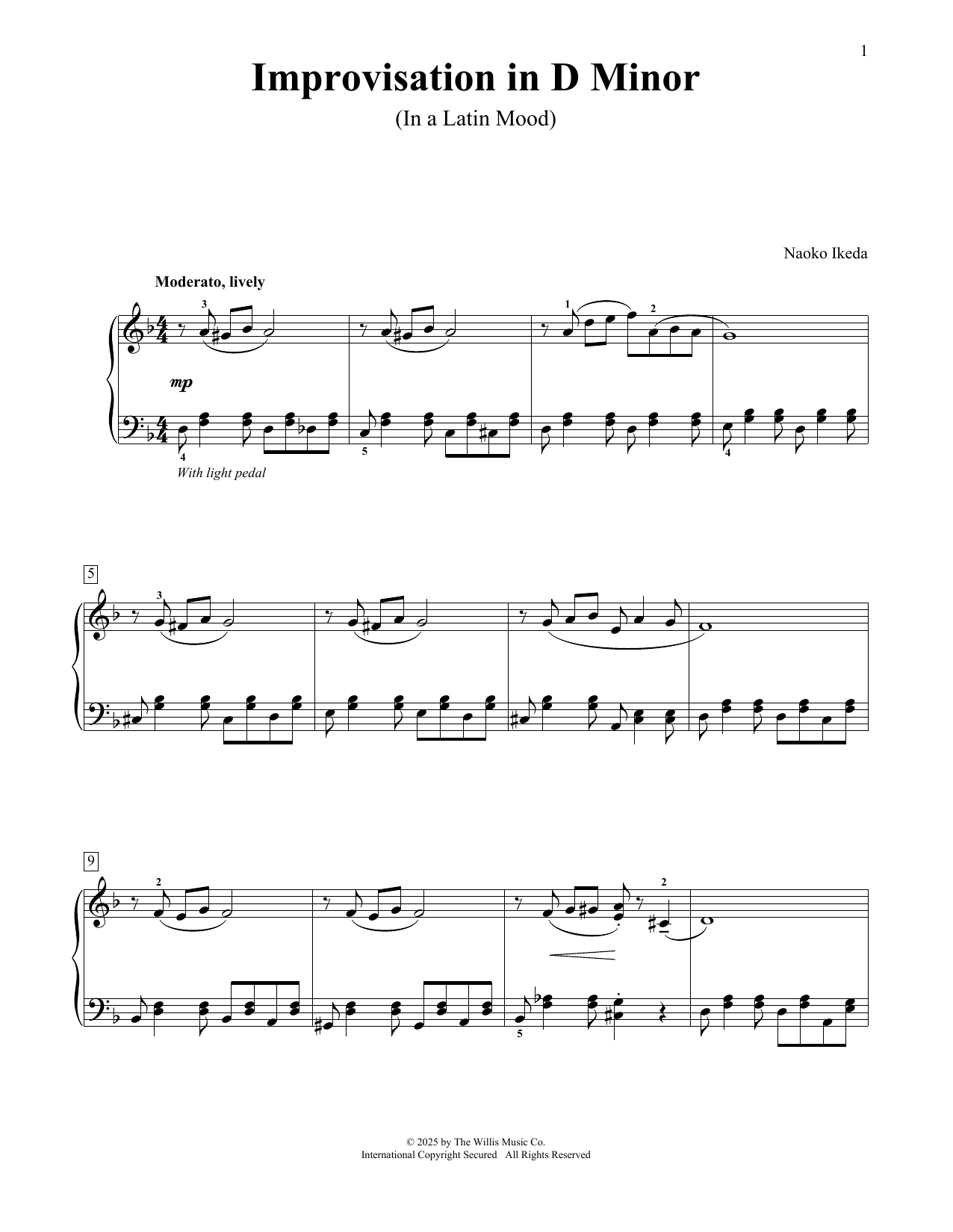
Naoko Ikeda is a contemporary composer whose work spans educational and concert settings. Her writing combines accessibility with genuine musical substance, creating pieces that teach while they engage.
Why we love this
Ikeda writes improvisation studies that actually sound musical rather than formulaic. Students spend their practice time on real musicianship—phrasing, harmonic awareness, textural variety—not generic exercise patterns. The D minor tonality gives the piece an introspective warmth that holds attention across three pages.
What to expect
Introspective and searching, with moments of gentle discovery. The D minor context creates a contemplative mood that invites the pianist to linger, explore small musical gestures, and listen carefully to harmonic color rather than chase tempo.
Who it's for
Intermediate pianists ready to explore written improvisation as a bridge toward free improvising. This works equally well for students building confidence in D minor or for those beginning to understand how composers generate longer musical ideas from harmonic frameworks.
How to get the most out of it
Experiment with touch and dynamics within the improvisational sections to find where your voice emerges most clearly.
Map out the harmonic anchors before you play, then decide which moments invite rubato and which demand rhythmic stability.
Listen for balance between melodic gestures and the underlying harmonic motion; let neither overwhelm the other.
How to use it
Position this in a student recital as a showcase for interpretive thinking, or use it in lessons as an entry point for discussions about form, harmony, and personal voice. It pairs naturally with other contemporary works that value restraint and harmonic awareness.
Skills your students will build
Harmonic awareness and voice leading in a single key center
Phrasing and interpretation within a partially notated framework
Color and texture development using varied accompaniment figures
Listening and responding to one's own musical choices in real time
You May Also Like
Scan to Complete Your Purchase
Use your phone's camera to scan the code below
You'll log in on your phone and the order will be added to your account