
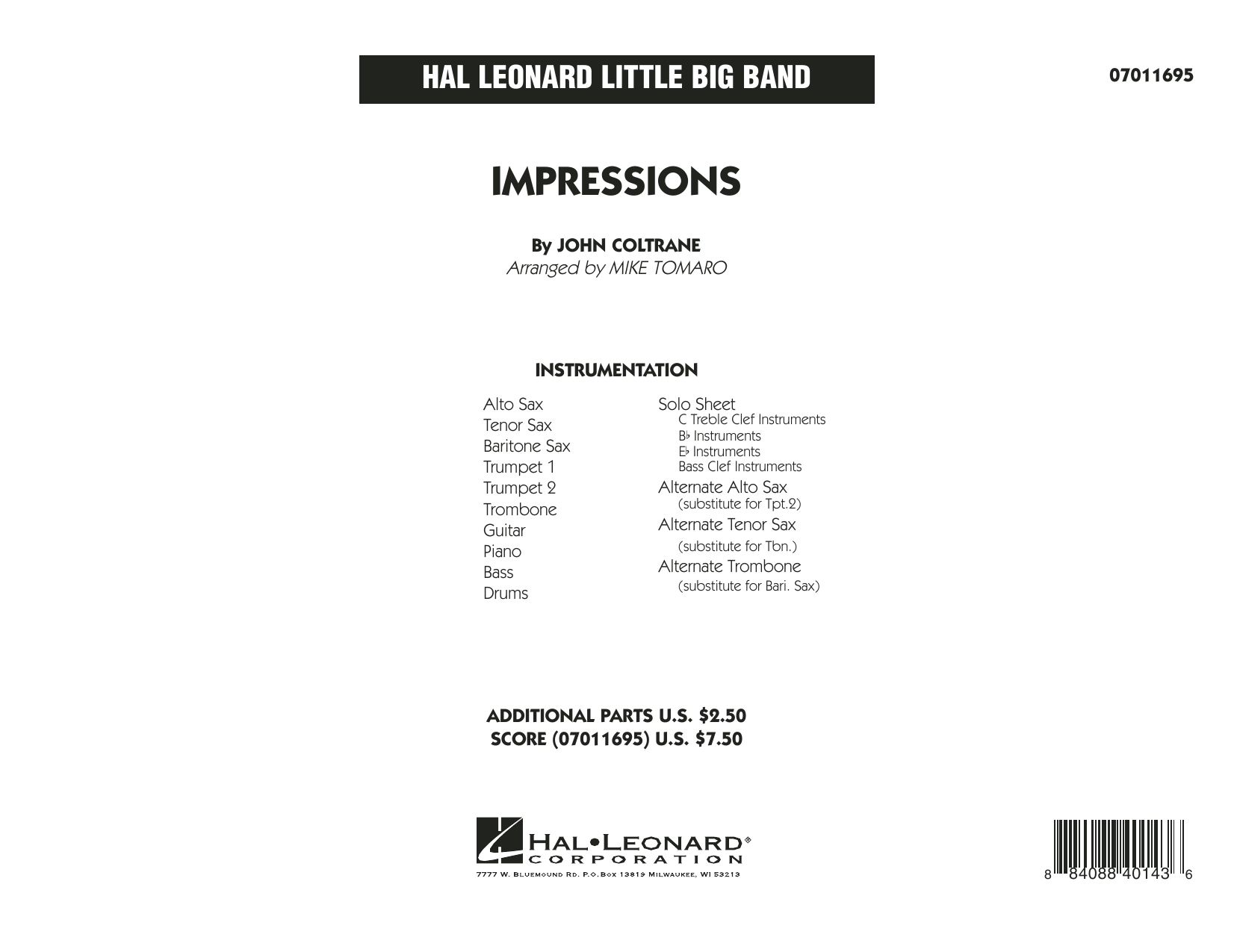

Impressions (arr. Mike Tomaro): Jazz Ensemble Conductor Score & Parts
By John Coltrane / Arranged by Mike Tomaro
Grade: 4
Item: 35-PK01215475
$45.00
Pickup currently not available
Buy Extra Parts (Digital PDF Download)
Parts Added to Cart!
Description
With its modal chord structure, this Coltrane classic is a great solo vehicle within the small band setting.


Impressions (arr. Mike Tomaro): Jazz Ensemble Conductor Score & Parts isn't in MakeMusic Cloud just yet...but it could be. Let us know you'd like to see it, and you'll help shape what comes next. In the meantime, start a free trial and dive into thousands of interactive titles your students can play along with today.
Request This Title
Tell us you want it.
Start Your Free Trial
Explore everything that's ready to play right now.
Sample Audio
No sample audio found.
Sample Video
No sample videos found.
Additional Details
Publisher:
Hal Leonard
SKU:
35-PK01215475
More about this title
About the Composer: John Coltrane
John Coltrane revolutionized jazz saxophone through his relentless harmonic exploration and spiritual intensity. His late 1960s compositions, including Impressions, emerged from his deep investigation of modal jazz and Eastern musical philosophy, expanding what was possible within small group improvisation.
Coltrane's influence on jazz education remains profound. His compositions reward repeated listening and study, offering soloists genuine harmonic complexity while remaining accessible to developing ensembles.
Why we love this
Tomaro's arrangement opens the modal harmonies without oversimplifying them, letting your soloists explore the changes authentically. The Grade 4 scoring keeps rhythmic sections engaged and driving while spotlighting whoever steps forward on melody, which makes it equally valuable as a concert feature or a teaching tool for understanding modal improvisation.
What to expect
Impressions floats in a cool, introspective space where the chord movement feels both simple and infinite. The modal sound gives room to breathe, encouraging soloists to paint with longer lines and broader gestures rather than rapid note clusters.
Who it's for
Jazz ensembles at the intermediate level who want a standard that teaches real harmonic language and opens door for genuine improvisation. This works equally well for programs emphasizing small combo work, combos extracting material from a full ensemble arrangement, or directors seeking repertoire that challenges students to listen and respond to one another.
How to get the most out of it
- Lock the groove first. The rhythm section needs unwavering pocket before soloists enter; the modal structure demands a steady, hypnotic foundation beneath the changes.
- Allow space for the soloist to breathe and develop ideas across chorus lengths rather than rushing through the form. Coltrane's original conception rewards patient exploration.
- Balance the comping voices so they support without cluttering; the chord movement is the anchor, not the accompaniment texture.
- Dial in the tempo intentionally. Too fast and you lose the meditative quality; too slow and the band loses momentum.
How to use it
Feature this mid-set to showcase your strongest improvisor and give audiences a moment of genuine listening. Its moderate tempo and meditative character provides natural programming contrast to higher-energy arrangements, and it works beautifully as the anchor piece in a jazz education concert focused on standards and compositional technique.
Skills your students will build
- Improvising over modal chord changes
- Comping approaches that support rather than compete with soloists
- Listening and responding in real time to harmonic movement
- Sustaining groove over longer harmonic cycles
- Recognizing and performing a jazz standard within a small group context