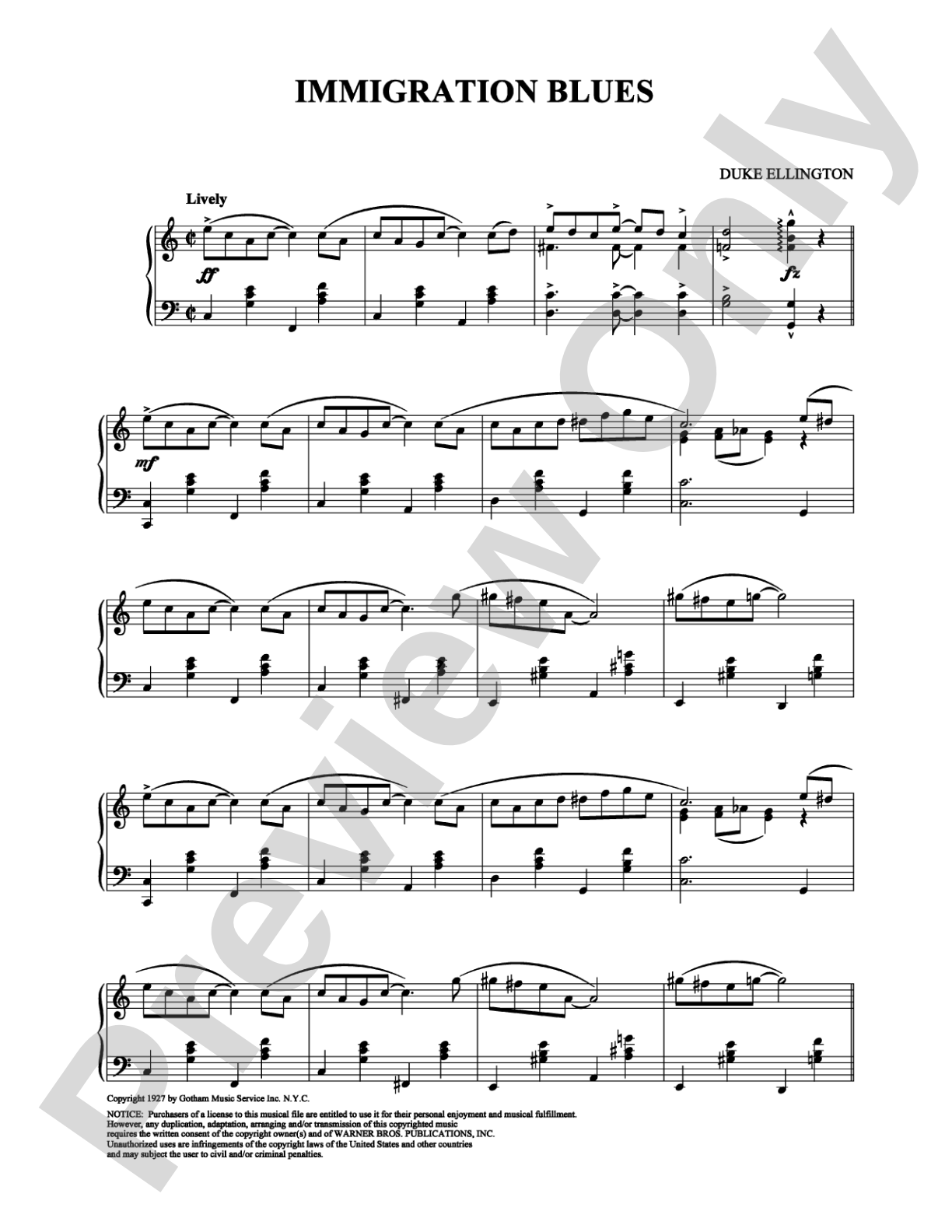
Immigration Blues: Piano Digital Sheet Music

Immigration Blues: Piano Digital Sheet Music

Duke Ellington

Item: 00-PS-0008196

Digital Download
$3.99
Description

Immigration Blues: Piano Digital Sheet Music isn't in MakeMusic Cloud just yet...but it could be. Let us know you'd like to see it, and you'll help shape what comes next. In the meantime, start a free trial and dive into thousands of interactive titles your students can play along with today.

Sample Audio
No sample audio found.
Sample Video
Additional Details
SKU: 00-PS-0008196

More about this title

About the Artist: Duke Ellington

Duke Ellington (1899-1974) stands as one of the most prolific and influential composers in American music history. His output spanned six decades and encompassed jazz standards, extended concert works, film scores, and sacred music, each bearing his unmistakable harmonic sophistication and orchestral sensibility.

Ellington's approach to composition went beyond typical jazz practice; he treated the ensemble itself as an instrument, writing idiomatically for individual musicians and exploring dissonance and chromaticism years ahead of his contemporaries. His music remains central to jazz education because it demonstrates how advanced harmonic thinking, blues tradition, and popular appeal can coexist.

Why we love this

Ellington's blues compositions reveal the harmonic depth beneath what often sounds deceptively simple on the surface. A piece like this gives pianists a chance to explore how blues changes can be reharmonized and inflected in ways that feel both sophisticated and deeply rooted in tradition.

What to expect

The blues meets urbane sophistication. There's a contemplative quality beneath the title's reference to social experience, with Ellington's characteristically rich chord substitutions adding complexity to a form that can seem straightforward on paper. The piece balances introspection with the swing-era confidence that defined his best work.

Who it's for

Jazz pianists building facility with sophisticated blues harmony and those studying Ellington's compositional voice will find this essential. Teachers introducing blues reharmonization concepts benefit from having an Ellington piece in their students' hands.

How to get the most out of it

  • Pay attention to the relationship between melody and harmony; Ellington rarely treats the right hand as separate from the harmonic movement. Let the voicings inform your phrasing rather than playing through them.
  • Approach dynamics and touch with restraint until you understand the blues changes fully. The beauty of this piece lives in economy, not display.
  • Listen to Ellington's recorded versions to absorb his rhythmic approach to phrasing and his use of space. Jazz notation captures only part of what makes the music live.

How to use it

This works well in a jazz recital showcasing different composers' approaches to the blues form, or as a standalone study piece for pianists preparing to tackle Ellington's larger catalog. It also serves instructors teaching jazz history or composition through analysis of recorded performances.

Skills your students will build

  • Reharmonizing blues progressions with seventh chords and chromatic substitutions
  • Balancing written notation with idiomatic jazz interpretation
  • Understanding Ellington's use of dissonance and voice leading within a traditional form
  • Developing touch and control for jazz ballad playing

You May Also Like