Im Tirtzu Sheet Music Preview

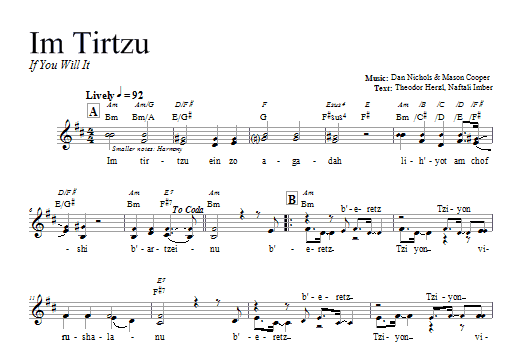
Im Tirtzu: Lead Sheet / Fake Book

As performed by Dan Nichols

Item: 35-DS00090888

Digital Download
$3.99
Description

Im Tirtzu: Lead Sheet / Fake Book isn't in MakeMusic Cloud just yet...but it could be. Let us know you'd like to see it, and you'll help shape what comes next. In the meantime, start a free trial and dive into thousands of interactive titles your students can play along with today.

Sample Audio
No sample audio found.
Sample Video
Additional Details
Publisher: Hal Leonard
Page Count: 1
SKU: 35-DS00090888

More about this title

About the Artist: Dan Nichols

Dan Nichols is a composer and arranger whose work spans Jewish liturgical music, contemporary worship, and educational repertoire. His arrangements often balance accessibility with musical substance, making traditional material approachable for diverse performers and ensembles.

Why we love this

This lead sheet captures a text with deep cultural resonance in a format that invites instrumental and vocal musicians to collaborate naturally. The single-page layout keeps focus on melody and harmony without unnecessary complexity, letting performers bring their own musicality to a song that rewards straightforward, heartfelt interpretation.

What to expect

There is clarity and purpose in this melody, reflecting the strength of its text. The harmonic framework supports rather than overshadows the vocalist, creating space for emotional communication and connection with the audience.

Who it's for

Pianists and keyboardists accompanying soloists or small ensembles in liturgical, educational, or concert settings will find this lead sheet practical and immediate. It works equally well for music students learning to navigate lead sheets and for experienced musicians seeking accessible traditional material to add to a program.

How to get the most out of it

  • Shape the melody with intentional phrasing rather than playing it straight through; this text often benefits from space and reflection between phrases.
  • Treat the chord changes as guides for harmonic color rather than strict rhythmic markers; flexibility in accompaniment style will enhance the song's expressiveness.
  • Consider the range of your vocalist carefully and adjust the key if needed to ensure the melody sits comfortably while maintaining the song's essential character.

How to use it

Pair this with other Jewish liturgical or world music selections to build cultural programming depth, or use it as a bridge piece between more complex works in a mixed concert. It also serves well in educational settings where students are learning to read and interpret lead sheet notation.

Skills your students will build

  • Reading and interpreting lead sheet notation
  • Comping with chord symbols and jazz voicings
  • Balancing accompaniment to support a vocalist
  • Maintaining harmonic clarity in minimal-note textures

You May Also Like