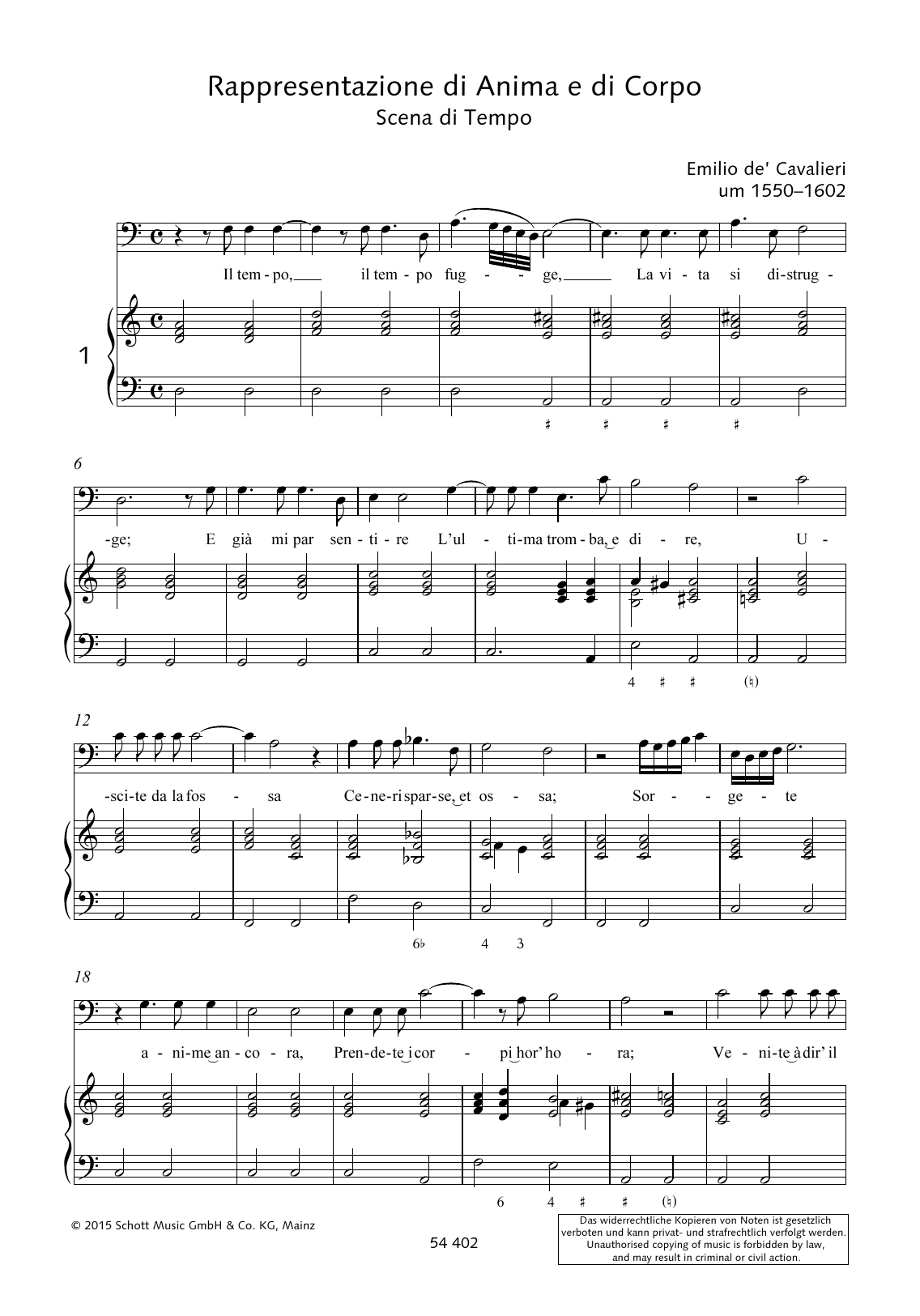
Il tempo fugge, La vita si distrugge Sheet Music Preview

Il tempo fugge, La vita si distrugge: Piano Vocal

By Emilio de Cavalieri / Edited by Claudia Eder / Edited by Wolfgang Birtel

Item: 35-DS00371525

Digital Download
$4.99
Description

Il tempo fugge, La vita si distrugge: Piano Vocal isn't in MakeMusic Cloud just yet...but it could be. Let us know you'd like to see it, and you'll help shape what comes next. In the meantime, start a free trial and dive into thousands of interactive titles your students can play along with today.

Sample Audio
No sample audio found.
Sample Video
Additional Details
Publisher: Hal Leonard
Page Count: 3
SKU: 35-DS00371525

More about this title

About the Composer: Emilio de Cavalieri

Emilio de Cavalieri (c. 1540-1602) was a Roman composer and organist who bridged the Renaissance and early Baroque periods. He worked in the Medici court in Florence and later served the papacy in Rome, where he composed sacred music, madrigals, and dramatic works that anticipated the development of opera.

De Cavalieri's sacred vocal music often blends intricate counterpoint with expressive text painting, reflecting the transitional compositional language of his era. His works remain valuable for singers exploring the intersection of Renaissance polyphony and Baroque emotional directness.

Why we love this

This brief but profound meditation on mortality carries genuine spiritual weight without resorting to sentimentality. The text sets up a contemplative mood that rewards careful phrase shaping and text clarity, making it an excellent teaching piece for singers learning how to make liturgical Latin resonate with modern audiences.

What to expect

Quiet, meditative, and tinged with melancholy. The harmonic language carries a gentle solemnity that unfolds without haste. There's an underlying acceptance in the text and music, a recognition of life's brevity that feels honest rather than sorrowful.

Who it's for

This piece suits solo singers with some vocal maturity and text diction skills, particularly those exploring sacred repertoire from the Renaissance-Baroque transition. Pianists need comfort with figured bass interpretation and early music keyboard textures. It works well for recitalists building programs around themes of mortality, spirituality, or Italian Renaissance vocal music.

How to get the most out of it

  • Approach the opening phrases with restraint; the emotional power emerges from clarity of line rather than dramatic volume.
  • Shape longer note values as gentle arcs rather than holding them flat; this maintains forward motion through the text.
  • Balance the voice and piano so that accompaniment supports without overwhelming the vocal line's intimacy.
  • Allow slight breathing space between phrases to emphasize the contemplative text without disrupting the flow.

How to use it

Pair this with other early Italian sacred works for a focused recital program, or use it as a contrasting anchor in a broader vocal recital that spans centuries. It also fits well in liturgical or devotional concert settings. Given its brief duration, it serves as an ideal palate cleanser between larger works.

Skills your students will build

  • Latin diction and clear vowel formation in sustained phrases
  • Historical text interpretation and emotional restraint
  • Baroque keyboard accompaniment idioms and figured bass realization
  • Phrasing across longer melodic arcs without modern rubato
  • Balance between vocal projection and intimate ensemble sound

You May Also Like