
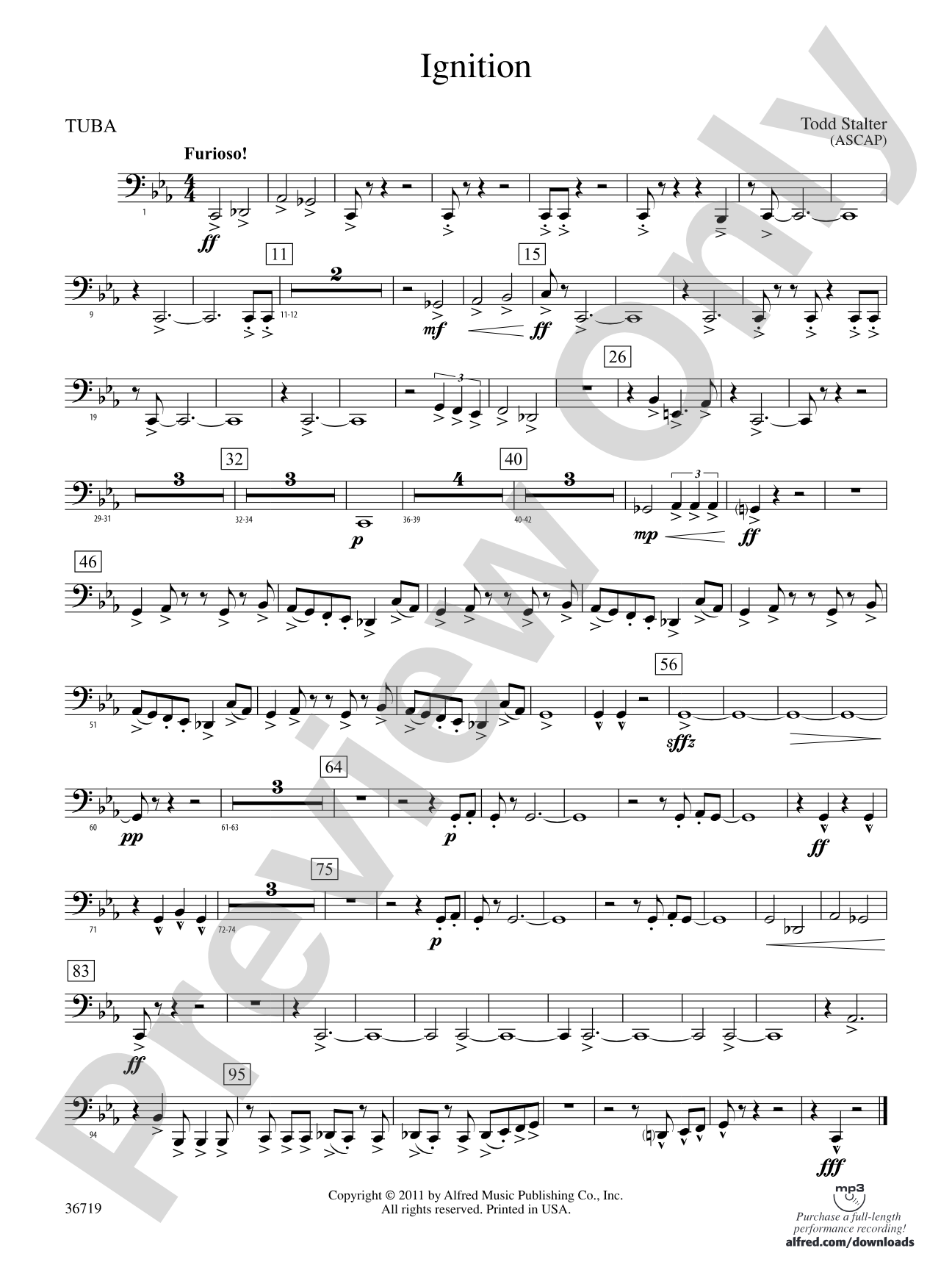

Ignition: Tuba
By Todd Stalter
Grade: 4 (Medium Difficult)
Item: 00-PC-0015147_TB1
$3.00
Pickup currently not available
Description
"Ignition" is a blindingly fast, raucously energetic concert opener that derives its title from the consecutive rising three-note cells that are the building blocks for almost the entire work. However, the energy unleashed in the music and the imagery of the title serve both as a metaphor for the "spark" of creativity, and as a "celebration in sound" for those who find and follow their own true life's passion and pass it along to others, "igniting" the flame for another generation. It was written for the Atlanta Youth Wind Symphony and their conductor, Scott Stewart, who have been steadfast supporters of Todd Stalter's compositions, as a musical "Thank you!" from a grateful composer. This title is available in MakeMusic Cloud.


Don't just read it, hear it, play along with it, and watch your students grow with it. In MakeMusic Cloud, Ignition: Tuba comes alive with professional accompaniment, adjustable tempo, and built-in practice tools that turn solo practice into real progress.
Open in the Player
Jump straight in and assign it today.
Start Your Free Trial
Open this title and explore the full library in minutes.
Sample Audio
1
Audio File
--:--
0:00
0:00
Sample Video
Additional Details
Series:
Alfred Concert Band
Publisher:
Alfred Music
Page Count:
224
SKU:
00-PC-0015147_TB1
More about this title
About the Composer: Todd Stalter

Todd Stalter built his reputation over 34 years as Director of Bands at Eureka High School in Illinois, where his ensembles consistently earned Superior ratings at state contests and won 16 Class 1A state marching championships. His bands performed at Orchestra Hall in Chicago and Walt Disney World, and he was inducted into the Illinois State Marching Band Championships Hall of Fame. Beyond the high school podium, Stalter has guest-conducted All-State Bands in Georgia and Delaware, adjudicated extensively across the Midwest, and presented clinics on composition and music education at conferences throughout the region.
Stalter's compositional voice has reached concert stages worldwide, with works appearing on state festival lists and in the respected Teaching Music Through Performance in Band series published by GIA. He holds degrees from Illinois State University, where he studied trumpet performance and conducting, and maintains an active schedule as both a clinician and composer for band and string orchestra.
Why we love this
Stalter has crafted a piece that works as a concert opener precisely because it moves with infectious momentum while remaining pedagogically sound at Grade 4. The three-note rising cell construction gives students a tangible compositional device to hear and understand, turning what could be a pure energy fest into a lesson in motivic development. A conductor familiar with Stalter's work knows his pieces reward careful rehearsal with musical payoff that feels entirely earned.
What to expect
Ignition crackles with the kind of unbridled enthusiasm that makes an audience sit up and pay attention from the downbeat. The rising three-note cells feel like sparks igniting in sequence, building into a celebration of sound that's both raucous and meticulously crafted. There's genuine joy in the orchestration and momentum, with moments of clarity that prevent the energy from becoming chaotic.
Who it's for
Concert bands at the Grade 4 level looking for a high-impact opener with substance behind the energy. Directors who want their students to experience real compositional craft while delivering an audience-pleasing performance.
How to get the most out of it
- Nail the articulation consistency in the rising three-note cells early in rehearsal; once that rhythmic gesture locks in, the forward momentum builds naturally and requires far less effort to maintain.
- Balance the tutti sections by checking that harmonic doublings aren't weighted too heavily toward any single section; the blindingly fast character depends on clarity and separation, not density.
- Keep tempo steady through the piece; resist the urge to accelerate during the most energetic passages, which can muddy detail in the upper voices.
- Use the conductor score to identify where thematic material passes between sections, and highlight those moments for your students so they understand how the piece breathes and shifts color.
How to use it
Open a winter concert or spring festival performance with this piece to immediately establish energy and engagement. It pairs well with lyrical or contemplative works that follow, creating strong contrast on a program. The piece also works as a confident selection for contest or festival play, where its technical demands and musical substance will impress while its accessibility keeps rehearsal time proportionate.
Skills your students will build
- Executing rapid articulation patterns with precision and consistency
- Reading and performing at a brisk tempo without sacrificing rhythmic clarity
- Identifying and tracking motivic material across multiple instrumental sections
- Balancing ensemble texture in dense, fast-moving passages
- Responding to dynamic and color changes within high-energy music