
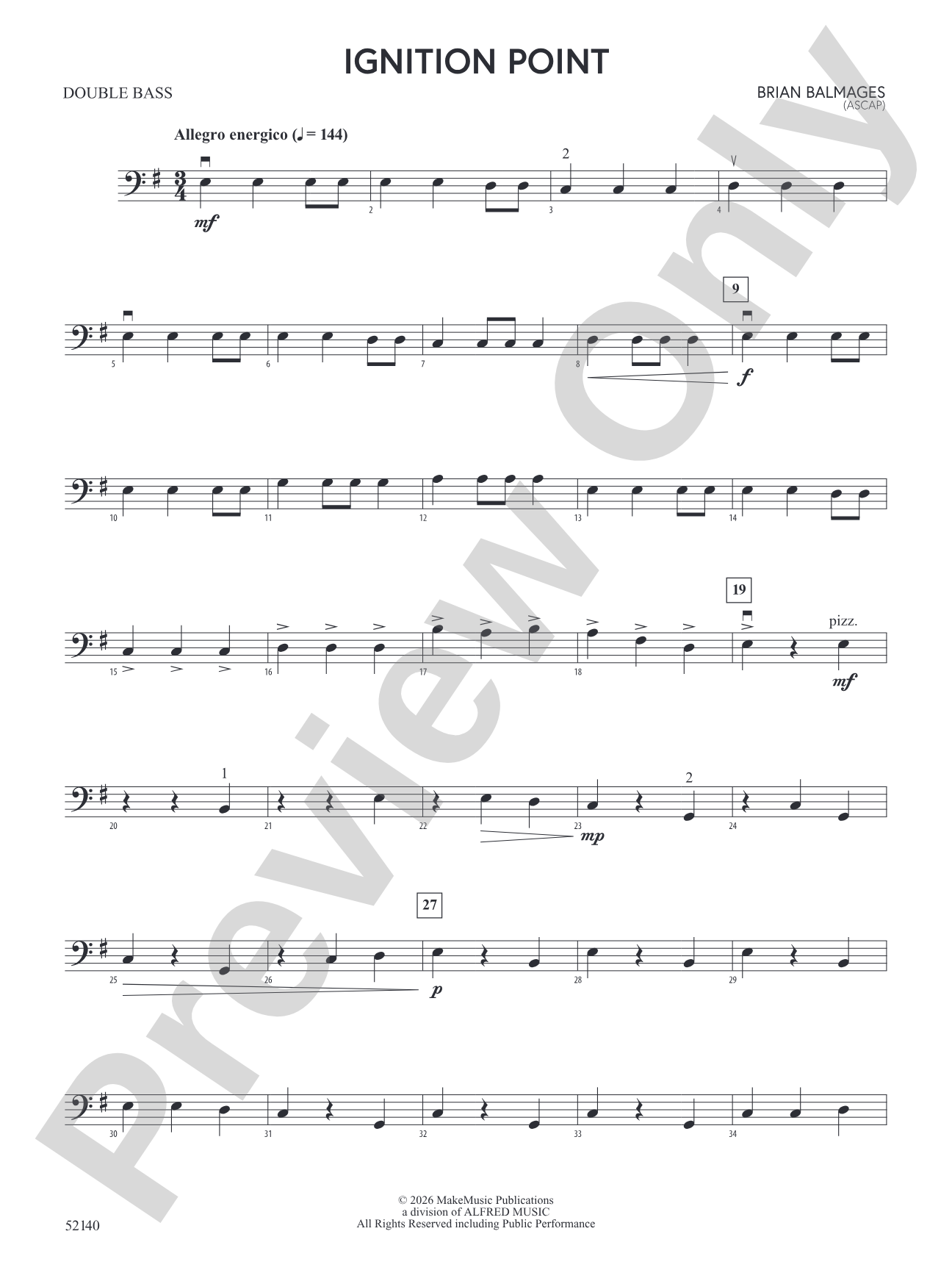

Ignition Point: String Bass
By Brian Balmages
Grade: 1.5
Item: 00-PC-0019854_SB
$3.00
Pickup currently not available
Description
Feel the tension as a powerful force reaches its peak in this high-velocity string work by Brian Balmages! Clever rhythmic interplay and contemporary harmonies keep the audience on edge, yet the music is very accessible to student musicians. Ignition Point is a perfect piece to expand your ensemble's tonal palate. (1:30)


Don't just read it, hear it, play along with it, and watch your students grow with it. In MakeMusic Cloud, Ignition Point: String Bass comes alive with professional accompaniment, adjustable tempo, and built-in practice tools that turn solo practice into real progress.
Open in the Player
Jump straight in and assign it today.
Start Your Free Trial
Open this title and explore the full library in minutes.
Sample Audio
1
Audio File
--:--
0:00
0:00
Sample Video
Additional Details
Series:
MakeMusic Developing Strings
Publisher:
MakeMusic Publications
SKU:
00-PC-0019854_SB
More about this title
About the Composer: Brian Balmages

Brian Balmages has established himself as a composer and conductor whose work crosses orchestral, band, and chamber music with equal fluency. His compositions have reached audiences worldwide, from professional symphony orchestras to school ensembles, performed at venues including Carnegie Hall, the Kennedy Center, and the Sydney Opera House. He holds the A. Austin Harding Award from the American School Band Directors Association, won the 2020 NBA William D. Revelli Composition Contest for Love and Light, and serves as an elected member of the American Bandmasters Association.
Balmages received the inaugural James Madison University Distinguished Alumni Award and was commissioned by the University of Miami to compose music for the inauguration of its 6th president. His work has been performed at the Presidential Inaugural Prayer Service and appears regularly on all-state and festival programs. He currently directs MakeMusic Publications and Digital Education for Alfred and MakeMusic.
Why we love this
Balmages understands exactly how to write for developing string players without sacrificing musical sophistication. The rhythmic complexity and contemporary harmonic language keep your ensemble engaged and your audience invested, while the accessible range and straightforward technical demands mean students can focus on ensemble balance, phrasing, and building genuine musicianship rather than fighting the notes.
What to expect
Ignition Point captures the mounting pressure of something about to break loose. Clever rhythmic layering and angular harmonies create forward momentum and electric tension, yet the writing remains transparent enough that young musicians can hear their individual contributions. The piece has an urgency that keeps listeners leaning in.
Who it's for
String orchestras at the early intermediate level who are ready to engage with contemporary compositional techniques without needing advanced virtuosity. This piece works beautifully for ensembles preparing for festival or contest performance and for directors seeking to broaden their students' exposure to modern harmonic language.
How to get the most out of it
- Subdivide the contemporary rhythmic patterns in sectionals before pulling the ensemble together; having violins and violas lock in their interplay first prevents the piece from losing its propulsive energy.
- Shape the dynamics with intention throughout the rising tension. Avoid the trap of playing too loud too early; let the accumulation of rhythmic layers do the work of building intensity.
- Balance the fuller passages by keeping the cello line singing clearly through the accompaniment texture; this anchors the harmonies and prevents muddiness.
- Emphasize the articulation markings as written. The staccato figures define much of the contemporary character and drive the piece forward.
How to use it
Schedule this as a concert opener or mid-set energy boost where it will shake audiences out of passive listening and signal that your ensemble is capable of contemporary repertoire. It pairs well with traditional string literature on the same program, creating effective contrast while the 1:30 length makes it ideal for festival rotation.
Skills your students will build
- Rhythmic independence while maintaining ensemble cohesion
- Reading contemporary harmonic language and pitch systems
- Dynamic control and shaping over extended musical phrases
- Balancing rhythmic clarity with lyrical tone production
- Responding to conductor cues in syncopated and layered textures