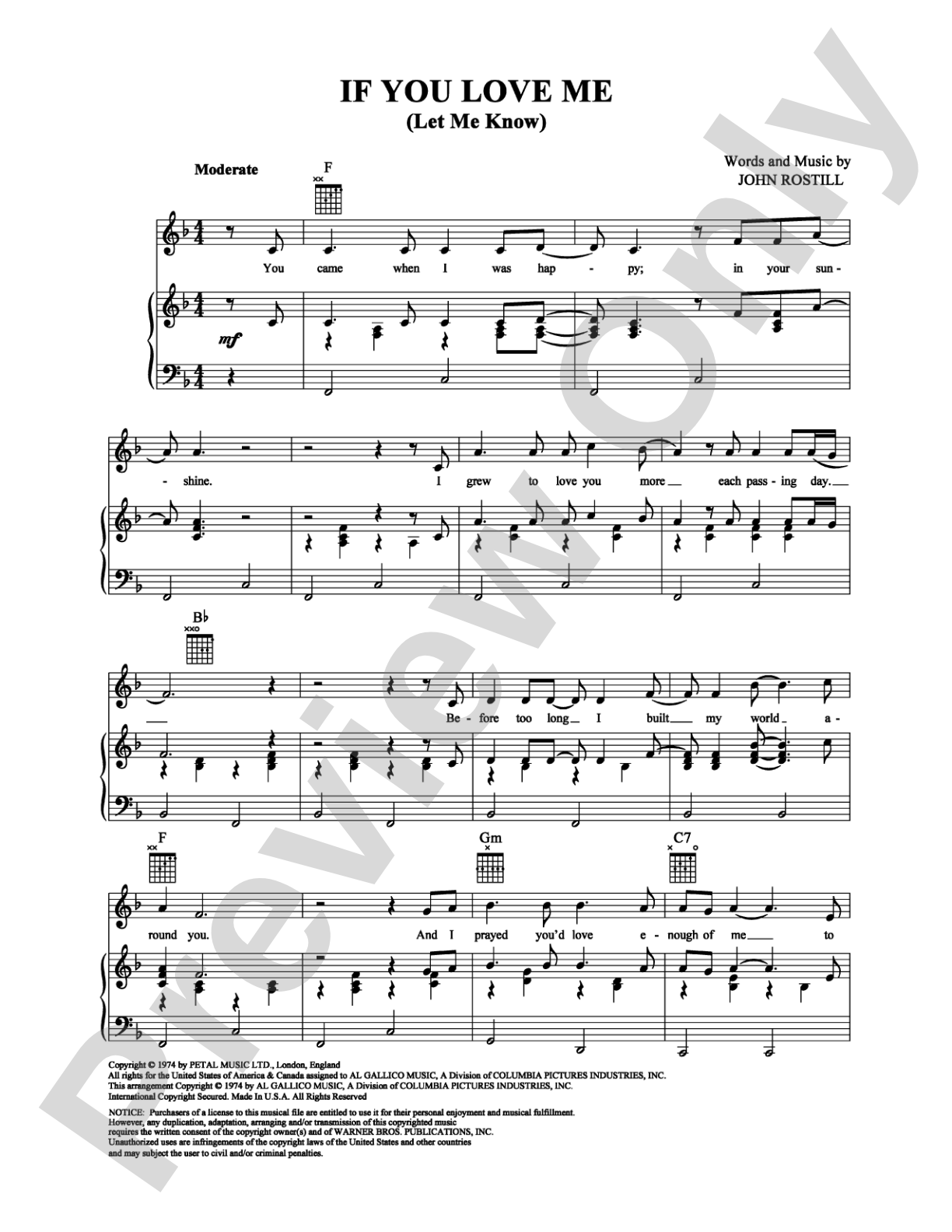
If You Love Me (Let Me Know): Piano/Vocal/Chords Digital Sheet Music

If You Love Me (Let Me Know): Piano/Vocal/Chords Digital Sheet Music

John Rostill, Olivia Newton-John

Item: 00-PS-0004376

Digital Download
$3.99
Description

If You Love Me (Let Me Know): Piano/Vocal/Chords Digital Sheet Music isn't in MakeMusic Cloud just yet...but it could be. Let us know you'd like to see it, and you'll help shape what comes next. In the meantime, start a free trial and dive into thousands of interactive titles your students can play along with today.

Sample Audio
No sample audio found.
Sample Video
Additional Details
SKU: 00-PS-0004376

More about this title

About the Artist: Olivia Newton-John

Olivia Newton-John rose to international prominence in the 1970s and 1980s as a vocalist, actor, and recording artist whose work spanned pop, rock, country, and musical theatre. Her chart success was extraordinary; she earned multiple Grammy Awards, American Music Awards, and platinum certifications across numerous albums. Beyond her recording career, she demonstrated serious musical versatility through her roles in film musicals and live performances, bringing technical vocal skill and emotional authenticity to every project she undertook.

Newton-John's artistry shaped pop music education and performance standards for generations of singers. Her ability to interpret a lyric with clarity and conviction, combined with her range and control, made her recordings natural reference points for vocal study. Teachers and students continue to draw on her recordings as models for phrasing, breath control, and stylistic interpretation in contemporary pop and rock contexts.

Why we love this

This Newton-John classic offers singers and pianist-vocalists an accessible entry point into sophisticated pop-rock arranging. The song's emotional directness and melodic strength make it rewarding to perform, while the harmonic language teaches voice leading and functional chord progressions in a contemporary pop idiom. Programming this piece signals your students are ready for repertoire that demands both vocal maturity and pianistic fluency.

What to expect

Warm and direct, with an emotional openness that feels both vulnerable and strong. The melody has a natural lyricism that invites singers to breathe and phrase expressively, while the harmonic support remains grounded and unpretentious. There's an understated sophistication here: nothing overwrought, just honest musical communication.

Who it's for

This piece suits intermediate to advanced pianists who sing, as well as vocalists working with a pianist collaborator. It works equally well in recital, studio recording, or as part of a pop or musical theatre repertoire survey. Students exploring contemporary songwriting craft and performers seeking material that bridges classical vocal technique with popular music sensibility will find this a natural fit.

How to get the most out of it

  • Balance the vocal line to sit naturally above the piano accompaniment; the lyrics should never compete with rhythmic or harmonic activity in the left hand.
  • Shape the melody with legit tone and clear vowels, avoiding an overly belted or stylized interpretation that will tire the voice.
  • Use the chord symbols as a guide for harmonic awareness, but let them serve the larger phrase shape rather than flattening the line into separate harmonic units.
  • Pay attention to the rhythmic precision of any syncopation in the accompaniment; lock the accompaniment pattern firmly so the vocal line can float naturally above it.

How to use it

Include this in a recital exploring 1970s-1980s singer-songwriter repertoire, pairing it with other pop or rock standards that showcase vocal artistry. It also serves well as a bridge piece in a musical theatre program, demonstrating how pop songwriting informs contemporary stage music. This is excellent material for a student recital showcasing contemporary vocal literature alongside art song or musical numbers.

Skills your students will build

  • Singing with clear diction and emotional connection in a contemporary pop idiom
  • Reading and interpreting chord symbols while maintaining phrase continuity
  • Balancing vocal line and accompaniment as a collaborative duo
  • Sustaining legit vocal tone across a full range without strain or stylistic compromise
  • Understanding functional harmony in pop and rock songwriting

You May Also Like