If Ye Love Me Sheet Music Preview

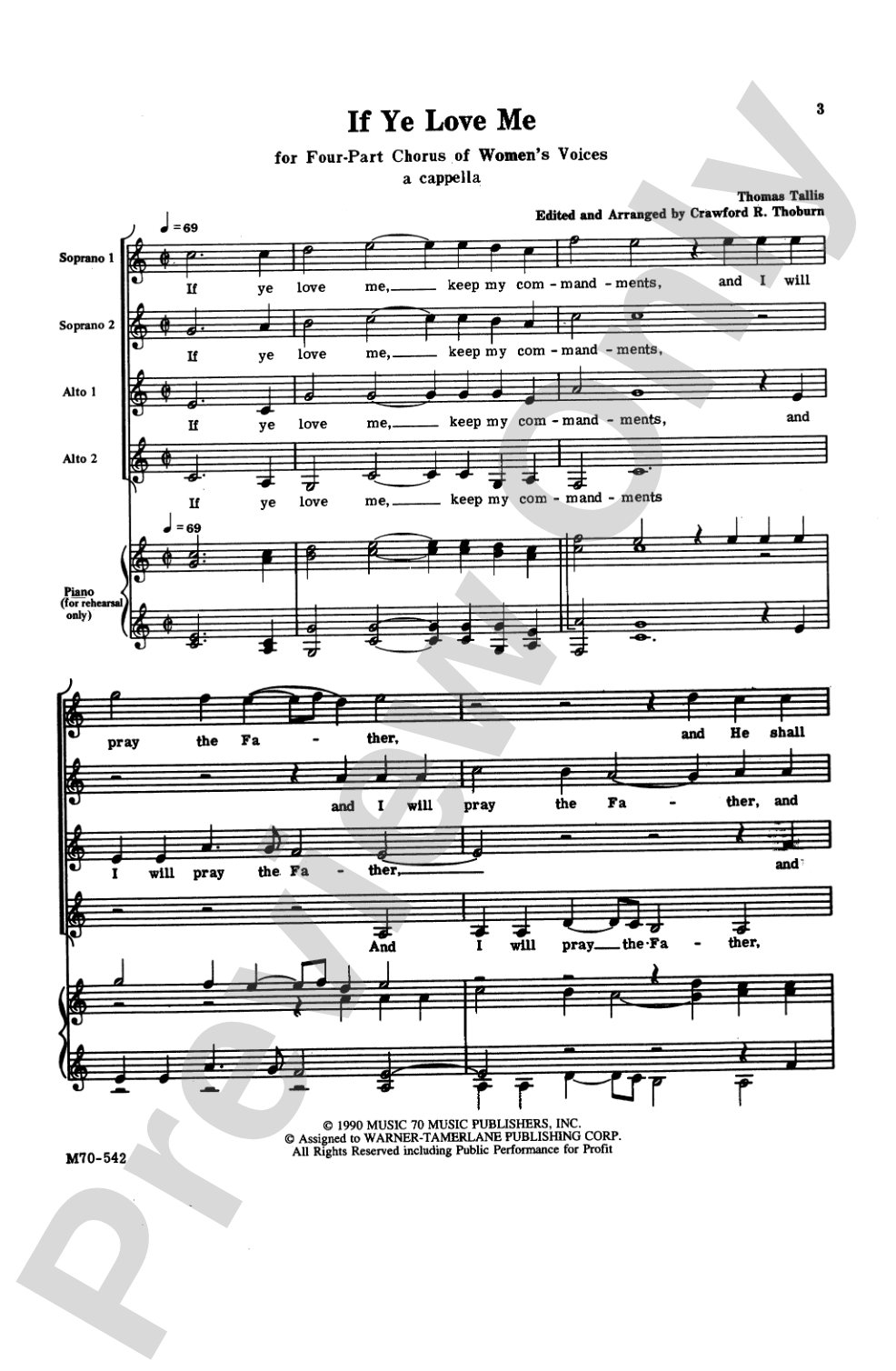
If Ye Love Me: SSAA Choral Octavo

By Thomas Tallis / arr. Crawford R. Thoburn

Item: 00-PO-0005122

Digital Download
$2.25

Minimum order quantity: 20 copies

Description

If Ye Love Me: SSAA Choral Octavo isn't in MakeMusic Cloud just yet...but it could be. Let us know you'd like to see it, and you'll help shape what comes next. In the meantime, start a free trial and dive into thousands of interactive titles your students can play along with today.

Sample Audio
No sample audio found.
Sample Video
Additional Details
Series: Alfred Archive Edition: Lawson-Gould Music Publishers
Publisher: Alfred Music
Page Count: 8
SKU: 00-PO-0005122

More about this title

About the Composer: Thomas Tallis

Thomas Tallis (c. 1505-1585) stands among the most important English composers of the Renaissance, having navigated the religious and political upheavals of Tudor England with both artistic integrity and practical survival instinct. His output spans sacred and secular genres, but his choral writing remains the cornerstone of his legacy, prized for its harmonic sophistication, structural clarity, and profound spiritual depth.

Tallis mastered the polyphonic idiom of his era while developing a distinctly English voice within it. His works were preserved and performed long after his death, making him one of the few Renaissance composers whose music achieved continuous transmission into the modern era. For choral directors, Tallis represents a gateway into Renaissance sacred music that is both accessible and intellectually rewarding.

Why we love this

Crawford Thoburn's arrangement opens Tallis to choirs that may not have the full four-part or eight-part resources the original demands. The SSAA voicing preserves the harmonic essence while remaining practical for many ensembles, and the eight-page format suggests a piece substantial enough to matter on a program without becoming unwieldy in preparation.

What to expect

The piece carries a serene, contemplative quality rooted in its liturgical origins. Harmonic movement unfolds gradually, creating moments of dissonance and resolution that feel inevitable rather than jarring. There's an intimacy in the four-part texture that invites listeners into a space of quiet reverence.

Who it's for

This arrangement fits choirs with solid reading skills and a commitment to ensemble blend. Directors working with treble-voiced ensembles (all women, youth choirs, or choirs with limited lower voices) will find this a direct path into Renaissance sacred repertoire without compromise to musical substance.

How to get the most out of it

  • Pay close attention to the text underlay, which will guide your phrasing around the natural speech rhythms and grammatical structure of the words.
  • Balance the independent voice lines as equals rather than supporting the top voice. Tallis wrote polyphony where every part sings a complete musical idea.
  • Shape phrases through subtle dynamic shifts and vowel resonance rather than sudden changes in volume, which suits both the harmonic language and the liturgical context.
  • Sustain long notes with vocal presence and breath management; resist the urge to let tone fade on held tones, as this undercuts the harmonic function of each voice.

How to use it

Pair this with other Renaissance sacred works to build a thematic concert segment, or use it as an anchor piece in a program exploring the history of English choral music. Its eight-page length makes it substantive enough to stand alone as the centerpiece of a shorter concert or to anchor a longer program without overshadowing works around it.

Skills your students will build

  • Reading Renaissance notation and harmonic language
  • Balancing independent melodic lines in polyphonic texture
  • Sustaining tone on long notes while maintaining harmonic clarity
  • Coordinating text underlay across multiple voice parts
  • Blend and intonation in four-part all-treble voicing

You May Also Like