
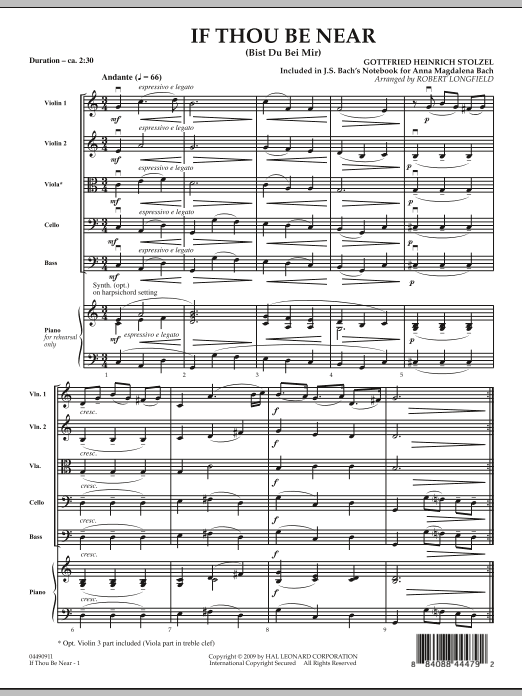

If Thou Be Near (Bist Du bei Mir): String Orchestra Conductor Score & Parts
By Johann Sebastian Bach / By Gottfried Heinrich Stolzel / Arranged by Robert Longfield
Grade: 2-3
Item: 35-PK00133267
$50.00
Pickup currently not available
Buy Extra Parts (Digital PDF Download)
Parts Added to Cart!
Description
This beloved aria heard so often at weddings and other special events has been associated with J.S. Bach due to its inclusion in Bach's "Notebook for Anna Magdalena Bach;" however, it was composed by German composer Stolzel for an opera and has been carefully arranged here for string ensemble in a version that is perfect for teaching legato, expressive style. Dur: 2:30


If Thou Be Near (Bist Du bei Mir): String Orchestra Conductor Score & Parts isn't in MakeMusic Cloud just yet...but it could be. Let us know you'd like to see it, and you'll help shape what comes next. In the meantime, start a free trial and dive into thousands of interactive titles your students can play along with today.
Request This Title
Tell us you want it.
Start Your Free Trial
Explore everything that's ready to play right now.
Sample Audio
No sample audio found.
Sample Video
No sample videos found.
Additional Details
Publisher:
Hal Leonard
SKU:
35-PK00133267
More about this title
About the Composer: Johann Sebastian Bach
Johann Sebastian Bach (1685-1750) stands as one of the most influential composers in Western music history. His systematic exploration of harmony, counterpoint, and fugal writing established foundational principles that shaped centuries of musical thought. For ensemble directors, Bach's work remains invaluable for teaching musicians how to balance individual voices while serving the larger harmonic architecture.
Why we love this
This arrangement captures what makes the melody so enduring without requiring advanced technique from your strings. The legato writing naturally develops bow control and phrase shaping in younger players, while the piece's transparency lets each section hear itself clearly during rehearsals. Programming it signals sophistication to your audience while remaining accessible to ensembles still building fundamental skills.
What to expect
Intimate and contemplative, with the warmth of a familiar hymn. The melody unfolds with gentle inevitability, inviting listeners into a moment of quiet reflection rather than commanding their attention.
Who it's for
String orchestras at the intermediate level who want to develop expressive playing and legato technique without tackling complex rhythmic or harmonic language. This works equally well for musicians preparing for solo festival performances and for ensembles seeking a concert opener that establishes an elegant mood.
How to get the most out of it
- Shape the opening phrase with a gentle swell that peaks around the second measure, then allow the line to settle naturally into the accompanying material.
- Balance the melody against the harmonic foundation by having your first violins sing without strain; the Stolzel writing rewards a warm, singing tone over vibrato intensity.
- Communicate with your string section about the emotional trajectory. This piece deepens when players understand they are supporting a complete musical thought, not simply filling out chords.
How to use it
Open a concert with this piece to establish an elegant atmosphere and settle your audience immediately. It pairs naturally with other Baroque selections or serves as a poignant transition between contrasting works. Consider performing it during spring concerts alongside other repertoire focused on lyrical writing and string technique.
Skills your students will build
- Sustained legato playing across multiple bow changes
- Phrasing and expressive line shaping in a tonal context
- Balancing individual voice independence with ensemble blend
- Reading and executing dotted rhythmic figures with precision
- Understanding harmonic function through supportive accompaniment writing