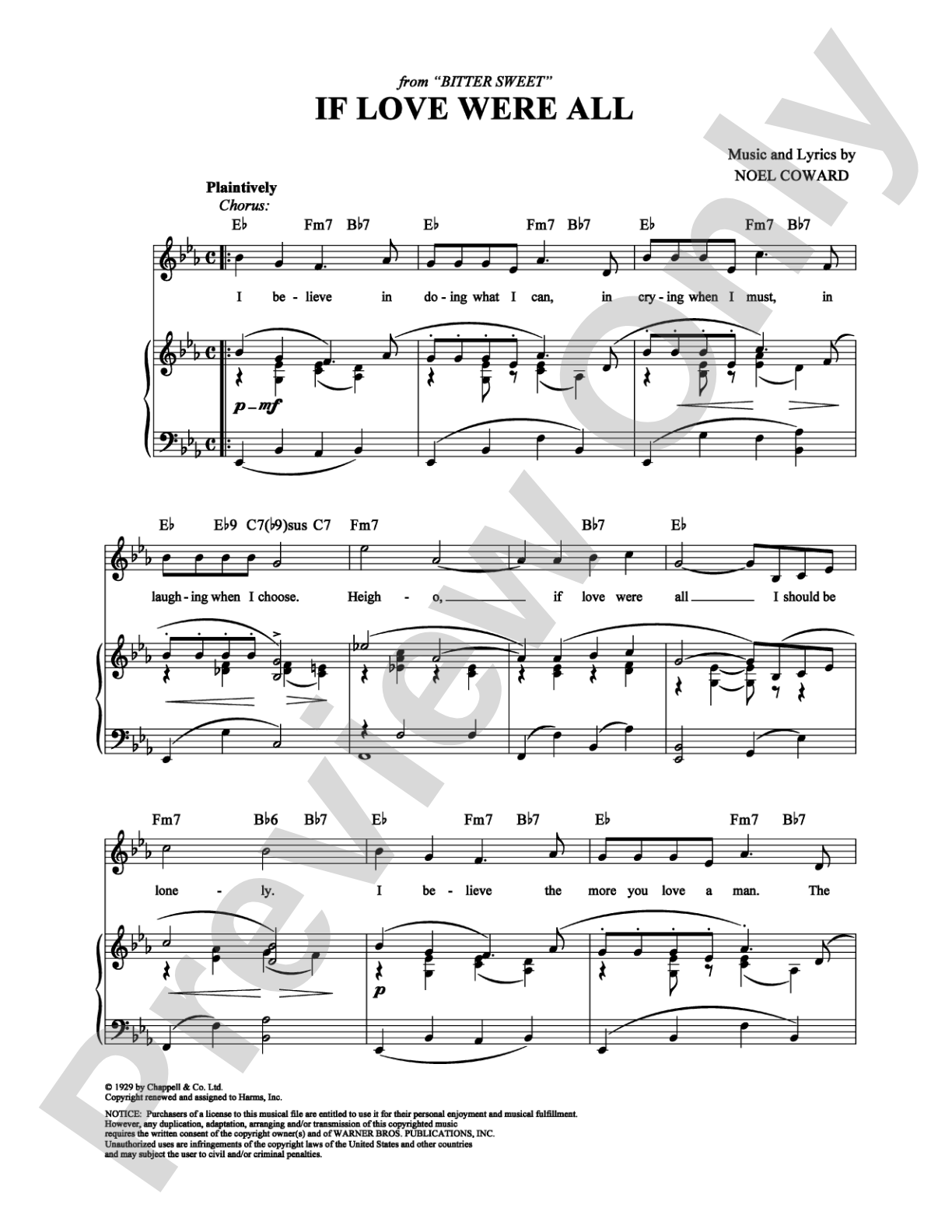
If Love Were All: Piano/Vocal/Chords Digital Sheet Music

If Love Were All: Piano/Vocal/Chords Digital Sheet Music

Judy Garland, Noel Coward

Item: 00-PS-0001910

Digital Download
$3.99
Description

If Love Were All: Piano/Vocal/Chords Digital Sheet Music isn't in MakeMusic Cloud just yet...but it could be. Let us know you'd like to see it, and you'll help shape what comes next. In the meantime, start a free trial and dive into thousands of interactive titles your students can play along with today.

Sample Audio
No sample audio found.
Sample Video
Additional Details
SKU: 00-PS-0001910

More about this title

About the Artist: Judy Garland

Judy Garland's vocal artistry shaped American musical theater and popular song for generations. Her interpretive intelligence, the way she could find emotional truth in a lyric and communicate it without sentimentality, remains a masterclass in phrasing and storytelling through music.

Why we love this

Garland's signature arrangement of this Noel Coward song gives singers a clear, singable interpretation grounded in her distinctive phrasing. The piano/vocal/chords format makes it accessible for voice students, jazz ensembles, and recital pianists who want to learn how a master artist shaped a standard.

What to expect

A moment of bittersweet reflection framed with theatrical elegance. The song balances wit and melancholy, offering singers room for both comedic timing and genuine emotional depth. Garland's arrangement highlights the song's tender core while maintaining the sophisticated, conversational tone Coward intended.

Who it's for

Voice students preparing recitals or jazz repertoire who benefit from studying a master's approach to a standard. Accompanists working with singers in lessons or performance contexts, and musicians building a working knowledge of Great American Songbook literature.

How to get the most out of it

  • Study Garland's original recording to absorb her tempo choices and rubato; her timing of the lyrical passages informs how the piano accompaniment should breathe.
  • Shape the phrase endings with care. Garland's strength lies in the way she releases words and allows silence to speak; avoid rushing to the next phrase.
  • Use the chord symbols to explore optional voicings if you're improvising or accompanying a different vocalist; the foundation Garland established is flexible enough to support varied interpretations.
  • Mark places where the voice and piano separate rhythmically. Garland's placement of lyrics sometimes sits slightly ahead of or behind the beat, creating intimacy; coordinate this with your accompanist.

How to use it

Include this in a recital or cabaret-style concert featuring standards from the 1930s-1940s. It pairs well with other Coward songs or with mid-century vocal repertoire that demands clarity and character. The piano/vocal format makes it an accessible addition to student recitals or studio showcases exploring the American songbook.

Skills your students will build

  • Phrasing and breath placement in a standard with conversational lyrics
  • Balancing legit and contemporary vocal approaches to a theatrical song
  • Interpreting chord symbols and understanding harmonic structure
  • Listening to and learning from a recorded performance as a teaching tool

You May Also Like