
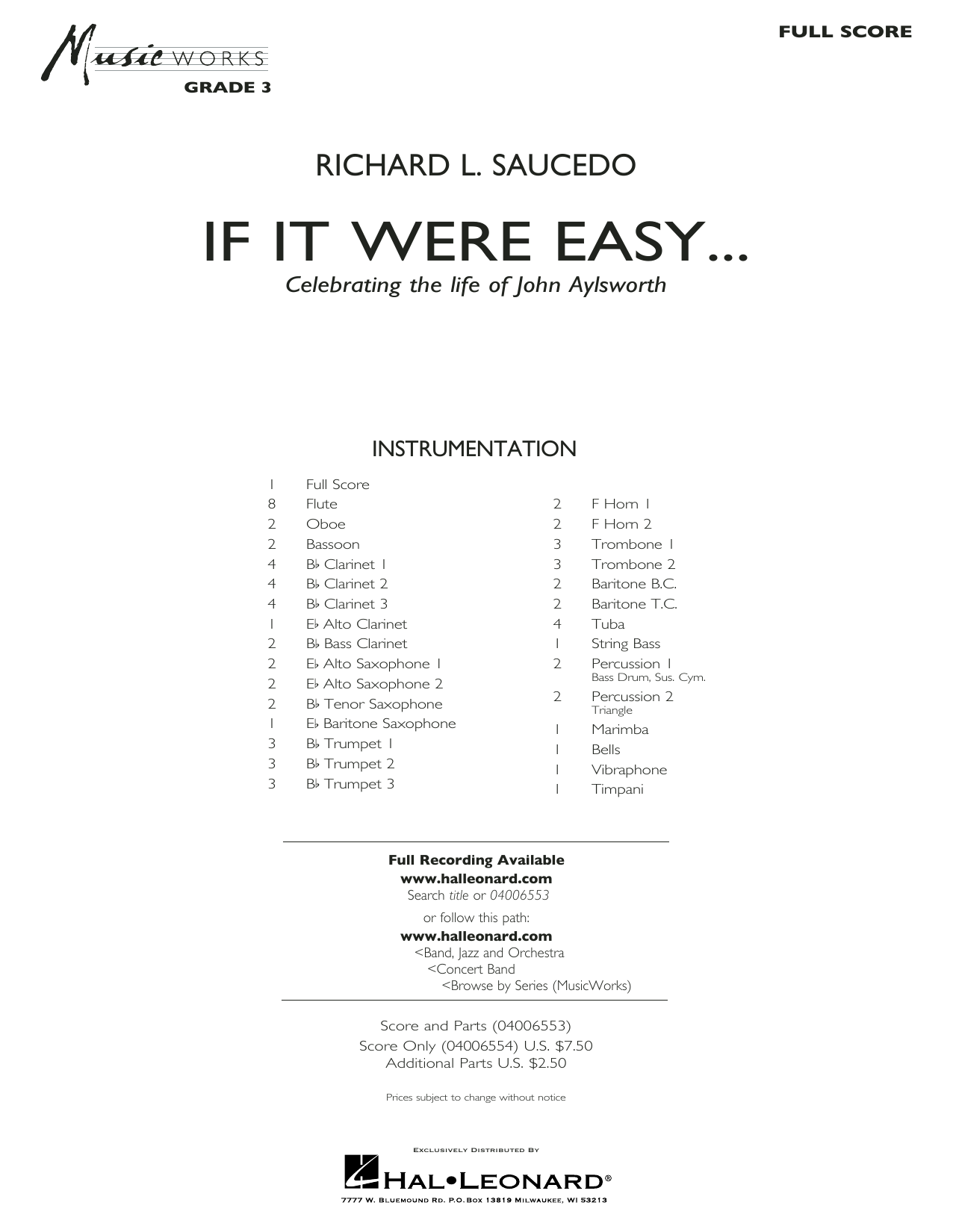

If It Were Easy...: Concert Band Conductor Score & Parts
By Richard L. Saucedo
Grade: 3
Item: 35-PK00469430
$70.00
Pickup currently not available
Buy Extra Parts (Digital PDF Download)
Parts Added to Cart!
Description
Composed as a tribute and memorial to a revered educator, "If It Were Easy..." brings to mind a range of emotions and moods, including the idea that goals worth achieving are not always easy, but require dedication and perseverance. The piece begins quietly then builds gradually to a glorious full band chorale before tapering to a quiet and delicate finish.


Discover MakeMusic Cloud: thousands of interactive titles your students can play along with today.
Sample Audio
No sample audio found.
Sample Video
Additional Details
Publisher:
Hal Leonard
SKU:
35-PK00469430
More about this title
About the Composer: Richard L. Saucedo

Richard L. Saucedo directed the Carmel High School bands in Indiana for 31 years before retiring in 2013, during which time his ensembles accumulated state, regional, and national titles across concert, jazz, and marching settings. The Carmel Wind Symphony I performed at the Music for All National Concert Band Festival three times and claimed the Indiana State Championship in 2013, while the Marching Greyhounds finished in the top ten at the Bands of America Grand Nationals for 17 consecutive years, winning national championships in 2005 and 2012.
Saucedo's contributions to music education earned him the title of Indiana Bandmaster of the Year (1998-99) and Outstanding Music Educator (2010), leading to his induction into the Music for All Hall of Fame (2015) and the Drum Corps International Hall of Fame (2022). Beyond the classroom, he has worked as a freelance composer and arranger for marching bands, concert bands, choral ensembles, and orchestras, and served as brass arranger for the Cavaliers Drum and Bugle Corps during five DCI World Championship runs. He holds membership in the American Bandmasters Association and currently serves as a Senior Educational Consultant for Music for All and Bands of America.
Why we love this
Saucedo crafts an arc that teaches as much as it moves. The piece models how a quiet, introspective opening can grow into a moment of affirmation without ever feeling manipulative, and that restraint in the ending shows real compositional maturity. For Grade 3 bands developing their ability to shape long lines and balance ensemble sound, this work offers both the musical substance and the emotional payoff that make rehearsals feel purposeful.
What to expect
The music begins as an intimate conversation, hesitant and searching, then gradually finds confidence as more voices join in. By the time the full band reaches its peak, the effect is one of earned triumph; the quiet finish feels like peaceful resolution after honest effort.
Who it's for
Grade 3 bands preparing festival and contest repertoire need works that engage audiences while remaining achievable in rehearsal. This piece suits ensembles ready to handle longer formal structures and the expressive discipline required to move seamlessly between contrasting dynamics and moods.
How to get the most out of it
- Shape the opening with genuine softness and space between phrases; resist any urge to move the tempo forward until the piece asks you to. The quiet section is the foundation of everything that follows.
- Let the gradual build feel organic rather than mechanical. Each wave should feel like a natural response to what came before, not a predetermined crescendo.
- Balance the full band chorale so that inner voices anchor the sound; it's easy for this moment to become shrill if the upper woodwinds push too hard.
- Bring the ensemble back to stillness with intention in the final section. The return to delicate textures rewards careful listening from every player.
How to use it
Include this work on a concert celebrating perseverance and growth, pairing it with other pieces that explore different emotional landscapes. Its moderate length and strong narrative arc make it ideal as a centerpiece rather than an opener, giving audiences a moment to settle in before the piece asks them to follow its emotional journey.
Skills your students will build
- Sustaining soft dynamics and clarity at low volumes
- Managing gradual tempo and dynamic changes over extended phrases
- Balancing ensemble texture during full band chords
- Shaping dramatic contrast between sections without loss of cohesion
- Controlling the final taper to a quiet conclusion