
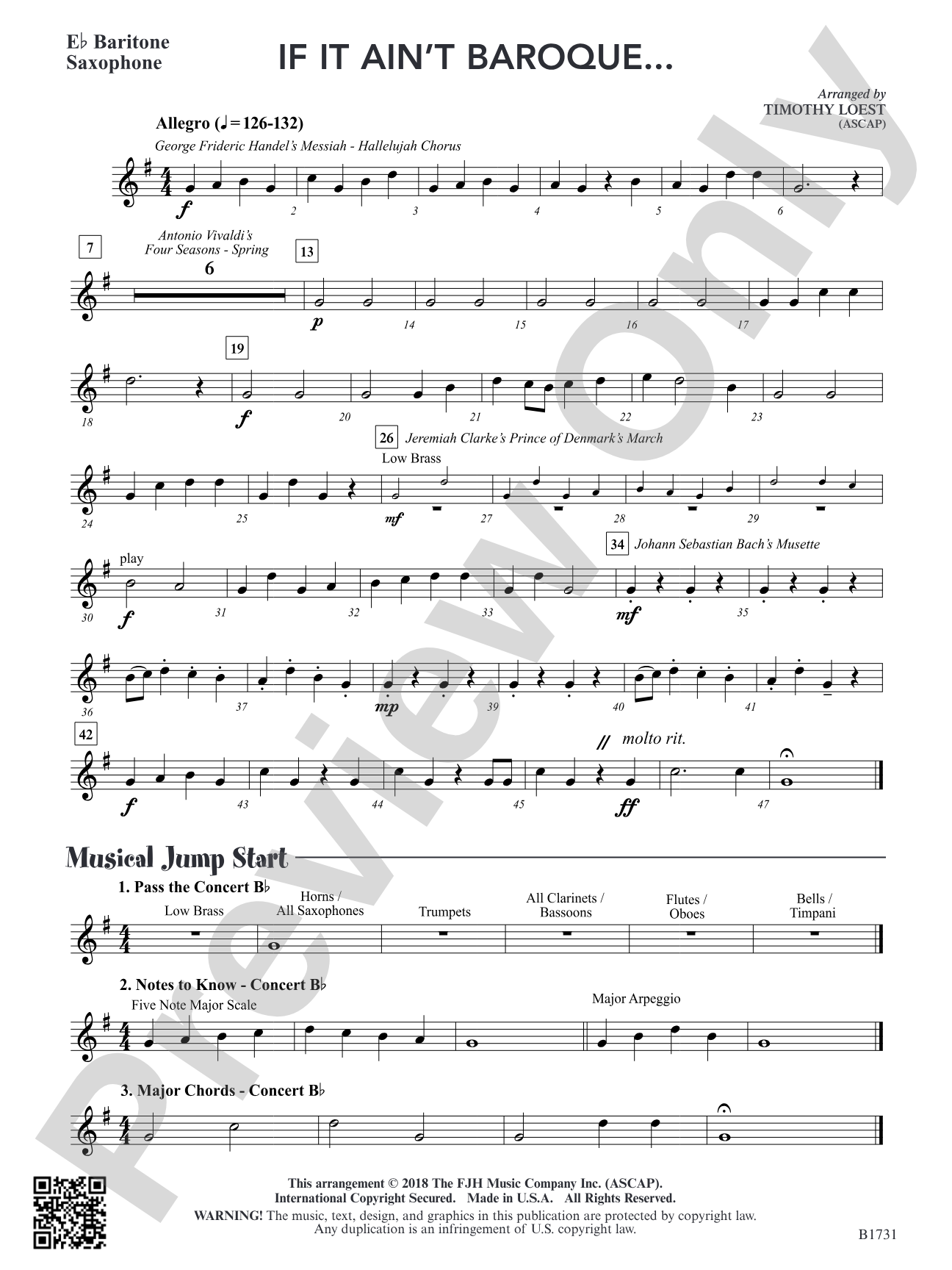

If It Ain't Baroque...: E-flat Baritone Saxophone
Arranged by Timothy Loest
Level:.5
Item: 98-PC-DB1731_BTX
$7.00
Pickup currently not available
Description
This exceptional arrangement may well be the first of its kind to capture the spirit of the Baroque period using just six notes! Beginning and ending with Handel's Hallelujah Chorus, this work also presents Vivaldi's Spring, Clarke's Prince of Denmark's March, and J.S. Bach's Musette. A rare, unsurpassed find in bringing music history to life!


If It Ain't Baroque...: E-flat Baritone Saxophone isn't in MakeMusic Cloud just yet...but it could be. Let us know you'd like to see it, and you'll help shape what comes next. In the meantime, start a free trial and dive into thousands of interactive titles your students can play along with today.
Request This Title
Tell us you want it.
Start Your Free Trial
Explore everything that's ready to play right now.
Sample Audio
1
Audio File
--:--
0:00
0:00
Sample Video
Additional Details
Series:
FJH Starter Series
Publisher:
The FJH Music Company, Inc.
SKU:
98-PC-DB1731_BTX
More about this title
About the Arranger: Timothy Loest

Timothy Loest has spent over three decades in the classroom developing music that connects with young musicians and audiences alike. His compositions and arrangements are performed by student ensembles across the country, and his work has earned recognition at the state and national levels, including the Illinois Grade School Music Association's Cloyd Myers Memorial Award for Excellence in Music Education in 2017. His concert piece Cloud Gate (Reflections of a City) reached an audience of over 5,000 at Chicago's Millennium Park that same year.
Loest's publishing history spans from 1995 to the present, with works released through major publishers including C.L. Barnhouse, FJH Music Company, and MakeMusic Publications. He has also lent his expertise to several widely used band method resources, including Measures of Success, Warm-ups and Beyond, and Rhythms and Beyond. His music has appeared on television broadcasts including The Tonight Show Starring Jimmy Fallon and Good Morning America. In 2022, he founded Fanfare Music Press to focus on high-quality band compositions and arrangements. Loest holds a Bachelor of Music Education from Illinois State University and a Master of Music from Northwestern University, and maintains membership in ASCAP.
Why we love this
Loest has engineered something genuinely clever here: a conductor score and parts that distill four Baroque masterworks into a single, musically cohesive arrangement using only six pitches. The framing device of opening and closing with Handel's Hallelujah Chorus gives the piece architectural weight, while the inclusion of works by Vivaldi, Clarke, and Bach ensures students encounter genuine masterworks, not simplified parodies. This is the kind of arrangement that feels like a gateway, introducing students to music history with immediate, audible success.
What to expect
Opening with the triumphant certainty of Hallelujah, then pivoting into the bright vitality of Vivaldi's Spring, this arrangement moves with the confidence of a master class in miniature. Each section unfolds with its own character; the Clarke march lands with ceremonial grace, the Bach Musette settles into elegant simplicity, and the return to Handel brings the journey full circle. The restricted harmonic palette creates unusual clarity and directness.
Who it's for
This conductor score and parts are designed for concert bands at the beginning level who are ready for something more sophisticated than typical starter repertoire. Young musicians benefit from the accessibility of six notes combined with the genuine musical content of Baroque masterworks, while conductors gain a piece that teaches music history in real time.
How to get the most out of it
- Establish the Hallelujah Chorus section with clarity and confidence before tackling the middle movements; this familiar framing makes the transitions to Spring and the other works feel purposeful rather than abrupt.
- Pay attention to the articulation changes between sections. Each composer's style carries distinct character, and precision here prevents the piece from feeling like a medley.
- Keep the Six-Note limitation in mind as a feature, not a constraint. The restricted palette actually sharpens ensemble focus and makes intonation work more transparent.
- Balance the Musette section carefully; it can easily tip toward quaintness if the tempo wavers. Steady, crisp rhythmic foundation keeps it elegant.
How to use it
Program this as a concert opener on a band festival or concert where you want to establish both musical credibility and student confidence early. The Baroque framing makes it equally effective as a thematic concert piece if you're building a program around music history or as a standalone demonstration of what young musicians can achieve with strong arrangement and focused technique.
Skills your students will build
- Reading and performing music by four different Baroque composers in a single cohesive work
- Articulation and style distinctions across contrasting musical periods and genres
- Sustained ensemble focus and intonation control with a limited pitch vocabulary
- Musical phrasing and breath control across multiple contrasting sections