
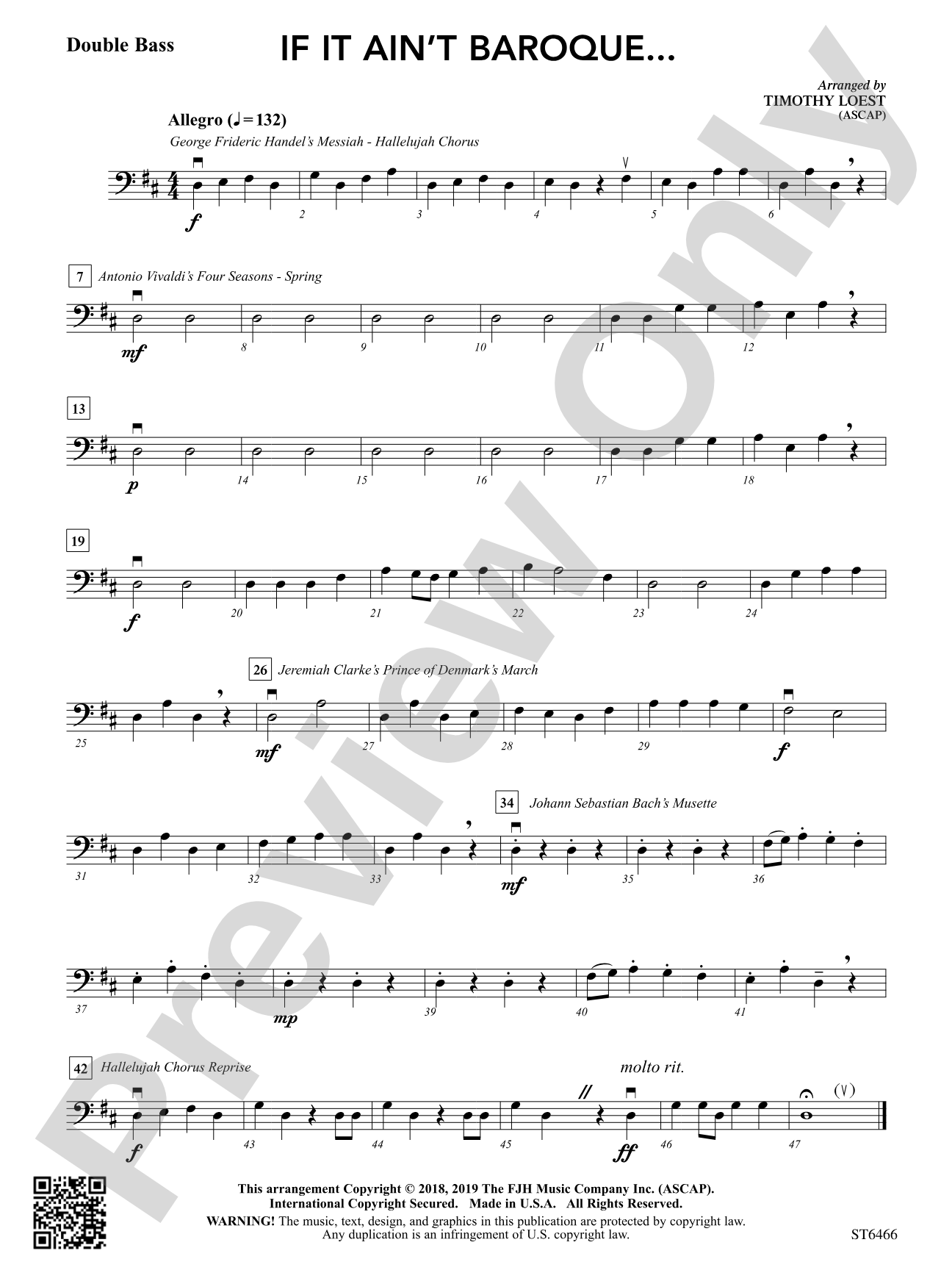

If It Ain't Baroque: Double Bass
Arranged by Timothy Loest
Grade: 1
Item: 98-PC-DST6466_SB
$7.00
Pickup currently not available
Description
This exceptional arrangement may well be the first of its kind to capture the spirit of the Baroque period using just six notes! Beginning and ending with Handel's Hallelujah Chorus, this work also presents Vivaldi's Spring, Clarke's Prince of Denmark's March, and J.S. Bach's Musette. A rare, unsurpassed find in bringing music history to life. Simply outstanding!


If It Ain't Baroque: Double Bass isn't in MakeMusic Cloud just yet...but it could be. Let us know you'd like to see it, and you'll help shape what comes next. In the meantime, start a free trial and dive into thousands of interactive titles your students can play along with today.
Request This Title
Tell us you want it.
Start Your Free Trial
Explore everything that's ready to play right now.
Sample Audio
1
Audio File
--:--
0:00
0:00
Sample Video
Additional Details
Series:
FJH Beginning Strings
Publisher:
The FJH Music Company, Inc.
SKU:
98-PC-DST6466_SB
More about this title
About the Arranger: Timothy Loest

Timothy Loest has spent over three decades in the classroom developing an arrangement practice that prioritizes both musical substance and student accessibility. His works for young ensembles are performed internationally, and his pedagogical contributions span method books (Measures of Success, Warm-ups and Beyond, Rhythms and Beyond, Chorales and Beyond) and original compositions that have reached audiences on network television including The Tonight Show Starring Jimmy Fallon and Good Morning America. In 2017, his composition Cloud Gate (Reflections of a City) was performed for over 5,000 spectators at Chicago's Millennium Park, and that same year he received the Illinois Grade School Music Association's Cloyd Myers Memorial Award for Excellence in Music Education.
Loest founded Fanfare Music Press in 2022 to publish compositions and arrangements of the highest caliber for band and strings. His publishing history spans three decades of partnerships with major houses including C.L. Barnhouse, FJH Music Company, and MakeMusic Publications. He holds degrees from Illinois State University (Bachelor of Music Education with high honors) and Northwestern University (Master of Music with program honors), maintains ASCAP membership, and continues to accept commissions for instrumental ensembles.
Why we love this
Loest solves a genuine challenge in beginning string education: how to build technique and musicality while keeping young players genuinely engaged with substantial repertoire. By condensing four masterworks into a single, cohesive piece that uses only six notes, he delivers uncompromised historical literacy without sacrificing playability. The dramatic bookend structure of Hallelujah Chorus gives students a memorable sense of arc, turning what could feel like a greatest-hits medley into something with genuine dramatic weight.
What to expect
A guided tour through four centuries of classical genius condensed into a single, buoyant performance. The piece moves between fanfare and dance, jubilation and grace, with the opening and closing Hallelujah framing the entire work like a musical embrace. Despite its simplicity, it never feels condescended to.
Who it's for
Beginning string orchestra students (Grade 1) who benefit from playing recognizable Baroque masterworks while staying within a limited technical range. This is ideal for players in their first or second year of instruction who need confidence and engagement alongside skill building.
How to get the most out of it
- Establish clear textural contrast between the four works. Handel's Hallelujah and Clarke's Prince of Denmark's March benefit from a confident, forward tempo, while Vivaldi's Spring asks for more rhythmic precision and articulation clarity.
- Use the open strings and limited range to your advantage by drawing full, resonant tone from every player. At Grade 1, a mature sound is often the biggest teaching win.
- Balance the return to Hallelujah in the final section by bringing it forward dynamically without rushing; this moment should feel earned and celebratory after the journey through the middle movements.
How to use it
Program this as a winter or spring concert opener to establish both the sophistication of your beginning ensemble and the breadth of string repertoire. It also works powerfully as a school assembly piece or community outreach concert where music history matters as much as musicianship. The Grade 1 accessibility ensures strong ensemble sound while the Baroque content educates and delights a mixed audience.
Skills your students will build
- Reading single-line melodic notation in treble clef
- Understanding Baroque style and historical context across four distinct composers
- Maintaining consistent rhythmic articulation across contrasting movement tempos
- Developing ensemble balance and tone quality with limited technical demands