
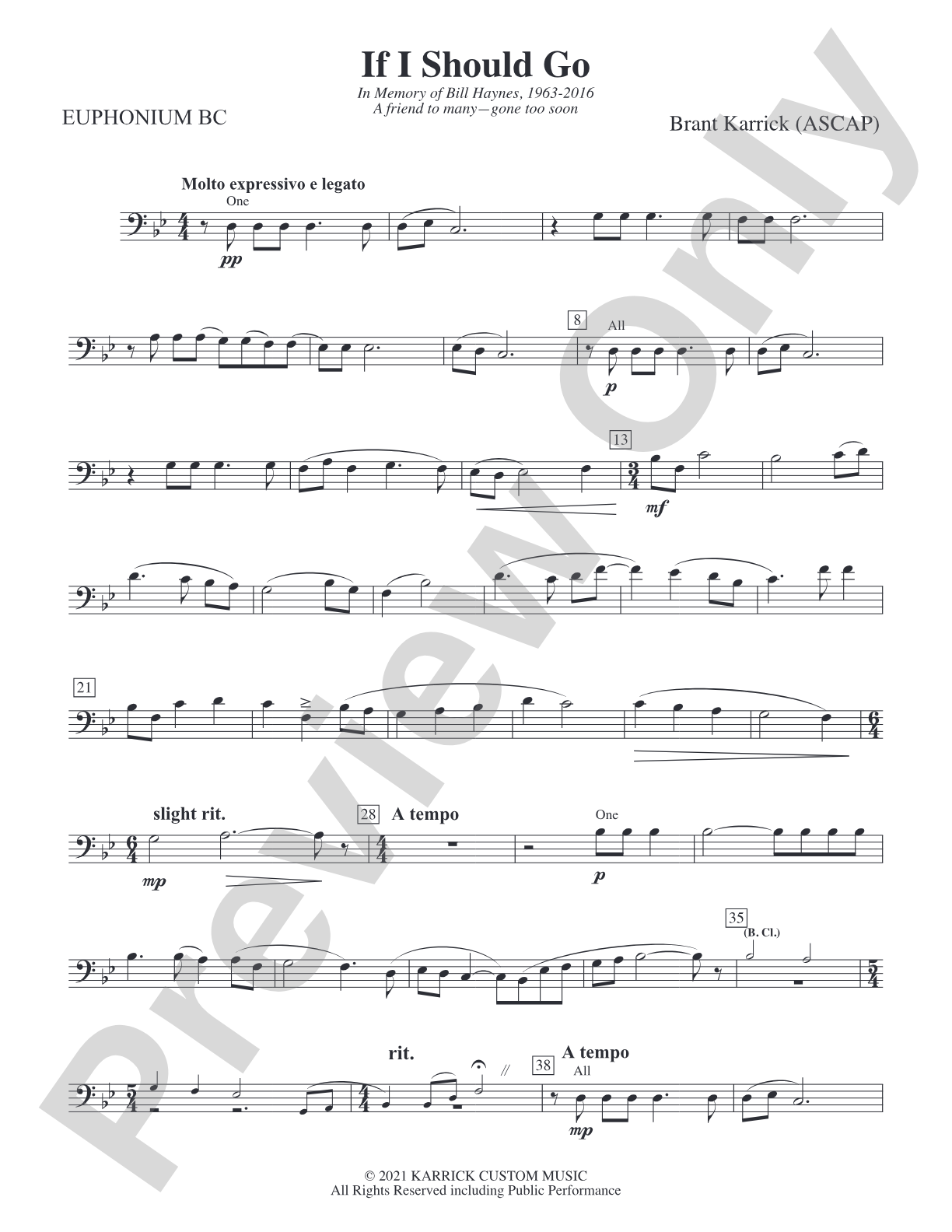

If I Should Go: Baritone B.C.
By Brant Karrick
Grade: 3.5
Item: 00-PC-0018739_BBC1
$5.99
Pickup currently not available
Description
If I Should Go was written to honor the memory of Bill Haynes, a musician, music educator, and conductor whose life tragically and senselessly ended in a car-jacking in 2016. Brant Karrick and Bill Haynes were very close friends beginning with their days in school together. The composer uses a musical warmth and vitality to reflect Bill's happy, kind, and generous spirit, while dissonances portray the sadness and depression felt by losing a loved one. "Danny Boy" is quoted as it was a favorite tune of Haynes. Further inspiration for If I Should Go came from the poem of the same name, written by Joyce Grenfell, that helps us all to carry on with life after losing someone we love. (5:25)


Discover MakeMusic Cloud: thousands of interactive titles your students can play along with today.
Sample Audio
1
Audio File
--:--
2
Audio File
--:--
Audio File
0:00
0:00
Sample Video
No sample videos found.
Additional Details
Series:
Alfred Digital Concert Band
SKU:
00-PC-0018739_BBC1
More about this title
About the Composer: Brant Karrick

Brant Karrick has shaped band programs at multiple institutions throughout his career. A faculty member at Northern Kentucky University since 2003, where he directs the full band curriculum and teaches conducting and orchestration, Karrick brings two decades of university teaching experience along with seven years in Kentucky public schools. He holds a Ph.D. in music education from Louisiana State University (1994), a Master's degree from Western Kentucky University, and a Bachelor's in music education from the University of Louisville.
Karrick's compositional voice has traveled internationally; his band works have been performed across the United States, Canada, Europe, South Africa, South America, Japan, and Australia. He remains active as a guest conductor, clinician, and adjudicator while maintaining his university responsibilities. His musical development was shaped by mentors including trumpet teacher Leon Rapier, composer David Livingston, and conductor Frank Wickes. Karrick is a voting member of ASCAP and holds professional affiliations with NAFME, the College Band Directors National Association, and Phi Beta Mu.
Why we love this
Karrick writes the kind of music that earns standing ovations not because it's showy, but because it moves people. This piece honors a real life and invites your students into something meaningful: the work of remembering someone and carrying that memory forward. The musical palette shifts beautifully between warmth and longing, giving your band genuine emotional ground to stand on while remaining fully accessible at grade 3.5.
What to expect
Warm light alternates with deeper shadow. The opening suggests grace and resilience; later, dissonant harmonies cut through like honest grief, never wallowing but never hiding either. The quoted "Danny Boy" emerges like a cherished memory surfacing, tender and bittersweet. The overall arc feels less like mourning and more like remembering someone's kindness while moving forward with purpose.
Who it's for
Concert bands at the intermediate to early advanced level who can handle layer-by-layer musical storytelling without losing ensemble cohesion. This score works for groups ready to engage meaningfully with commemorative repertoire and understand how composition can honor real people and real loss. It's also valuable for any program seeking grade 3.5 literature that transcends the everyday without demanding professional-level technique.
How to get the most out of it
- Balance the quoted "Danny Boy" melody so it sings through clearly without overwhelming the harmonic support; this moment anchors the piece's reflective center.
- Shape the warmer sections with a sense of gentle vitality rather than indulgence; Karrick's writing celebrates life, not wallowing in grief.
- Use the dissonant passages as interpretive opportunities to explore how tension and consonance can coexist; let students hear how these sounds serve the larger emotional arc.
- Attend to dynamic control in the ensemble transitions; the contrasts between sections carry meaning and deserve clarity rather than abruptness.
How to use it
Program this as a centerpiece for a concert devoted to meaningful themes or as part of a season arc that balances lighter and reflective works. It works especially well in spring concert settings where audiences expect more introspection. The five-minute duration fits naturally into memorial or remembrance-themed events without requiring thematic clustering; it stands on its own. Consider pairing it with other Karrick works or contrasting contemporary pieces to show your band's emotional and stylistic range.
Skills your students will build
- Layered ensemble balance between melody, countermelody, and harmonic foundation
- Shaping musical phrases across dissonant and consonant harmonic language
- Sustaining tone quality and intonation through chromatic and polytonal passages
- Understanding how compositional choices (quotation, texture, dynamics) serve emotional intent
- Responding expressively to contrasting sections within a unified formal structure