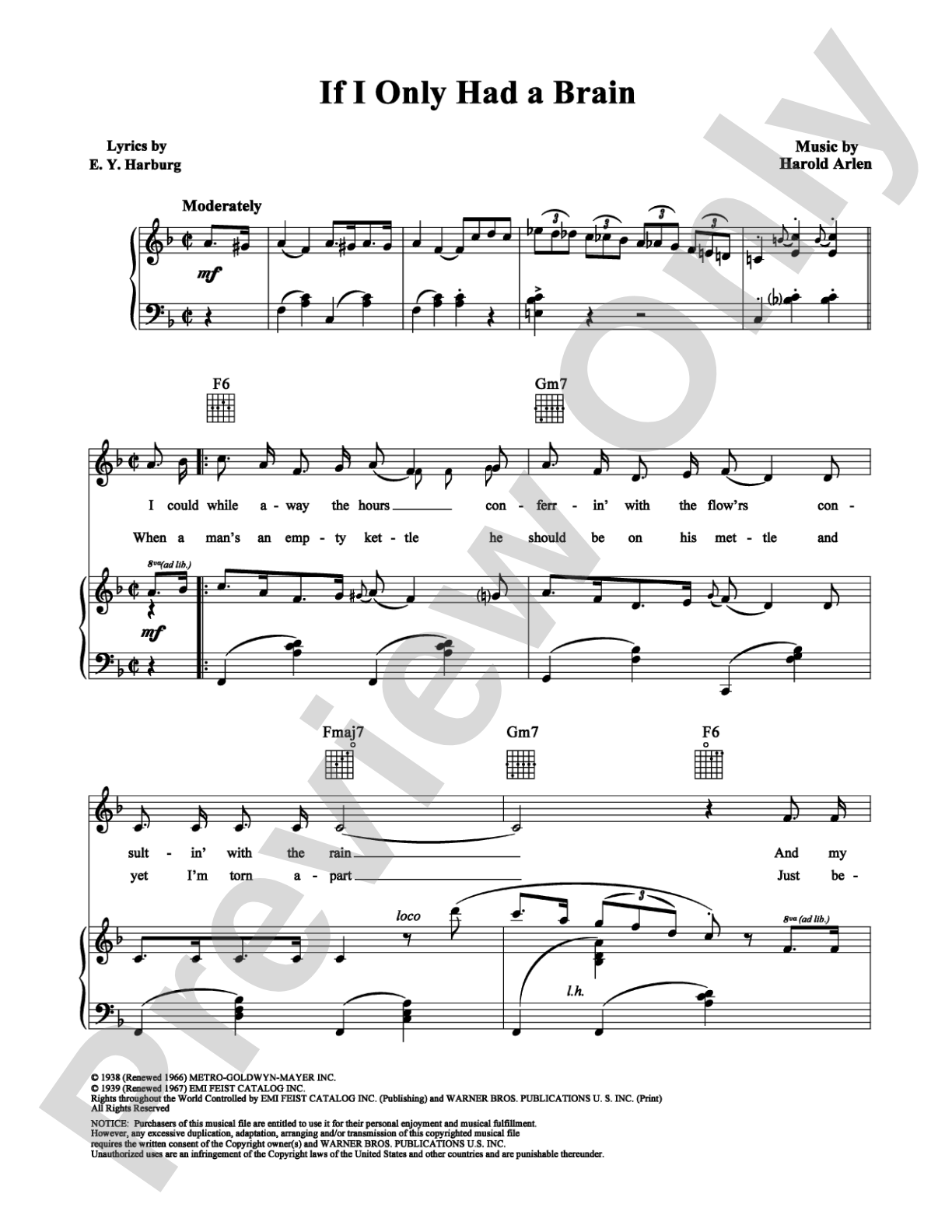
If I Only Had a Brain: Piano/Vocal/Chords Digital Sheet Music

If I Only Had a Brain: Piano/Vocal/Chords Digital Sheet Music

Harold Arlen, Ray Bolger

Item: 00-PS-0000554

Digital Download
$3.99
Description

If I Only Had a Brain: Piano/Vocal/Chords Digital Sheet Music isn't in MakeMusic Cloud just yet...but it could be. Let us know you'd like to see it, and you'll help shape what comes next. In the meantime, start a free trial and dive into thousands of interactive titles your students can play along with today.

Sample Audio
No sample audio found.
Sample Video
Additional Details
SKU: 00-PS-0000554

More about this title

About the Artist: Ray Bolger

Ray Bolger (1904, 1987) was an American actor, dancer, and singer best known for his role as the Scarecrow in The Wizard of Oz. His expressive physicality and comedic timing made him a distinctive presence on stage and screen, and he brought those same qualities to his vocal performances. Bolger's interpretation of "If I Only Had a Brain" became definitive, capturing both the character's vulnerability and his vaudeville-influenced charm.

Why we love this

This standard offers singers a character piece with built-in charm and comedic timing. The song's whimsical harmonic movement and conversational phrasing give pianists and vocalists room to shape the accompaniment expressively, making it rewarding for anyone seeking repertoire that balances accessibility with genuine musical substance.

What to expect

Earnest and gently humorous, this piece captures the vulnerability of self-doubt wrapped in vaudeville sensibility. The melody has a folk-song quality that makes it immediately singable, while the harmonies suggest both wistfulness and comic timing.

Who it's for

Vocalists preparing solo recital or audition repertoire will find this a charming addition to their catalog. Pianists accompanying singers benefit from the straightforward chord chart and conversational pacing, which rewards both musical collaboration and individual listening.

How to get the most out of it

  • Shape the melody with gentle rubato in the verse sections; the piano can follow the singer's phrasing rather than driving a strict tempo, allowing the character to emerge naturally.
  • Let the chord changes breathe. The harmonic movement supports the emotional arc of the lyrics, so resist over-pedaling; clear articulation in the left hand will sharpen the storytelling.
  • Balance the singer's dynamic range so comic moments land without mugging; understated delivery often enhances the humor more than overselling the situation.

How to use it

Program this in a recital focused on American standards or musical theater repertoire, pairing it with other character songs from the Golden Age. It also works well as an encore or as part of a teaching recital where students benefit from hearing a director model comedic phrasing and partnership between voice and piano.

Skills your students will build

  • Shaping conversational phrasing over a steady harmonic framework
  • Balancing comic timing with musical sincerity
  • Collaborating between singer and pianist on rubato and dynamic shape
  • Reading chord symbols and adapting harmonic voicings to complement the vocal line

You May Also Like