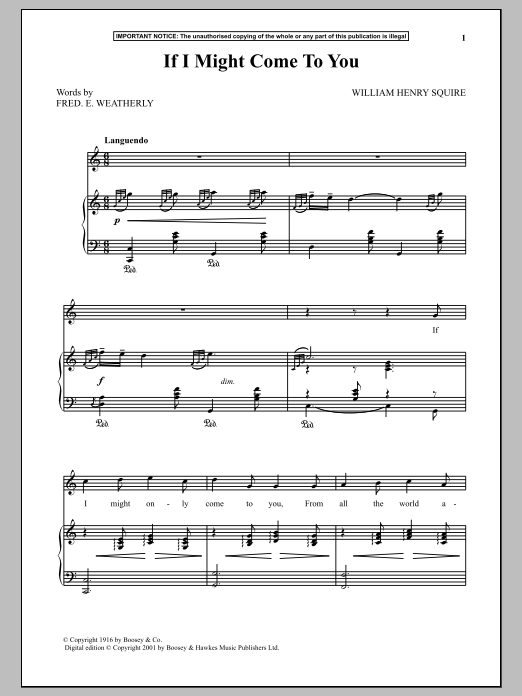
If I Might Come To You Sheet Music Preview

If I Might Come To You: Piano Vocal

As performed by William Henry Squire

Item: 35-DS00237820

Digital Download
$5.99
Description

If I Might Come To You: Piano Vocal isn't in MakeMusic Cloud just yet...but it could be. Let us know you'd like to see it, and you'll help shape what comes next. In the meantime, start a free trial and dive into thousands of interactive titles your students can play along with today.

Sample Audio
No sample audio found.
Sample Video
Additional Details
Publisher: Hal Leonard
Page Count: 4
SKU: 35-DS00237820

More about this title

About the Artist: William Henry Squire

William Henry Squire was a prolific English composer and pianist of the late 19th and early 20th centuries, known for his accessible vocal music and arrangements. His work bridged the worlds of classical training and popular song, making him a fixture in home music-making and recital programs during the Edwardian era.

Why we love this

Squire's vocal writing has a natural lyricism that doesn't demand excessive technical display from singers, yet the piano part carries real substance and character. This folk-influenced setting sits comfortably for voices across ranges and rewards singers who prioritize phrasing and tone over gymnastics.

What to expect

Warm and conversational, with the gentle plea of its title underscored by harmonic turns that feel both familiar and slightly wistful. The music settles into the ear without fanfare, letting the words and the emotional gesture do the real work.

Who it's for

Singers preparing recital material, intermediate pianists looking to accompany vocal students, and voice teachers seeking accessible four-page songs that don't require a full art song cycle. Solo vocalists and accompaniment pairs will find this straightforward to learn and effective in performance.

How to get the most out of it

  • Shape the vocal line with longer phrase breaths than the accompaniment might suggest; the piano's rhythmic detail should not dictate the singer's pacing.
  • Lean into the folk idiom by allowing rubato in the melody without dragging the piano's harmonic rhythm.
  • Balance the voice forward through the opening phrases so the intimate text setting lands clearly with listeners.

How to use it

This works beautifully on a recital pairing folk-adjacent repertoire from the turn of the century, or as a graceful interlude between longer or more demanding pieces. Teachers can use it to help singers develop interpretive choices within a compact, manageable framework.

Skills your students will build

  • Sustaining legit vocal line with minimal accompaniment support
  • Coordinating rubato between voice and piano
  • Navigating harmonic language rooted in folk idiom
  • Building interpretive choices at the phrase level

You May Also Like