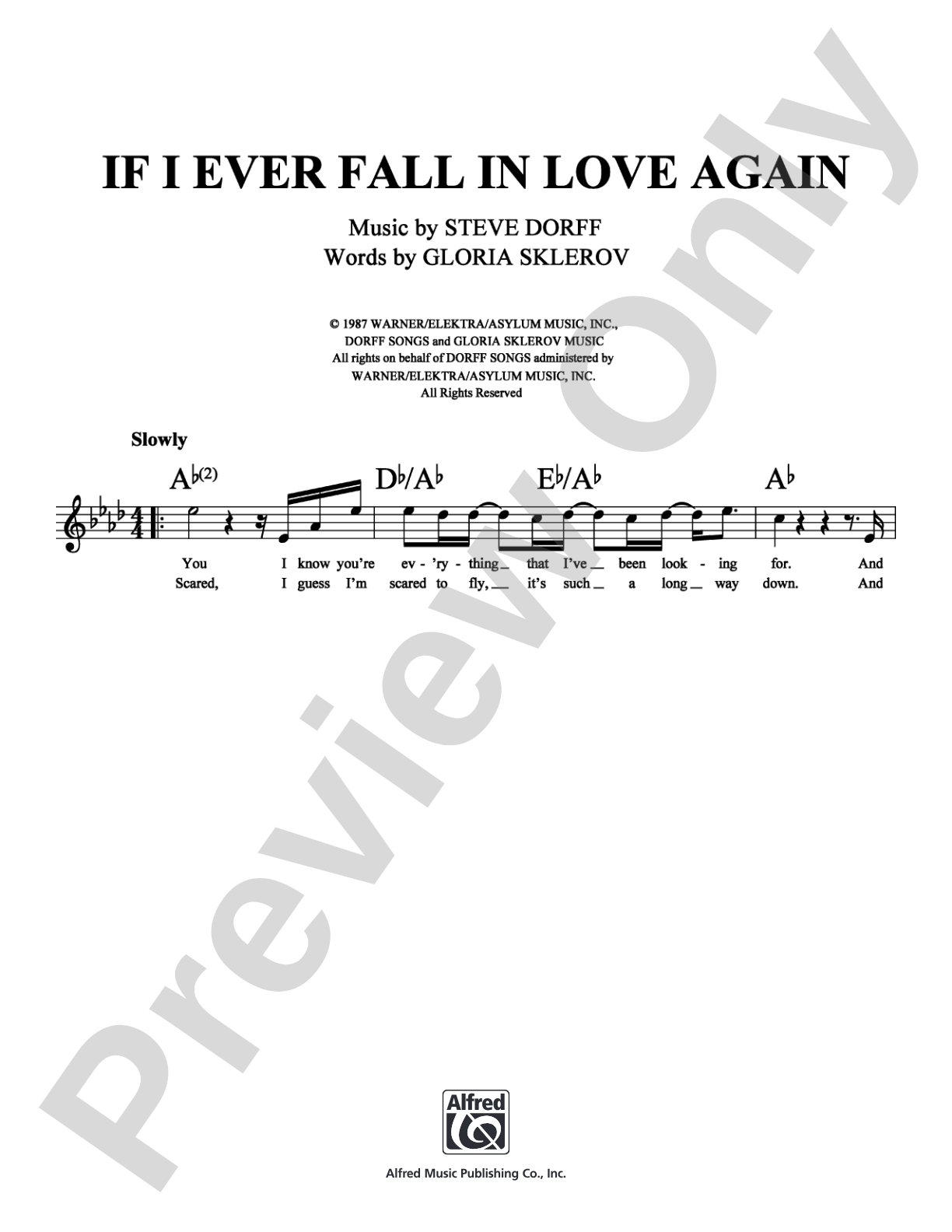
If I Ever Fall in Love Again: Lead Sheet Digital Sheet Music

If I Ever Fall in Love Again: Lead Sheet Digital Sheet Music

Anne Murray, Steve Dorff, Kenny Rogers

Item: 00-PS-0009304

Digital Download
$1.99
Description

If I Ever Fall in Love Again: Lead Sheet Digital Sheet Music isn't in MakeMusic Cloud just yet...but it could be. Let us know you'd like to see it, and you'll help shape what comes next. In the meantime, start a free trial and dive into thousands of interactive titles your students can play along with today.

Sample Audio
No sample audio found.
Sample Video
Additional Details
SKU: 00-PS-0009304

More about this title

About the Artist: Anne Murray

Anne Murray is a Canadian singer whose career spans multiple decades and genres, from country to pop to soft rock. Her ability to cross stylistic boundaries while maintaining vocal authenticity made her one of the most commercially successful recording artists of the 1970s and 1980s, with numerous Grammy Awards and Juno Awards recognizing her contributions to popular music.

Murray's vocal style—warm, controlled, and emotionally direct—became a model for singers working across country and pop repertoire. Her interpretations emphasize clarity of lyric and phrase shape over technical display, making her recordings valuable references for understanding how to serve a song's story.

Why we love this

Lead sheets of popular hits give singers and pianists concrete material for exploring how successful artists construct their interpretations. Murray's recording of this duet demonstrates how to balance conversational intimacy with melodic shape, and the lead sheet lets students see the harmonic architecture underneath her phrasing choices. For jazz combos, pop ensembles, or singers building jazz piano repertoire, this is working material that connects to a widely recognized recording.

What to expect

Introspective and hopeful, balancing romantic hesitation with openness to possibility. The melody sits comfortably in a conversational register, making it feel like an intimate conversation rather than a performance statement. The harmonic language is straightforward enough to follow but sophisticated enough to reward close listening.

Who it's for

Singers building a pop or country repertoire, jazz pianists exploring standards and contemporary popular songs, and small ensembles (duos, trios, combos) looking for accessible material with harmonic interest. This works for high school and college-level performers who want to engage with published song arrangements beyond classical repertoire.

How to get the most out of it

  • Examine the original recording to understand where Murray places the melody relative to the beat; her phrasing often sits slightly behind the pulse in ways that create conversational warmth. Use this as a reference for your own rhythmic choices rather than a prescription.
  • Pay attention to the lyric's narrative arc (doubt, possibility, vulnerability). Let that emotional trajectory shape your dynamic contour rather than treating each phrase with equal weight.
  • Consider the key and your own vocal range before performing. Lead sheets can be transposed; find a key that lets you access the song's emotional center without straining.

How to use it

Use this in a pop or cabaret concert where you're exploring duet repertoire, or as a feature for a jazz combo evening. It pairs well with other contemporary popular songs and gives singers material that audiences recognize and connect to immediately. Lead sheets also serve as study material in jazz history or popular music analysis courses.

Skills your students will build

  • Reading lead sheet notation and chord symbols
  • Interpreting lyrics to shape phrasing and dynamics
  • Transposing songs to match vocal range and character
  • Creating accompaniment voicings from chord charts
  • Understanding how melody interacts with harmonic changes in popular song form

You May Also Like