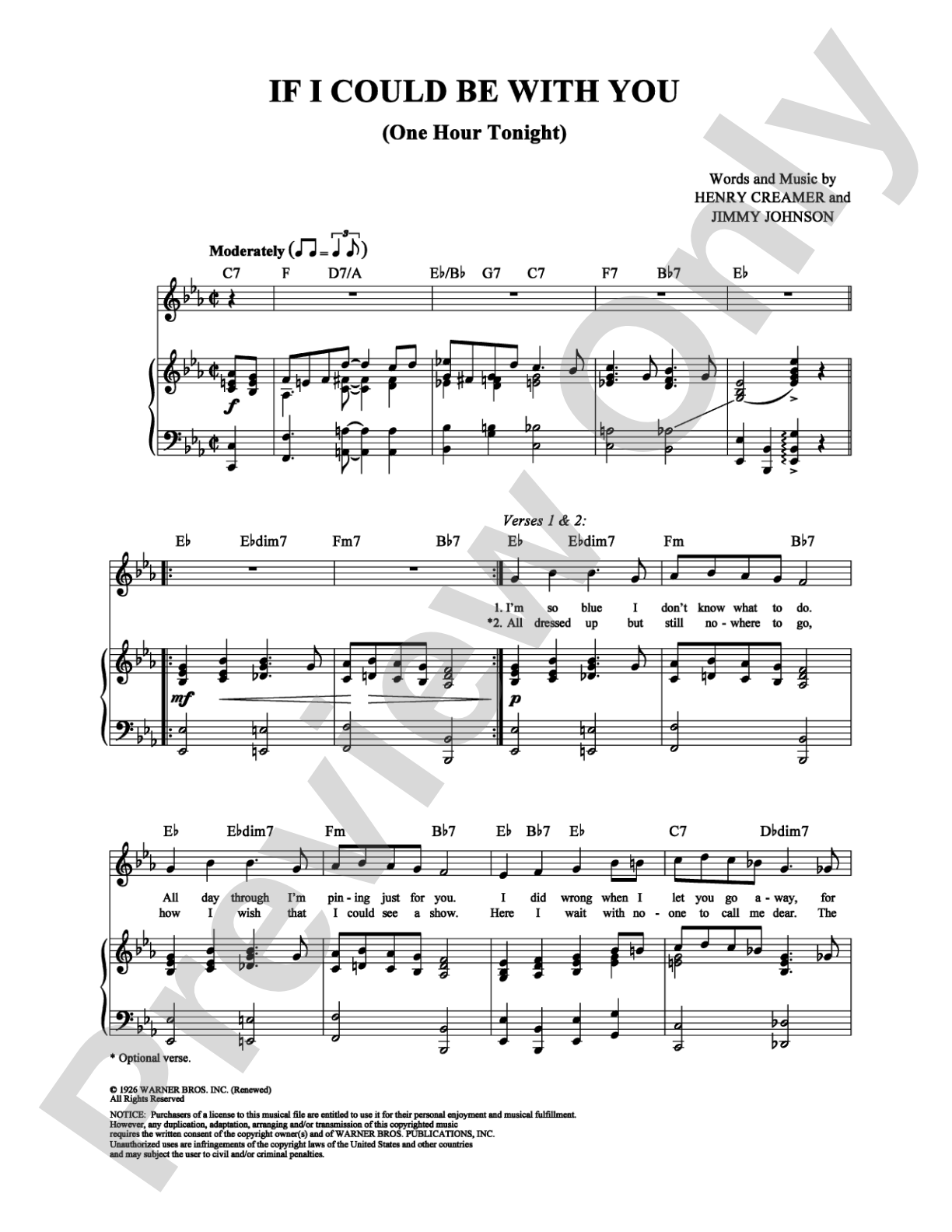
If I Could Be With You: Piano/Vocal/Chords Digital Sheet Music

If I Could Be With You: Piano/Vocal/Chords Digital Sheet Music

Jimmy Johnson, Louis Armstrong, Henry Creamer

Item: 00-PS-0008485

Digital Download
$3.99
Description

If I Could Be With You: Piano/Vocal/Chords Digital Sheet Music isn't in MakeMusic Cloud just yet...but it could be. Let us know you'd like to see it, and you'll help shape what comes next. In the meantime, start a free trial and dive into thousands of interactive titles your students can play along with today.

Sample Audio
No sample audio found.
Sample Video
Additional Details
SKU: 00-PS-0008485

More about this title

About the Artist: Louis Armstrong

Louis Armstrong (1901-1971) was a trumpeter, vocalist, and bandleader who fundamentally shaped jazz and American popular music. His distinctive tone, improvisational brilliance, and warm stage presence made him one of the most influential and recognizable musicians of the 20th century. Armstrong's ability to sing with the same rhythmic freedom and expressiveness he brought to his trumpet playing established him as a master of jazz vocal phrasing.

For music educators, Armstrong represents the intersection of technical mastery and emotional communication. His recordings demonstrate how jazz musicians balance composition with spontaneous interpretation, making his work invaluable for students learning to balance written music with personal expression.

Why we love this

This standard sits at the sweet spot between accessibility and sophistication. The melody is singable and memorable, the chord changes are jazz enough to teach voice leading and reharmonization, yet the arrangement remains approachable for pianists and singers still building their jazz vocabulary. Programming this alongside other jazz standards gives students a touchstone for understanding how great artists interpret the Great American Songbook.

What to expect

Warm and intimate, with the feeling of a late-night conversation in a small club. The melody has an aching tenderness beneath its simplicity, and the harmony invites subtle reharmonization and emotional coloring. It's a tune that asks you to play with restraint and nuance rather than flash.

Who it's for

Pianists and vocalists with solid jazz fundamentals who are ready to work on interpretation and ensemble listening. This works equally well for jazz combos, jazz vocal students, or singers preparing a jazz standard recital. It's also valuable for music theory students examining how jazz standards function harmonically and how artists navigate form through phrasing.

How to get the most out of it

  • Listen to Armstrong's original recording before rehearsing. Pay attention to how he delays phrases and bends notes around the beat rather than landing square on it. Your interpretation doesn't need to copy his, but understanding his approach will deepen your choices.
  • Treat the melody as a conversation between voice and piano. The vocal line is strong enough to lead, but the comping underneath shouldn't disappear. Balance clarity in the right hand voicings with rhythmic flexibility in the left.
  • Explore the space in the melody. This tune has natural breathing points and phrases that ask for rubato. Allow yourself to sit behind the beat in some passages and push slightly ahead in others.
  • Use the chord symbols as a springboard for comping variation, not a cage. Standard jazz practice means you're reharmonizing and responding to the vocalist's phrasing, not playing the same voicings the same way twice.

How to use it

Pair this with other classic jazz standards to build a set that showcases different eras and compositional styles. It works beautifully in a jazz evening concert or as part of a vocal recital that explores American songwriting. Consider programming it alongside other Armstrong recordings to help students appreciate how the same tune can shift in character depending on tempo, arrangement, and interpretation.

Skills your students will build

  • Jazz phrasing and rhythmic flexibility around the beat
  • Jazz chord symbol reading and comping voicing choices
  • Listening and responding as an ensemble (vocalist and accompanist)
  • Interpreting melody through rubato and dynamic shaping
  • Understanding form and harmonic movement in a standard

You May Also Like