
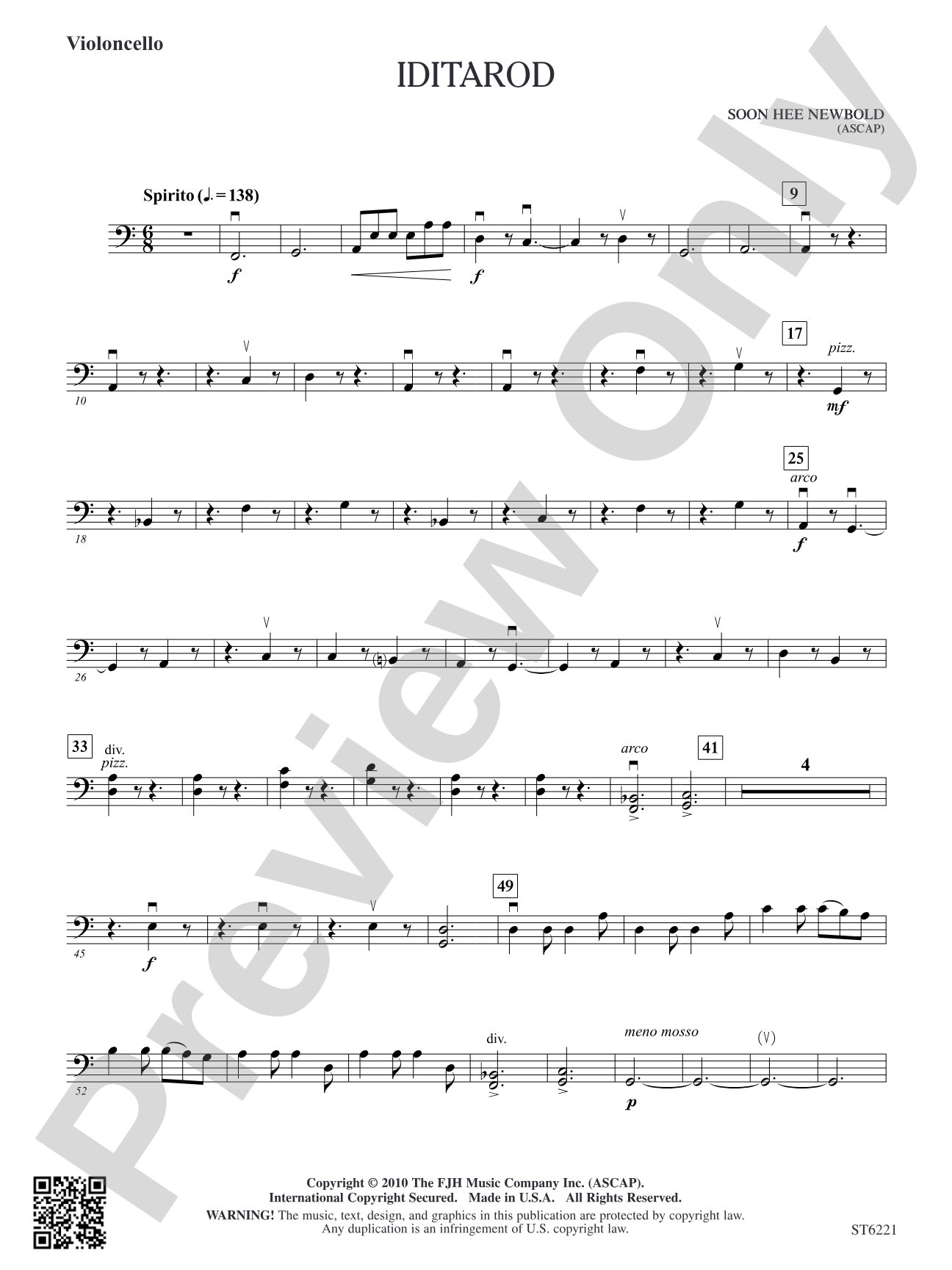

Iditarod: Violoncello
By Soon Hee Newbold
Grade: 4
Item: 98-PC-DST6221_VC1
$7.00
Pickup currently not available
Description
This riveting and explosive new work will take you on a journey through Alaska's harsh landscape with the sled dogs running the Iditarod. Known as "the last great race on Earth," the Iditarod Trail Sled Dog Race stretches over 1,150 miles of Alaska's wild terrain from Anchorage to Nome. This is Soon Hee Newbold at her very best!


Don't just read it, hear it, play along with it, and watch your students grow with it. In MakeMusic Cloud, Iditarod: Violoncello comes alive with professional accompaniment, adjustable tempo, and built-in practice tools that turn solo practice into real progress.
Open in the Player
Jump straight in and assign it today.
Start Your Free Trial
Open this title and explore the full library in minutes.
Sample Audio
1
Audio File
--:--
0:00
0:00
Sample Video
No sample videos found.
Additional Details
Series:
FJH String Orchestra
Publisher:
The FJH Music Company, Inc.
SKU:
98-PC-DST6221_VC1
More about this title
About the Composer: Soon Hee Newbold

Soon Hee Newbold brings a global musical perspective to her compositions, drawing on cultural traditions and ethnic styles encountered throughout her career as both performer and conductor. She began piano study at age five and took up violin at seven, eventually performing as a concert artist with professional ensembles across multiple continents. Her works appear regularly on stages ranging from Carnegie Hall and the Kennedy Center to the Midwest Band and Orchestra Clinic, performed by everyone from professional orchestras to beginning elementary groups. Beyond concert music, Newbold has composed for film and recording projects in Hollywood, and she remains active as a guest clinician and keynote speaker at music education conferences worldwide.
Newbold's conducting experience spans the United States and international venues including the Netherlands, Belgium, Australia, Indonesia, Singapore, and China. This breadth of exposure informs her compositional voice, which consistently honors diverse musical traditions while remaining accessible to student musicians at all levels.
Why we love this
Newbold captures the raw power and relentless drive of the Iditarod in purely orchestral terms, giving your ensemble a visceral programmatic experience that doesn't rely on narrative explanation or staging. Grade 4 writing at this level rarely maintains such dramatic momentum without becoming muddled, yet the scoring here stays clean and purposeful throughout. This is the kind of piece that reminds both students and audiences why they fell in love with string orchestra.
What to expect
Iditarod sweeps you across frozen terrain with relentless forward motion and visceral energy. The writing captures both the harshness of Alaska's wilderness and the grit of the sled dogs, building from tense opening moments into explosive passages that demand complete ensemble commitment.
Who it's for
String orchestra ensembles at the intermediate to upper-intermediate level who are ready for a substantial programmatic work with real dramatic arc. Directors seeking contest or festival material that engages students emotionally while meeting technical skill-building goals will find this particularly rewarding.
How to get the most out of it
- Build your tempo gradually through the opening sections rather than starting at full speed; this allows the dogs' journey to unfold with mounting intensity and gives the ensemble room to grow into the climactic passages.
- Balance the rhythmic drive of lower strings against the melodic content in upper voices; neither should overwhelm the other, even during the fastest sections.
- Pay attention to dynamic contrasts between solo passages and tutti moments; they're your primary tool for creating the sense of a vast, changing landscape.
- Shape phrases as if they represent different stages of the race; each section has its own character and momentum.
How to use it
This works brilliantly as a concert centerpiece that can stand alone or anchor a program exploring nature themes, adventure narratives, or American regional music. The festival-ready quality also makes it an excellent choice for spring competitions following a winter of technical development.
Skills your students will build
- Maintaining rhythmic precision and ensemble unity during extended driving passages
- Shaping musical phrases across longer formal sections
- Dynamic control and contrasting articulation within a programmatic context
- Balancing melodic interest against accompaniment figures in string voicings
- Responding to conductorial cues for dramatic effect and pacing