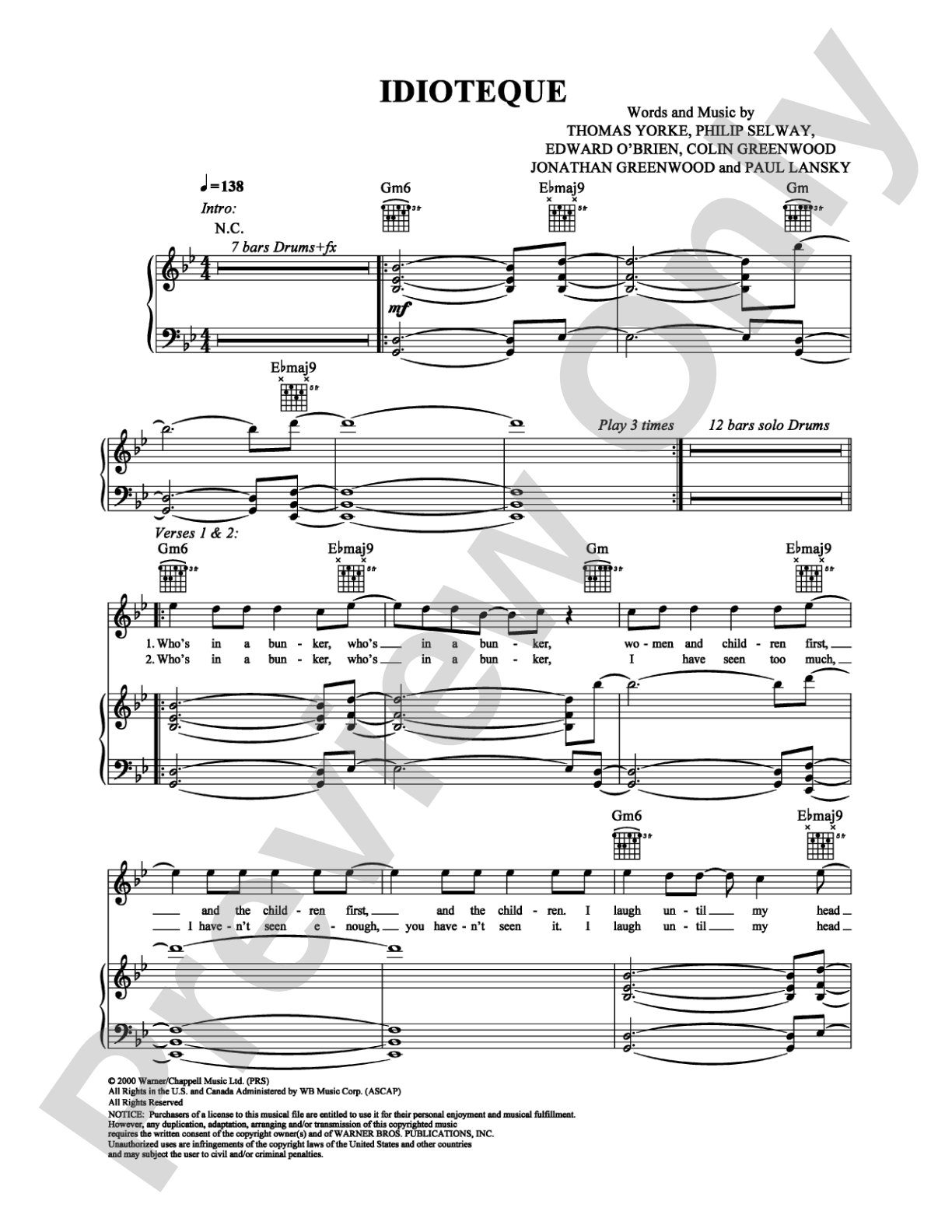
Thomas Yorke, Philip Selway, Jonathan Greenwood, Colin Greenwood, Edward O'Brien, Radiohead, Paul Lansky
Item: 00-PS-0006318
Digital Download
$3.99
Pickup currently not available
Description
Idioteque: Piano/Vocal/Chords Digital Sheet Music isn't in MakeMusic Cloud just yet...but it could be. Let us know you'd like to see it, and you'll help shape what comes next. In the meantime, start a free trial and dive into thousands of interactive titles your students can play along with today.
Explore everything that's ready to play right now.
Sample Audio
No sample audio found.
Sample Video
No sample videos found.
Additional Details
SKU:00-PS-0006318
More about this title
About the Artist: Radiohead
Radiohead emerged from Oxford in the early 1990s and became one of the most influential rock bands of their generation. Their 1997 album OK Computer marked a watershed moment in popular music, blending alternative rock with electronic textures, complex rhythms, and introspective lyrics that challenged conventional song structures.
Why we love this
Idioteque strips away Radiohead's production layering to reveal intricate harmonic movement and rhythmic precision that rewards close study. The song's blend of electronic sensibility with acoustic piano creates a bridge between contemporary songwriting and classical pianistic thinking, making it engaging for students who want to understand how modern artists construct harmony and texture.
What to expect
Idioteque occupies an unsettling emotional landscape, combining a driving, almost mechanical rhythmic pulse with lyrics full of existential dread and fragmentation. The piano part is deceptively simple on the surface but creates a claustrophobic, obsessive atmosphere through repetition and sparse harmonic movement.
Who it's for
Pianists and singer-pianists looking to expand beyond traditional classical and jazz standards into contemporary songwriting will find technical and interpretive challenges here. Teachers introducing upper-level students to the harmonic sophistication of modern popular music will appreciate how clearly this arrangement reveals the song's structure.
How to get the most out of it
Maintain the written tempo and metric feel even when the accompaniment pattern feels repetitive; the hypnotic quality depends on rhythmic stability underneath.
Balance vocal phrasing against the piano's minimal gesture; the spaces between sung phrases matter as much as the notes themselves.
Pay attention to the relationship between piano voicings and vocal melody; some chord extensions sit directly in the singing line and require careful voice leading.
Experiment with dynamic range within phrases rather than across entire sections; this song builds intensity through textural layering, not volume.
How to use it
This works well in a recital or showcase pairing contemporary songwriting approaches with classical repertoire, demonstrating how harmonic language has evolved. It also fits naturally into a concert exploring electronic music's influence on modern composition, or as a bridge piece between indie rock and art song contexts.
Skills your students will build
Reading and performing syncopated rhythmic patterns in a contemporary pop context
Interpreting minimal piano voicings to create textural atmosphere
Coordinating vocal phrasing with piano accompaniment patterns that don't follow traditional phrase structure
Understanding how electronic music sensibilities translate to acoustic instruments
Balancing repetitive accompaniment figures with dynamic vocal expression