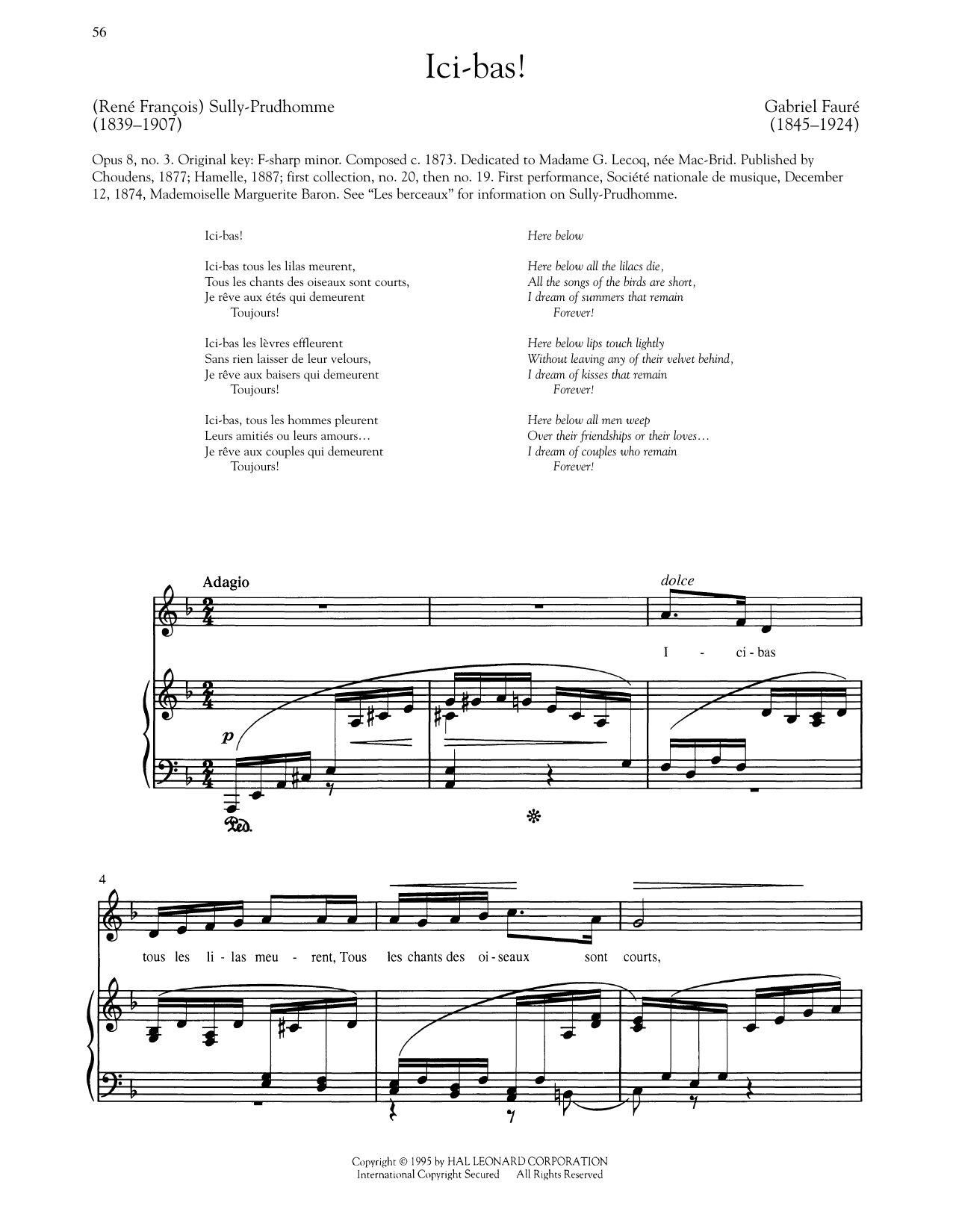
Ici-Bas (Low Voice) Sheet Music Preview

Ici-Bas (Low Voice): Piano Vocal

By Gabriel Fauré

Item: 35-DS01827448

Digital Download
$5.99
Description

Ici-Bas (Low Voice): Piano Vocal isn't in MakeMusic Cloud just yet...but it could be. Let us know you'd like to see it, and you'll help shape what comes next. In the meantime, start a free trial and dive into thousands of interactive titles your students can play along with today.

Sample Audio
No sample audio found.
Sample Video
Additional Details
Publisher: Hal Leonard
Page Count: 3
SKU: 35-DS01827448

More about this title

About the Composer: Gabriel Fauré

Gabriel Fauré (1845–1924) shaped French music through a compositional language that prized subtlety over spectacle. His harmonic innovations and gift for melody influenced generations of composers, yet his art songs reveal his greatest mastery: the ability to distill profound emotion into intimate, elegant forms. As director of the Paris Conservatoire late in his career, Fauré shaped music education itself, advocating for refined taste and careful craftsmanship.

Fauré's vocal writing sits at the heart of the French mélodie tradition. He understood the human voice not as a vehicle for display but as an equal partner with the piano, creating works where accompaniment and line breathe together. His songs reward singers who listen deeply and pianists who understand that restraint can carry as much weight as virtuosity.

Why we love this

Ici-Bas offers a masterclass in the French mélodie at its most refined. The low voice version opens this treasured song to baritones and mezzo-sopranos who deserve access to Fauré's sophisticated harmonic language and graceful melodic curves without transposition compromise. Programming it provides the kind of cultural weight and elegant restraint that balances heavier repertoire on any recital.

What to expect

Contemplative and gently philosophical, Ici-Bas unfolds with the quiet introspection of private reflection. The music moves through subtle harmonic shifts that suggest emotional shifts beneath a composed surface, creating a sense of intimate dialogue between singer and accompanist rather than performance for an audience.

Who it's for

Baritones and mezzo-sopranos preparing art song recitals or seeking substantial French repertoire beyond the soprano-centric canon. Intermediate to advanced singers comfortable with French diction and interpretive depth will find this piece both technically accessible and artistically rewarding.

How to get the most out of it

  • Honor the text's introspective quality by resisting the urge to push volume; Fauré's expression lives in nuance rather than projection
  • Coordinate rubato between voice and piano so the melodic line feels naturally conversational rather than metrically imposed
  • Listen carefully to the piano's harmonic movement and allow it to shape your phrase lengths; this song breathes through its accompanimental structure

How to use it

Pair this with other French mélodies to create a focused song recital set, or use it as a centerpiece moment on a larger vocal program where its elegant restraint provides contrast to more dramatic or theatrical works. It works particularly well in curated recitals exploring themes of mortality, nature, or inner life.

Skills your students will build

  • French language pronunciation and textual clarity in song
  • Interpretive flexibility with rubato in a classical context
  • Collaborative listening between voice and piano
  • Understanding harmonic movement as a guide to phrasing and expression
  • Sustained singing in a moderate dynamic range

You May Also Like