Ici-Bas (High Voice) Sheet Music Preview

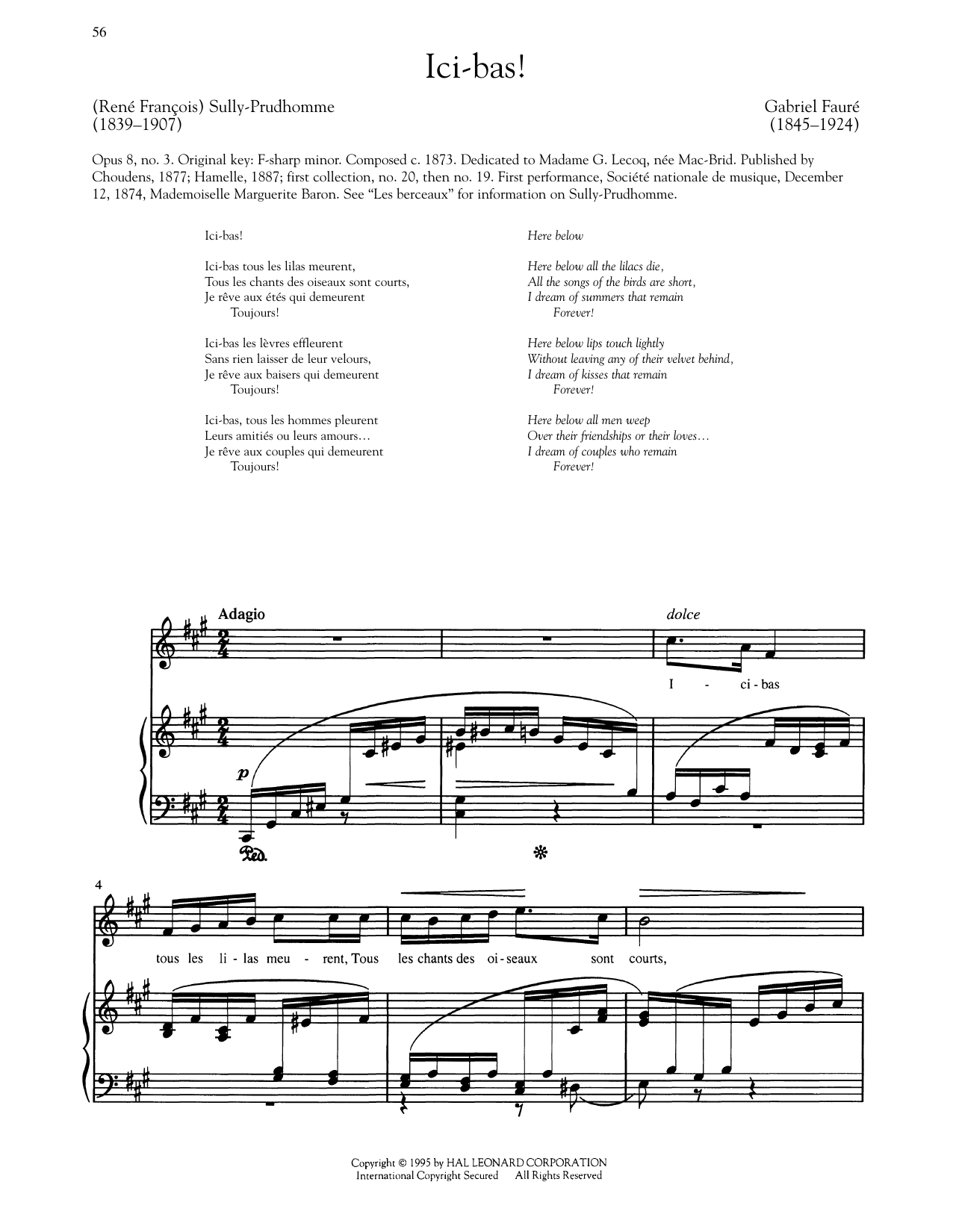
Ici-Bas (High Voice): Piano Vocal

By Gabriel Fauré / Edited by Sully-Prudhomme

Item: 35-DS01827453

Digital Download
$5.99
Description

Ici-Bas (High Voice): Piano Vocal isn't in MakeMusic Cloud just yet...but it could be. Let us know you'd like to see it, and you'll help shape what comes next. In the meantime, start a free trial and dive into thousands of interactive titles your students can play along with today.

Sample Audio
No sample audio found.
Sample Video
Additional Details
Publisher: Hal Leonard
Page Count: 3
SKU: 35-DS01827453

More about this title

About the Composer: Gabriel Fauré

Gabriel Fauré (1845–1924) was a French composer and pedagogue whose refined harmonic language shaped modern music. His songs, or mélodies, represent the pinnacle of French vocal writing; they balance lyrical beauty with sophisticated accompaniment and continue to anchor the recital repertoire today.

Why we love this

Fauré's 'Ici-Bas' sits at the sweet spot where technical maturity meets genuine emotional restraint. The piece demands real control from singers—nothing is overwrought, yet the harmonic language rewards careful attention to color and phrasing. This is the kind of song that teaches singers how to sing French music without resorting to artifice.

What to expect

Intimate and introspective, with a quietly philosophical cast. The music unfolds with gentle sophistication, offering moments of warmth within a fundamentally contemplative atmosphere. There's no drama here; instead, Fauré creates space for the listener to sit with the text.

Who it's for

Advanced high voice singers preparing for recital, auditions, or art song study. This suits mature singers with solid French language skills and the interpretive foundation to handle Fauré's restrained lyricism.

How to get the most out of it

  • Shape the vocal line in long arcs rather than phrase-by-phrase; Fauré's harmonic motion guides the direction more than obvious melodic contour.
  • Keep the piano part transparent and supportive; the accompaniment is intricate but should never overwhelm the voice.
  • Attend closely to dynamic subtlety. Fauré marks sparse dynamics, which means every change carries weight.
  • Treat the text as the primary guide for interpretation; the French prosody and meaning will unlock the musical phrasing.

How to use it

Perfect as a standalone recital piece or paired with other French mélodies to build a thematic program. In an art song class or voice studio, it serves as an essential study in how to accompany a vocal line—both pianist and singer gain from its economical clarity.

Skills your students will build

  • French diction and lyrical phrasing in mélodie
  • Reading and interpreting subtle dynamic markings
  • Harmonic awareness and voice-leading sensitivity
  • Vocal line shaping across longer formal structures
  • Collaborative balance between voice and piano

You May Also Like