I Will Say Goodbye: Piano Digital Sheet Music

I Will Say Goodbye: Piano Digital Sheet Music

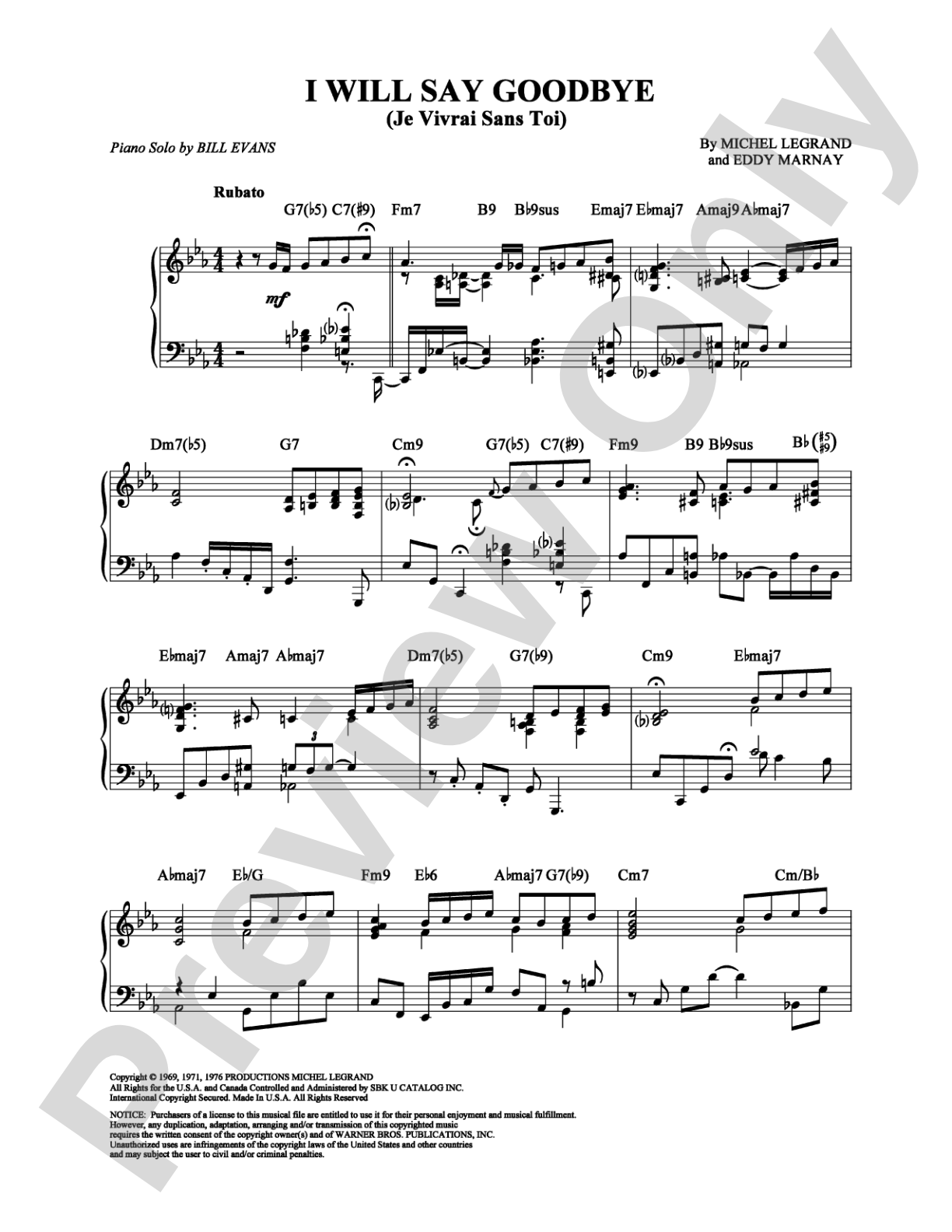
Bill Evans, Michel Legrand, Eddy Marnay

Item: 00-PS-0004353

Digital Download
$3.99
Description

I Will Say Goodbye: Piano Digital Sheet Music isn't in MakeMusic Cloud just yet...but it could be. Let us know you'd like to see it, and you'll help shape what comes next. In the meantime, start a free trial and dive into thousands of interactive titles your students can play along with today.

Sample Audio
No sample audio found.
Sample Video
Additional Details
SKU: 00-PS-0004353

More about this title

About the Artist: Bill Evans

Bill Evans (1929-1980) was a pianist and composer whose harmonic sophistication and introspective touch redefined what jazz piano could express. His work bridged classical training with jazz innovation, creating a body of music marked by lyrical sensitivity, complex chord voicings, and a contemplative approach to improvisation that influenced generations of pianists across both jazz and contemporary classical contexts.

Why we love this

Evans's compositions reward close listening and reveal new layers with repeated study. This piece gives pianists the chance to explore his signature harmonic language and touch-dependent phrasing in a focused setting, making it an excellent choice for developing players who want to understand how jazz vocabulary can serve emotional depth rather than speed or flash.

What to expect

The piece carries a quiet, reflective quality despite its title. There is resignation in the harmony and a gentle acceptance in the phrasing, more meditation than melodrama. The emotional weight comes from what Evans chooses to say rather than how loudly he says it.

Who it's for

Advanced jazz pianists and serious students ready to engage with sophisticated harmonic writing and introspective improvisation will find deep material here. This is equally valuable for classical pianists exploring jazz composition and for ensemble directors seeking material that demonstrates how jazz standards can serve recital or concert contexts.

How to get the most out of it

  • Pay attention to the voicings Evans uses in the left hand; they define the harmonic color. Resist the urge to fill space with unnecessary notes.
  • Approach dynamic control with nuance. Evans's style relies on subtle shaping within a quiet to moderate dynamic range rather than dramatic shifts.
  • Let silence breathe between phrases. The farewell quality of the piece depends on space as much as on the notes themselves.
  • Study his touch by listening to Evans's own recordings; the articulation and pedal work are integral to the composition's effect.

How to use it

Include this in a jazz recital to demonstrate compositional craft alongside performance skill, or program it in a mixed concert to bridge classical and jazz repertoire. It works especially well in intimate settings where the nuanced harmonic language can be heard clearly.

Skills your students will build

  • Interpreting jazz chord symbols and upper structure voicings
  • Developing touch control and dynamic subtlety in jazz context
  • Understanding harmonic progression through a lyrical, introspective lens
  • Building improvisation strategies that prioritize melodic content over technical display
  • Reading and performing jazz notation and notation conventions

You May Also Like