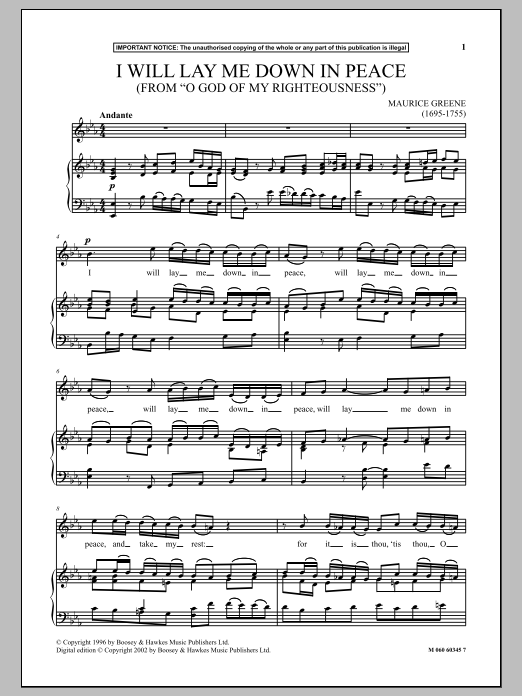
I Will Lay Me Down In Peace (from O God Of My Righteousness) Sheet Music Preview

I Will Lay Me Down In Peace (from O God Of My Righteousness): Piano Vocal

As performed by Maurice Greene

Item: 35-DS00238095

Digital Download
$5.99
Description

I Will Lay Me Down In Peace (from O God Of My Righteousness): Piano Vocal isn't in MakeMusic Cloud just yet...but it could be. Let us know you'd like to see it, and you'll help shape what comes next. In the meantime, start a free trial and dive into thousands of interactive titles your students can play along with today.

Sample Audio
No sample audio found.
Sample Video
Additional Details
Publisher: Hal Leonard
Page Count: 3
SKU: 35-DS00238095

More about this title

About the Artist: Maurice Greene

Maurice Greene (1696–1755) was one of England's most prolific and respected composers during the Georgian era. As Master of the King's Music and a founding member of the Academy of Ancient Music, Greene shaped English vocal and instrumental music through both his compositions and his advocacy for counterpoint. His sacred music drew on the English anthem tradition while incorporating the harmonic language and structural clarity of continental composers.

Greene's output encompassed over 80 vocal works, including anthems, songs, and keyboard pieces that remained in active performance well into the 19th century. His melodic gift and command of text setting made him a natural choice for sacred English words, and his works continue to offer pianists and singers accessible yet musically substantive material.

Why we love this

Greene's setting of this text achieves something rare: it feels intimate without sacrificing harmonic interest. The piano part unfolds with unhurried elegance, giving singers space to shape the text while maintaining the forward momentum of a well-crafted accompaniment. Vocalists appreciate how the vocal line sits naturally in the voice, and collaborative pianists find real musical engagement in a part that serves the text rather than overshadowing it.

What to expect

There is a quiet assurance in Greene's setting, a kind of musical acceptance conveyed through gentle harmonic progression. The piece creates a contemplative space where devotion feels earned rather than performed, allowing performer and listener to settle into something genuinely reflective.

Who it's for

This work suits singers preparing sacred vocal literature, whether for recital, church performance, or study of the English vocal tradition. Pianists seeking meaningful collaborative repertoire will find a piece that demands attention to both accompaniment texture and voice leading.

How to get the most out of it

  • Shape the melodic phrases according to the text's cadences rather than metronomic regularity; the music breathes where the poetry breathes.
  • Maintain clarity in the piano's inner voices, especially where they contribute to the harmonic movement that supports the vocal line.
  • Approach dynamics with restraint and intention; this music's power lies in its directness, not in dramatic extremes.

How to use it

Consider pairing this with other baroque or early Georgian sacred works to build a program centered on English musical devotion. Its modest scale and introspective quality also make it valuable as a study piece for singers learning to balance technical control with interpretive depth.

Skills your students will build

  • Singing sustained melodic phrases with textual clarity
  • Voice leading and harmonic understanding through score study
  • Collaborative ensemble awareness in the singer-pianist partnership
  • Interpretation of early English vocal music idioms

You May Also Like