I Will Always Love You Sheet Music Preview

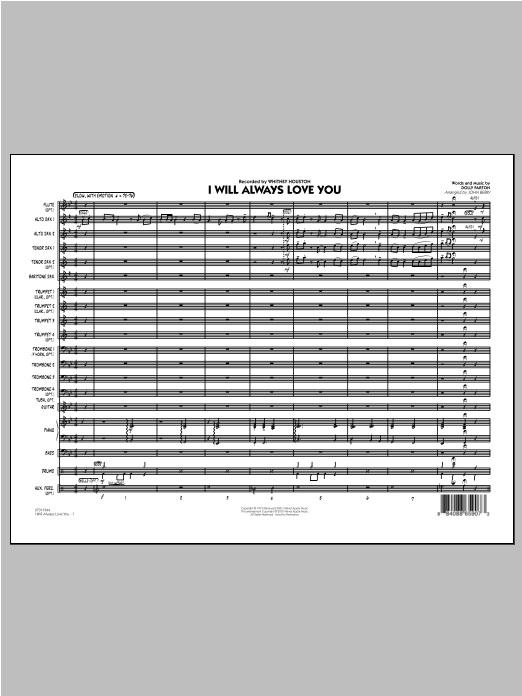
I Will Always Love You: Jazz Ensemble Conductor Score & Parts

As performed by Dolly Parton / As performed by Whitney Houston / Arranged by John Berry

Grade: 2

Item: 35-PK00246666

Digital Download
$40.00

One moment…

Description
This signature ballad by Whitney Houston is one she'll always be remembered for. Here is a great-sounding arrangement by John Berry that features a solo for alto sax, tasteful ensemble accompaniment lines, and later a short solo for trumpet. Nice change-of-pace programming.

I Will Always Love You: Jazz Ensemble Conductor Score & Parts isn't in MakeMusic Cloud just yet...but it could be. Let us know you'd like to see it, and you'll help shape what comes next. In the meantime, start a free trial and dive into thousands of interactive titles your students can play along with today.

Sample Audio
No sample audio found.
Sample Video
Additional Details
Publisher: Hal Leonard
SKU: 35-PK00246666

More about this title

About the Artist: Dolly Parton

Dolly Parton wrote and first recorded "I Will Always Love You" in 1974, a deeply personal ballad that became one of the most covered songs in popular music history. Her songwriting emphasizes emotional directness and melodic clarity, qualities that translate beautifully into ensemble arrangements and have made her compositions natural fits for educational and professional musicians across genres.

Why we love this

John Berry's arrangement respects the song's intimate heart while giving your ensemble genuine solo opportunities and voiced harmony work. The alto sax feature followed by the trumpet solo creates natural pacing and lets different voices shine without overwhelming the ballad's emotional core.

What to expect

Warm and intimate despite the ensemble context. The arrangement preserves the song's vulnerability while letting your players experience how a great ballad can move a room without needing complex harmonic language or technical fireworks.

Who it's for

Grade 2 jazz ensembles looking to program something accessible that still sounds sophisticated. This works equally well for concert programming or as a change-of-pace closer that audiences connect with immediately.

How to get the most out of it

  • Balance the ensemble lines so they support rather than compete with the alto sax solo; keep dynamics in check during the accompaniment sections.
  • Work the trumpet solo carefully for tone quality and phrasing; this isn't a technical showcase but an opportunity to sing through the horn.
  • Give the rhythm section space to breathe during solo passages; they're anchoring the moment, not filling it.

How to use it

Perfect as a concert finale or opening number when you want to shift the emotional temperature. Its accessibility makes it an excellent bridge piece between more demanding repertoire, and the familiar melody helps audiences settle into listening.

Skills your students will build

  • Solo phrasing over ensemble accompaniment
  • Balancing melodic lead with harmonic support
  • Sustaining ballad tempo without dragging
  • Reading and executing voiced harmony lines at Grade 2 level

You May Also Like