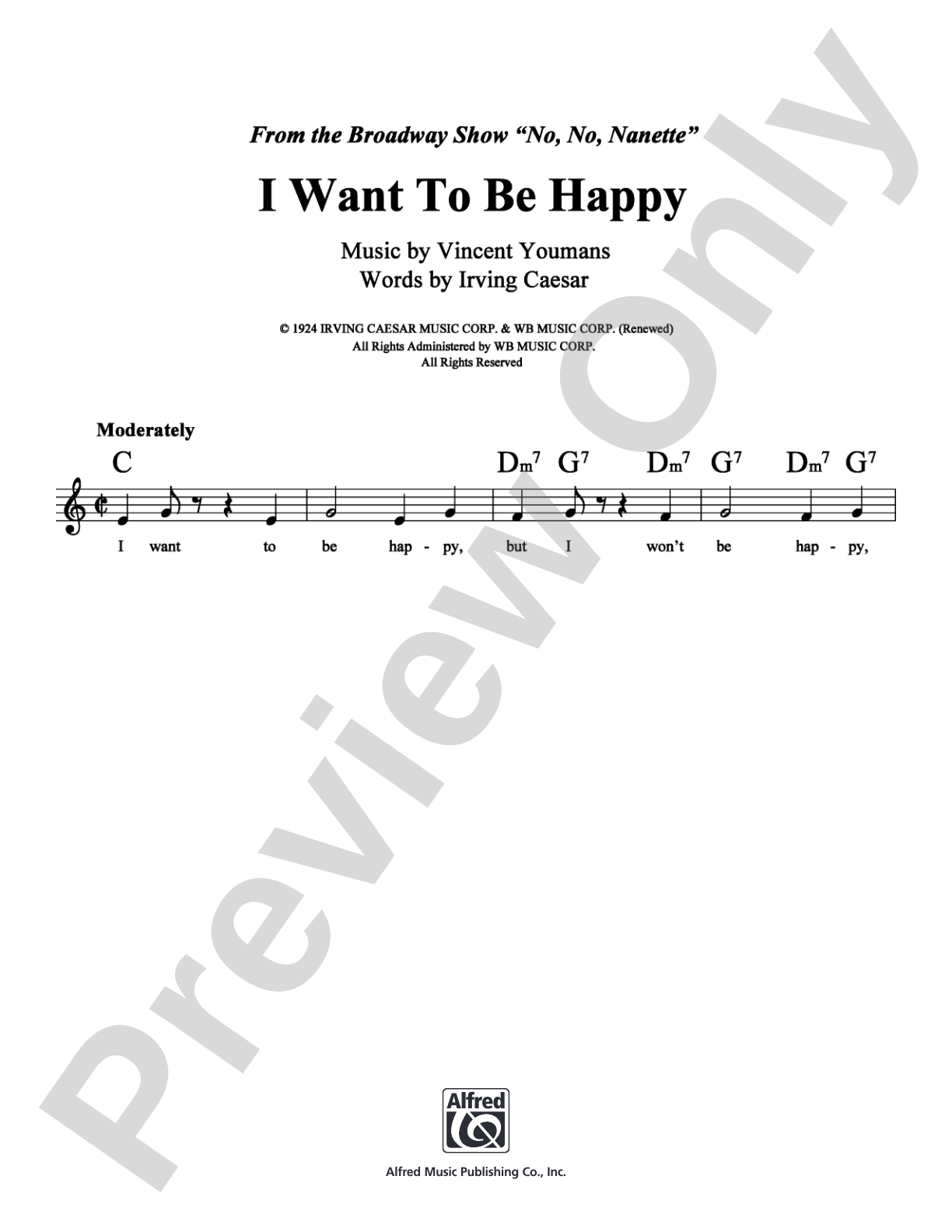
I Want To Be Happy: Lead Sheet Digital Sheet Music

I Want To Be Happy: Lead Sheet Digital Sheet Music

Vincent Youmans, Benny Goodman

Item: 00-PS-0008423

Digital Download
$1.99
Description

I Want To Be Happy: Lead Sheet Digital Sheet Music isn't in MakeMusic Cloud just yet...but it could be. Let us know you'd like to see it, and you'll help shape what comes next. In the meantime, start a free trial and dive into thousands of interactive titles your students can play along with today.

Sample Audio
No sample audio found.
Sample Video
Additional Details
SKU: 00-PS-0008423

More about this title

About the Artist: Benny Goodman

Benny Goodman (1909-1986) was a clarinetist and bandleader who became one of the most influential figures in American jazz and popular music. Known as the "King of Swing," Goodman broke racial barriers by leading integrated orchestras during the 1930s and 1940s, making him a cultural pioneer as well as a musical one. His clarinet tone, rhythmic precision, and ability to bridge swing and classical music left an indelible mark on twentieth-century music education and performance standards.

Goodman's legacy extends beyond performance into the teaching studio. His approach to phrasing, swing feel, and ensemble cohesion continues to inform how musicians understand jazz idiom and popular song interpretation. For educators, Goodman's recordings and arrangements remain essential references for understanding how standards of this era should breathe and swing.

Why we love this

This lead sheet captures a song that defined an era and remains a staple in jazz and pop repertoire across multiple instrumental and vocal contexts. Students studying swing style, jazz interpretation, or standard-song traditions gain immediate access to a piece that sits at the intersection of commercial success and musical substance. The simplicity of the lead sheet format makes it adaptable to any instrument or voice while preserving the harmonic and melodic integrity that made the tune endure.

What to expect

Bright, optimistic, and straightforward, this tune radiates the effortless charm of 1930s-1940s popular song. The melody sits naturally in the voice or across most instruments, inviting a confident, singing quality that feels conversational rather than showy. Harmonically accessible yet sophisticated, it exemplifies how popular song of the swing era balanced accessibility with musical substance.

Who it's for

This lead sheet serves jazz students, popular music learners, singers preparing vocal standards, and any instrumentalist exploring the swing repertoire and jazz interpretation. It works equally well for classical musicians branching into jazz idiom and for jazz musicians reinforcing foundational harmony and melody.

How to get the most out of it

  • Study recordings of Goodman's original performance to internalize the swing eighth-note feel and phrasing nuance that defines this standard.
  • Pay attention to the melody's natural arching phrases rather than over-subdividing rhythmically; let the lyrical contour guide your interpretation.
  • Experiment with chord substitutions and reharmonization once you have the melody secure; jazz tradition encourages personalization of standards.
  • Balance rubato or expressive timing against the underlying swing pulse to avoid losing forward momentum.

How to use it

Pair this with other standards from the same era in a jazz or popular music concert, or use it as a teaching piece in a jazz history or standards repertoire course. It works well as a small-ensemble feature or as part of a sight-reading curriculum focused on jazz idiom and chord changes.

Skills your students will build

  • Reading lead sheet notation with chord symbols
  • Understanding swing eighth-note feel and jazz phrasing
  • Interpreting jazz harmony and functional chord progressions
  • Adapting melody across different instruments and transpositions
  • Developing familiarity with standard songs as a foundation for improvisation

You May Also Like