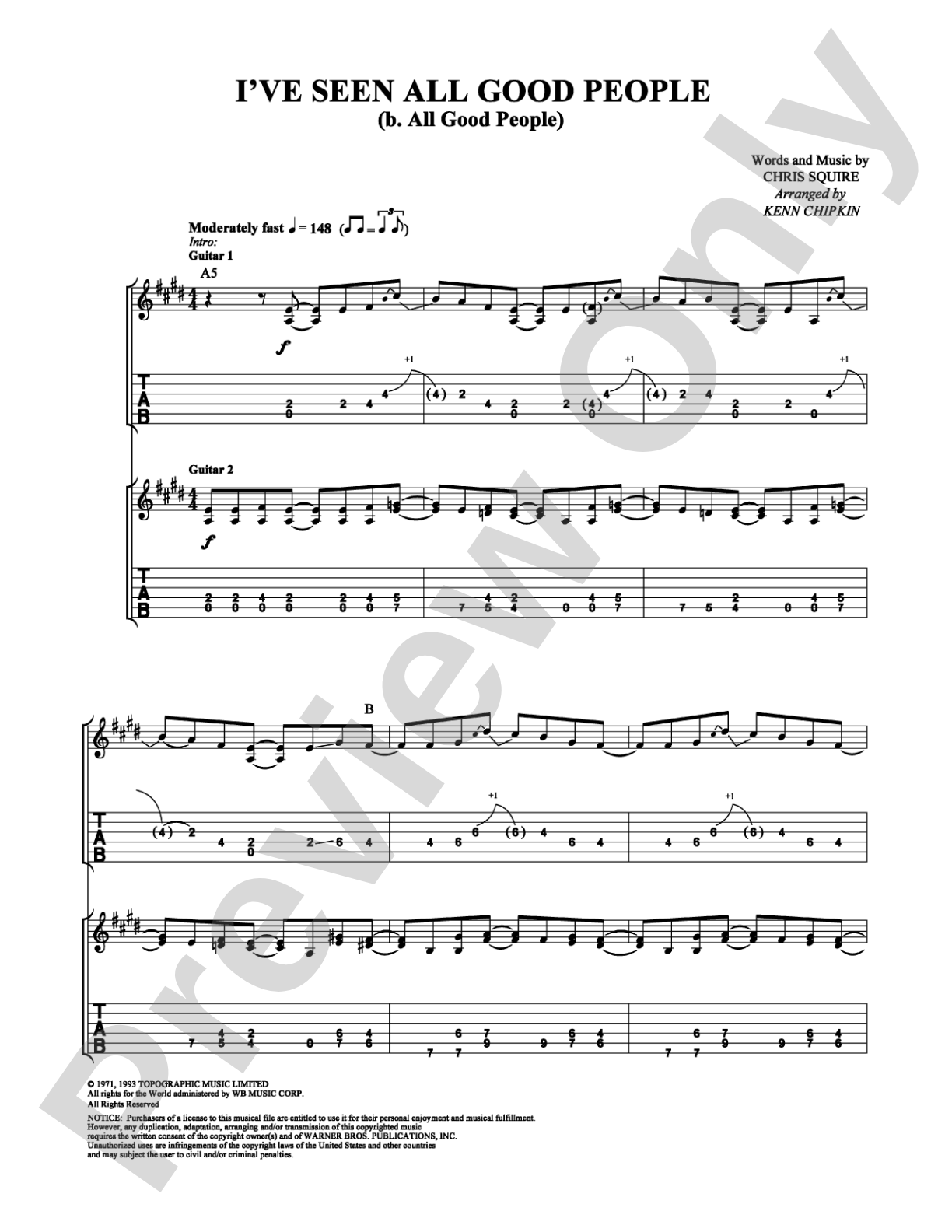
I've Seen All Good People (b. All Good People): Guitar TAB Digital Sheet Music

I've Seen All Good People (b. All Good People): Guitar TAB Digital Sheet Music

Yes, Chris Squire

Item: 00-PS-0003442

Digital Download
$2.99
Description

I've Seen All Good People (b. All Good People): Guitar TAB Digital Sheet Music isn't in MakeMusic Cloud just yet...but it could be. Let us know you'd like to see it, and you'll help shape what comes next. In the meantime, start a free trial and dive into thousands of interactive titles your students can play along with today.

Sample Audio
No sample audio found.
Sample Video
Additional Details
SKU: 00-PS-0003442

More about this title

About the Artist: Yes

Yes emerged from the progressive rock movement of the 1970s and became one of the decade's most inventive and technically ambitious bands. Known for intricate arrangements, virtuosic musicianship, and willingness to expand rock music into symphonic and experimental territory, Yes created some of the era's most challenging and rewarding material for musicians to learn from.

Their influence on instrumental rock and progressive music education remains significant. Yes demonstrated that popular music could demand serious musical study from performers, making their catalog valuable for students seeking to develop advanced technical skills alongside complex rhythmic and harmonic understanding.

Why we love this

This track sits at the intersection of accessibility and technical challenge. "All Good People" draws listeners in with memorable melodies and infectious energy while revealing sophisticated chord movements and syncopation that reward repeated study. Guitar students get to work with genuinely interesting material that feels rewarding to master, rather than simplified versions of complex ideas.

What to expect

The song pulses with propulsive energy and clever rhythmic displacements that create forward momentum without relying on speed alone. Harmonically adventurous passages wind through the melody, creating a sense of sophisticated complexity that feels both cerebral and deeply musical. There's a quality of controlled precision balanced against genuine rock and roll swagger.

Who it's for

Guitar students with intermediate to advanced reading skills who want to explore rock repertoire beyond three-chord progressions. Players pursuing progressive rock, fusion, or complex popular music will find genuine technical and musical challenges worth sustained practice. This works especially well for students in rock ensembles or those studying contemporary music composition.

How to get the most out of it

  • Map out the rhythmic subdivisions in relation to the drum track before focusing on individual note accuracy. Progressive rock guitar lines often sit across the beat in ways that feel unnatural until you lock them to the band's pulse.
  • Work through any extended passages in smaller chunks, establishing consistent fingering patterns before increasing tempo. This song contains enough technical density that piecemeal practice prevents frustration.
  • Use the tab alongside standard notation if available to clarify fret positions, especially in passages where multiple fingering options exist. Cross-checking both formats builds stronger understanding of the fingerboard.
  • Reference recorded versions to grasp articulation and tone shaping choices. The original recording contains subtle dynamics and attack variations that tab alone cannot convey.

How to use it

Feature this in a progressive rock or contemporary music showcase where it can hold its own alongside other technically significant pieces. Students performing this gain credibility with peers and audiences who recognize Yes as serious musicians, making it a natural anchor point for a unit on rock music education. It also works well as an individual challenge piece for guitarists ready to move beyond standard teaching repertoire.

Skills your students will build

  • Reading and executing syncopated rhythmic patterns across the beat
  • Navigation of complex chord progressions and harmonic movement
  • Consistent fingering strategy for passages without obvious patterns
  • Articulation clarity and tone control for both melodic and rhythmic playing
  • Rhythmic coordination with accompanying recorded tracks and band members

You May Also Like