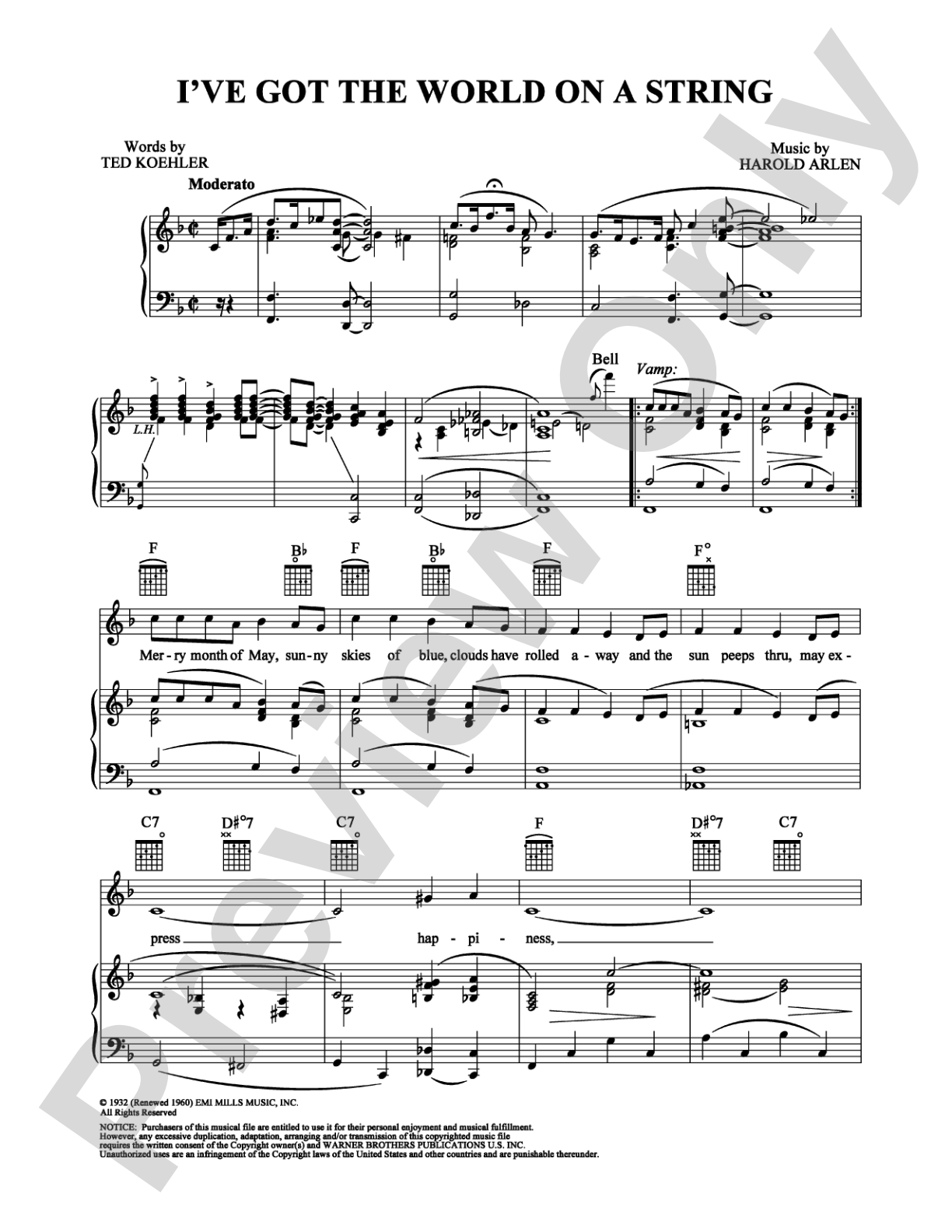
I've Got the World On A String: Piano/Vocal/Chords Digital Sheet Music

I've Got the World On A String: Piano/Vocal/Chords Digital Sheet Music

Harold Arlen, Bing Crosby, Cab Calloway, Frank Sinatra

Item: 00-PS-0002488

Digital Download
$3.99
Description

I've Got the World On A String: Piano/Vocal/Chords Digital Sheet Music isn't in MakeMusic Cloud just yet...but it could be. Let us know you'd like to see it, and you'll help shape what comes next. In the meantime, start a free trial and dive into thousands of interactive titles your students can play along with today.

Sample Audio
No sample audio found.
Sample Video
Additional Details
SKU: 00-PS-0002488

More about this title

About the Artist: Bing Crosby

Bing Crosby (1903-1977) shaped American popular music and vocal style across radio, film, and recording. His relaxed phrasing, perfect diction, and ability to swing within a melodic line made him one of the most influential singers of the 20th century and a model for generations of jazz and pop vocalists.

Crosby's approach to the Great American Songbook emphasized intimate delivery and rhythmic flexibility. His interpretations of standards remain teaching tools for understanding how to balance technical control with conversational ease in performance.

Why we love this

This standard works equally well as a teaching piece for understanding jazz piano accompaniment voicings or as a solo recital selection. The melody sits comfortably for singers across vocal ranges, and the harmonic progression offers enough substance to challenge intermediate pianists while remaining accessible for learning swing accompaniment techniques.

What to expect

Optimistic and suave, with a melody that sits naturally in the speaking voice. The harmonic language evokes 1930s sophistication; the piece feels conversational rather than overly theatrical, encouraging a warm and personable delivery.

Who it's for

Vocalists preparing repertoire for jazz standards or American songbook recitals, and pianists seeking accessible swing-era accompaniment practice. This piece suits singers developing legit jazz tone and phrasing, as well as piano students learning to voice and comp behind a vocalist.

How to get the most out of it

  • Treat the rhythm section with a light swing feel rather than strict tempo; let the melody breathe and anchor the phrasing to lyrical content, not just beat division.
  • Balance vocal projection with the piano part. The accompaniment should support without overwhelming; adjust dynamic levels so both parts maintain clarity in smaller venues.
  • Experiment with rubato in the melody line, particularly at phrase endings. This tune rewards a vocalist who listens to the piano and responds conversationally rather than mechanically.

How to use it

Include this in a jazz standards set or a program exploring American popular song from the golden age of radio. It pairs well with other Tin Pan Alley repertoire and provides a stylistic anchor when programming mixed song selections.

Skills your students will build

  • Swing rhythm and rubato in melody and accompaniment
  • Jazz chord voicings and comping techniques
  • Phrasing and legit jazz vocal tone
  • Collaboration between vocalist and pianist
  • Reading lead sheet notation and realizing chords

You May Also Like