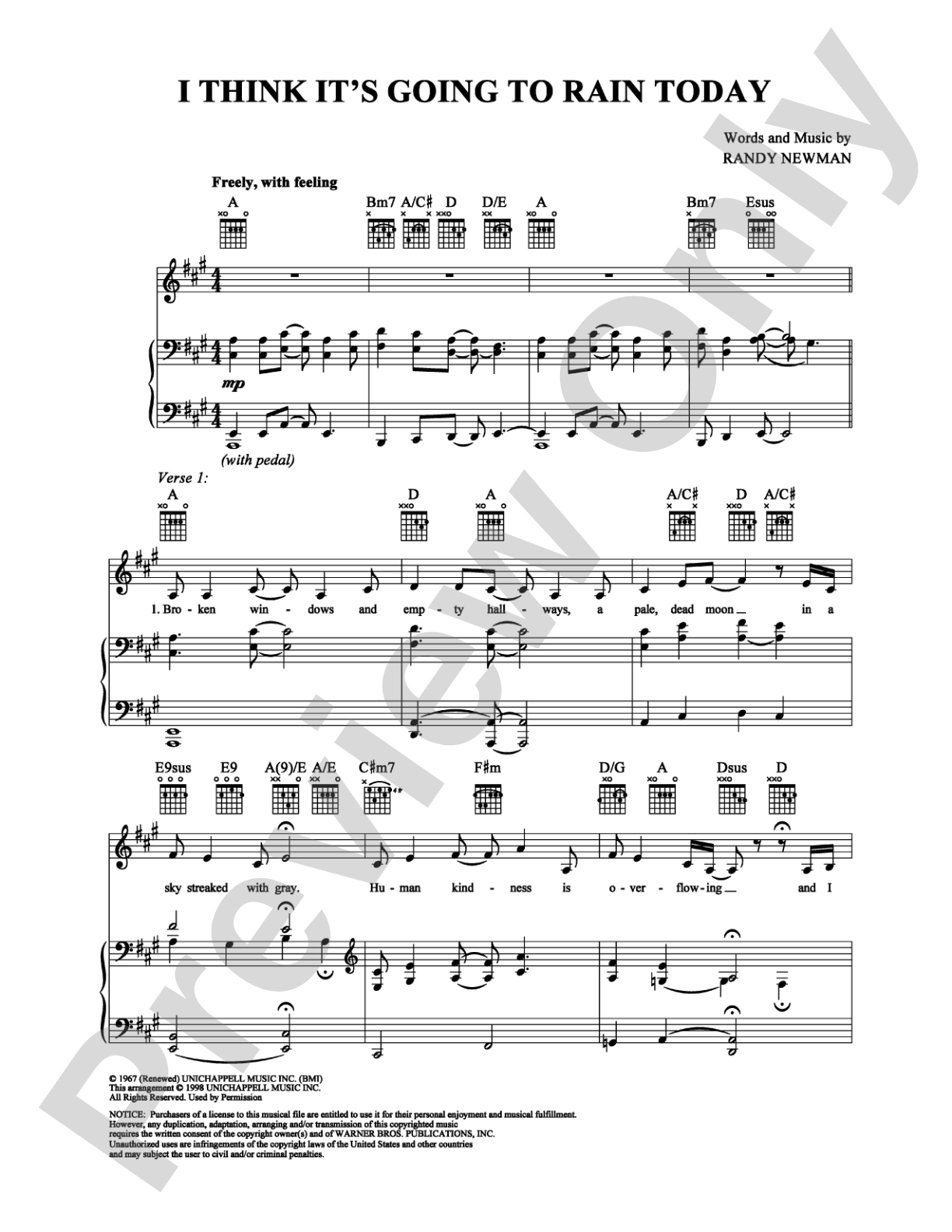
I Think It's Going to Rain Today: Piano/Vocal/Chords Digital Sheet Music

I Think It's Going to Rain Today: Piano/Vocal/Chords Digital Sheet Music

Randy Newman

Item: 00-PS-0004553

Digital Download
$3.99
Description

I Think It's Going to Rain Today: Piano/Vocal/Chords Digital Sheet Music isn't in MakeMusic Cloud just yet...but it could be. Let us know you'd like to see it, and you'll help shape what comes next. In the meantime, start a free trial and dive into thousands of interactive titles your students can play along with today.

Sample Audio
No sample audio found.
Sample Video
Additional Details
SKU: 00-PS-0004553

More about this title

About the Artist: Randy Newman

Randy Newman is a composer, lyricist, and pianist known for his distinctive voice in pop and film music. His career spans decades, marked by sharp wit, sophisticated harmonies, and deeply human storytelling that resists easy categorization. Newman has earned multiple Grammy Awards and Academy Award nominations, and his influence extends across popular music, theater, and film scoring.

Why we love this

Newman's piano-driven arrangements reward careful listening and interpretation. The chord voicings invite musicians to explore subtle harmonic color, and the lyrical restraint of this ballad sits naturally in the voice, making it accessible without being simplistic. It's a piece that lets singers and pianists discover their own emotional authenticity rather than demanding technical flash.

What to expect

This is a contemplative, gently melancholic ballad that captures a moment of quiet resignation. The melody settles into the piano's middle register with understated elegance, and the progression unfolds like someone thinking out loud. There's an almost conversational quality to the whole song, as if Newman is sharing a private observation about uncertainty and acceptance.

Who it's for

Singers and pianists working on accessible yet sophisticated pop-rock material will find this piece rewarding. It suits recitals, coffee house performances, or informal settings where lyrical storytelling and emotional clarity take priority over virtuosity. Music students studying songwriting and interpretation will benefit from analyzing Newman's approach to melody and harmony.

How to get the most out of it

  • Support the vocal line with sparse, conversational piano accompaniment; resist the urge to fill every measure. The power lives in what's left unsaid.
  • Shape the phrases around the natural speech rhythm of the lyrics rather than forcing strict metric placement. Newman's melodies follow language as much as they follow time.
  • Attend to the chord changes with intention. Small harmonic shifts carry meaning here, so voice the piano part to highlight how each chord moves into the next.
  • Build the dynamic arc gradually across the full form. Start intimate and allow the emotional weight to accumulate toward a natural climax, then release.

How to use it

Place this song in a recital where it can breathe alongside other introspective material, perhaps pairing it with other singer-songwriter repertoire or art song. It works well as a palate cleanser between more energetic pieces, or as part of a program exploring themes of vulnerability and resilience in contemporary music.

Skills your students will build

  • Reading and interpreting jazz-influenced chord symbols
  • Shaping vocal lines according to speech patterns rather than strict metric regularity
  • Building dynamic continuity across an entire ballad form
  • Voicing piano accompaniment to support rather than compete with the voice
  • Understanding how harmonic movement creates emotional resonance

You May Also Like