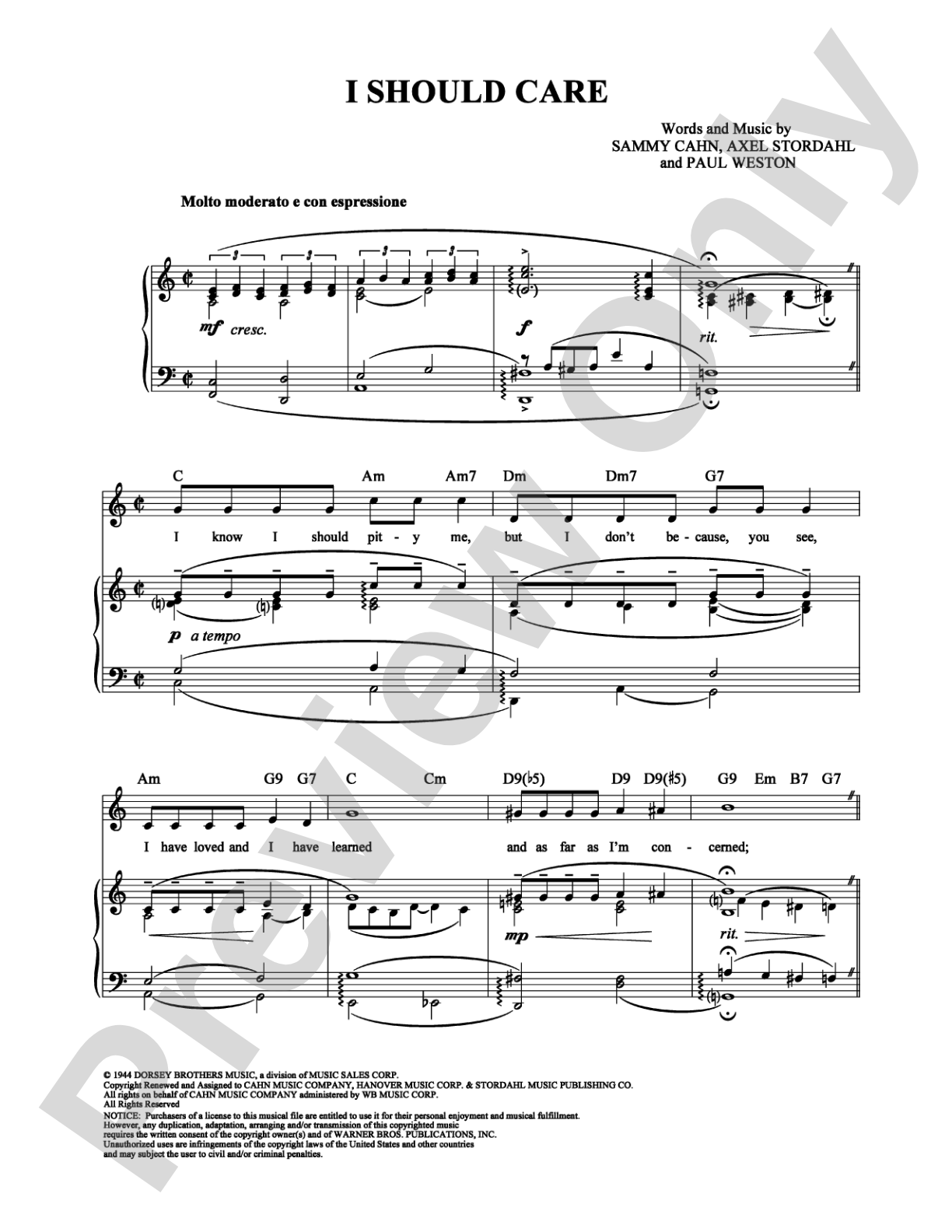
I Should Care: Piano/Vocal/Chords Digital Sheet Music

I Should Care: Piano/Vocal/Chords Digital Sheet Music

Frank Sinatra, Sammy Cahn, Tommy Dorsey, Axel Stordahl, Paul Weston

Item: 00-PS-0005673

Digital Download
$3.99
Description

I Should Care: Piano/Vocal/Chords Digital Sheet Music isn't in MakeMusic Cloud just yet...but it could be. Let us know you'd like to see it, and you'll help shape what comes next. In the meantime, start a free trial and dive into thousands of interactive titles your students can play along with today.

Sample Audio
No sample audio found.
Sample Video
Additional Details
SKU: 00-PS-0005673

More about this title

About the Artist: Frank Sinatra

Frank Sinatra (1915-1998) shaped American popular song through his phrasing, breath control, and interpretive depth. His influence on vocal performance extends across jazz, standards, and popular music, making his recordings essential reference material for singers studying legit phrasing and emotional storytelling.

Why we love this

Sinatra's recording of this standard became definitive, and having the exact chord changes and melody from his arrangement gives singers and pianists the foundation to understand how a master interpreter shaped the tune. The song's straightforward harmonic language makes it accessible for intermediate singers while offering enough interpretive space for genuine artistic choices.

What to expect

A introspective torch ballad that asks why you care about someone who doesn't care back. The harmonic progression and vocal line invite a conversational, intimate delivery, creating a moment of quiet vulnerability rather than dramatic outpouring.

Who it's for

Intermediate to advanced vocalists building a standards repertoire, pianists accompanying singers in jazz or popular music contexts, and voice students studying mid-century phrasing and interpretation. It works equally well for jazz ensembles adding a ballad to their setlist.

How to get the most out of it

  • Study Sinatra's phrasing on the original recording, noting where he extends or shortens phrases for emotional effect rather than strict metric regularity.
  • Balance the vocal melody against the piano accompaniment so the singer remains the clear focal point while the pianist supports harmonic color and rhythmic shape.
  • Explore the lyric's introspection to inform your interpretation of tempo and dynamics; this is a reflective song, not a swinging novelty.

How to use it

Pair this with other standards from the 1940s-50s era to create a focused program segment, or use it as a solo feature in a jazz or cabaret-style concert. Its emotional restraint makes it an effective closer or transition piece between more energetic selections.

Skills your students will build

  • Reading lead sheets with chord symbols and vocal melody
  • Balancing lyrical phrasing against metric pulse
  • Interpreting jazz and swing harmonic progressions
  • Accompanying singers with supportive but musically independent piano lines
  • Understanding legit vocal tone and diction in a standards context

You May Also Like